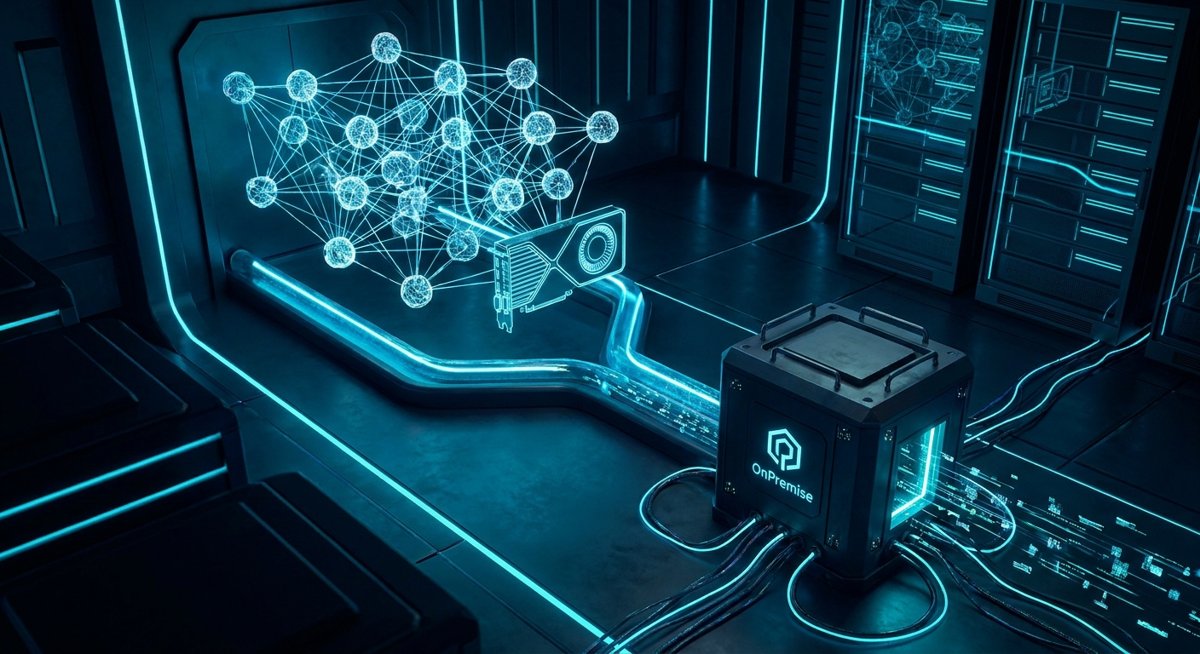
The probe that puts the model access point in focus
The United States Department of Justice has turned a spotlight on a step that many AI infrastructure teams know well: the point where an open model is found, downloaded, and adapted for a self-hosted environment. The reported investigation concerns Nvidia's potential acquisition of Hugging Face for around 13 billion dollars. It is not only a question of financial size: it is a signal about control of distribution.
For AI-Radar, the issue is not the corporate deal itself. It is the way a platform born as a neutral space for open-source models could become one link in a vertical chain that starts with silicon and reaches model weights. Teams that use Hugging Face today to download an LLM, choose a tokenizer, or compare fine-tuning implementations are not just browsing a catalog: they are using a coordination infrastructure.
The probe is still at an early stage. However, the fact that authorities are looking at the integration between a seller of training and inference accelerators and the main hub of open models signals a phase change. The bottleneck is no longer only the availability of silicon: it is the ability to shape the paths through which those models become usable.
Hugging Face is not just a model warehouse
Hugging Face has built a distinctive position. The platform has become the reference point for distributing, downloading, and adapting open-source models. It hosts tokenizers, datasets, fine-tuning libraries, and weight repositories. But its value for an on-premise infrastructure goes beyond the archive: it is a coordination layer that reduces the integration cost between different components.
A team evaluating a self-hosted deployment does not start from scratch. It downloads a model, checks the documentation, chooses a framework, prepares the inference pipeline, and compares quantization configurations. Hugging Face has reduced friction in each of these steps. A possible change of control raises a concrete question: will that path remain truly neutral with respect to the underlying hardware?
Neutrality is not an abstract ideal. It is a technical variable. Today a team can evaluate the same LLM on different accelerators, measure tokens per second, check required VRAM, and decide whether to move the workload. If the model access point favors one hardware ecosystem, evaluation does not disappear, but it becomes more expensive and less reliable.
Repositories do not host only files. They contain documentation, examples, format conversions, and recommended configurations. These elements orient technical choices more than they appear to. Control of the platform can influence which benchmarks are highlighted, which optimizations receive maintenance, and which architectures remain first-class.
Vertical integration and total cost of ownership
Integration between hardware and distribution changes incentives. When a GPU maker also controls the platform from which models are downloaded, documentation and conversion tools can steer choices without explicit constraints. Default paths, published benchmarks, and recommended configurations can favor its own solutions enough to shift the real cost of a project.
For an organization estimating the Total Cost of Ownership of a self-hosted infrastructure, this is not a detail. TCO includes power consumption, internal skills, maintenance, and exit costs. If a framework or a pipeline is optimized for a single vendor, exit costs rise. Exclusivity is not needed: an asymmetry of information and tooling is enough.
Today neutral repositories allow teams to compare implementations, assess performance on different architectures, and choose the most suitable runtime. If the repository operator is also the hardware seller, runtime choice can become an extension of channel strategy. The difference is subtle but structural: the cost is no longer written only in a price list, but distributed across the ecosystem.
The losers in this scenario are organizations that have bet on alternative accelerators or mixed environments. Their room for choice does not disappear, but it requires more verification work and more specialized skills. In practice, distribution neutrality is a component of TCO that often goes unaccounted for until it disappears.
Data sovereignty and vendor dependence
Many companies and institutions choose open models and on-premise pipelines precisely to avoid dependence on a single cloud provider or proprietary APIs. The possible move of Hugging Face under Nvidia control would touch this lever. The model access point would enter a supply chain controlled by a single player, even if the files remained downloadable.
The issue is not only classic antitrust. It is the ability to shape the evolution of distribution formats and fine-tuning practices. Teams that develop or adapt models locally may find themselves following conventions that, however open, are designed with specific hardware in mind. Sovereignty is not only about where data runs, but also about which technical paths remain viable without dependencies.
A concrete example, without specific figures, is the management of weights and conversions. If reference libraries are maintained inside a corporate perimeter that sells GPUs, optimizations for other architectures risk becoming a niche activity. The result is lower interoperability, which in a self-hosted environment translates into operational rigidity and less adaptability.
For public organizations and regulated sectors, this aspect can weigh more than the price of a card. Choosing an open-source LLM is not enough to guarantee autonomy if the distribution and adaptation path is controlled by a single actor. Sovereignty must be designed along the entire chain, from repository to runtime.
Who is watching, who is holding back, who is accelerating
The probe does not affect only the two companies involved. It sends a signal to those building distribution alternatives, to developers of competing frameworks, and to investors in non-Nvidia hardware. If platform neutrality is called into question, interest in independent repositories and tooling grows, even though critical mass remains difficult to replicate.
Startups offering on-premise runtimes or stacks can read the story as a confirmation of the direction. The demand for autonomy concerns not only silicon, but also the governance of software resources. However, the risk of fragmentation is real: without a neutral point of comparison, selection costs rise for everyone.
In this picture, cloud providers are not simple spectators. Vertical integration between GPUs and repositories can shift some elasticity toward on-premise, but it can also push customers toward integrated bundles. Teams managing heterogeneous fleets face a tension between smooth integration and verifiability of alternatives.
The game is played on incentives. A hardware vendor that controls distribution can improve the user experience and reduce time-to-value. But it can also make comparing alternatives more expensive. The trade-off is exactly this: smoother integration versus less verifiability and greater dependence.
What to watch in the coming months
The first signal to monitor is the evolution of the probe: what commitments or remedies will be discussed, and whether the deal will be conditioned on neutrality guarantees. A statement of principle is not enough: details on governance, repository access, and library maintenance matter.
The second plane is technical. Teams managing self-hosted infrastructure should watch whether download, conversion, and fine-tuning paths remain truly hardware-independent. Changes in documentation, published benchmarks, or default configurations are more concrete indicators than any announcement.
The third front is standards. The evolution of distribution formats, quantization practices, and inference APIs will say a lot about the direction. Neutrality is measured not only in repositories, but also in the ability to run the same model on different architectures without significant changes.
Finally, for deployment decision-makers the signal is clear: TCO must be recalculated to include dependence on the distribution platform. VRAM and tokens per second remain essential metrics, but they are not enough. The availability of real alternatives, ease of migration, and control of tooling are integral parts of the choice.



💬 Comments (0)
🔒 Log in or register to comment on articles.
No comments yet. Be the first to comment!