Nvidia Expands Its Offering with Nemotron 3 Nano Omni
Nvidia, traditionally recognized as a leader in AI hardware, is expanding its strategy by making a decisive move into the field of AI models. The company recently unveiled Nemotron 3 Nano Omni, an open-weight multimodal model that marks a significant step in this direction. This release highlights Nvidia's commitment to providing not only the underlying infrastructure but also the software tools and models necessary to power the next generation of AI applications.
Nemotron 3 Nano Omni has been specifically designed to enable autonomous AI agents on edge devices. This focus on edge computing is crucial for scenarios where latency is a critical factor, connectivity is limited, or data sovereignty requires processing to occur locally, away from centralized cloud data centers.
Architecture and Optimization for the Edge
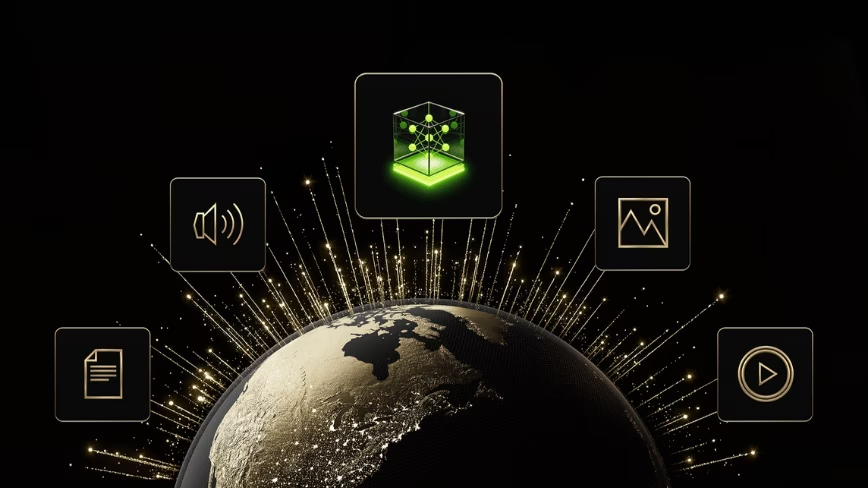
The core of Nemotron 3 Nano Omni lies in its ability to unify vision, audio, and language understanding within a single architecture. This multimodality is fundamental for creating AI agents that can interact with the real world more comprehensively and naturally. The model boasts a total of 30 billion parameters, a considerable size for an LLM.
However, the key innovation for edge device application is the implementation of a Mixture-of-Experts (MoE) design. Thanks to this architecture, Nemotron 3 Nano Omni activates only three billion parameters for each forward pass. This strategy drastically reduces the computational and VRAM memory requirements for inference, making the model more efficient and suitable for hardware with limited resources, typical of edge environments. Optimizing the number of active parameters per pass is a decisive factor for throughput and latency in distributed deployment scenarios.
Implications for On-Premise Deployment and Data Sovereignty
Nemotron 3 Nano Omni's design for edge computing has profound implications for organizations evaluating on-premise or hybrid deployment strategies. Running AI models directly on local devices or bare metal servers offers significant advantages in terms of data sovereignty, regulatory compliance, and security, especially for sectors like finance, healthcare, or defense operating in air-gapped environments.
The reduction in resource requirements due to the MoE design can translate into a more favorable TCO for large-scale deployments, as it allows for the use of less expensive hardware or the extension of the useful life of existing infrastructure. For those evaluating on-premise deployments, AI-RADAR offers analytical frameworks on /llm-onpremise to assess the trade-offs between initial and operational costs, and the benefits in terms of control and performance. The ability to run complex models locally reduces dependence on external cloud services and related concerns about data residency and network latency.
Future Prospects and Nvidia's Role in the AI Landscape
The release of Nemotron 3 Nano Omni positions Nvidia not only as a silicio provider but also as a strategic player in AI model development. This move reflects a broader trend in the industry, where hardware companies seek to verticalize their offerings to capture greater value across the entire artificial intelligence pipeline. The ability to offer a multimodal model optimized for the edge is a clear signal of Nvidia's vision for a future where AI will be pervasive, integrated into smart devices and autonomous systems.
Expanding into AI models, particularly with open-weight solutions, can accelerate AI adoption in critical sectors, providing developers and businesses with powerful tools to create innovative applications. This approach helps democratize access to advanced artificial intelligence capabilities while maintaining a focus on the constraints and opportunities offered by local and distributed deployments.


💬 Comments (0)
🔒 Log in or register to comment on articles.
No comments yet. Be the first to comment!