
Nvidia Enters the CPU Market with Vera
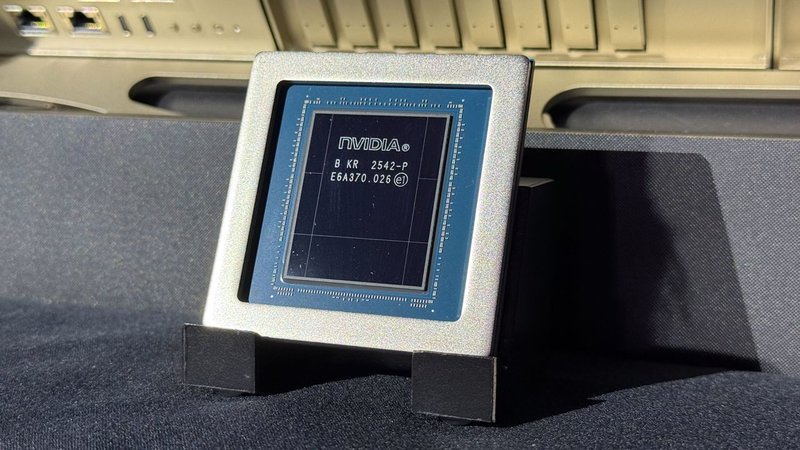
Nvidia, historically recognized as the undisputed leader in the GPU sector, is taking a significant step in the hardware landscape with the introduction of Vera, its first CPU. This strategic move indicates an evolution in the company's vision, shifting from an approach focused exclusively on graphics and computational acceleration via GPUs to a broader vertical integration strategy that also includes the core of computing systems.
Nvidia's entry into the CPU segment with Vera is not merely an expansion of its catalog but a statement of intent. Traditionally, data centers and high-performance computing (HPC) systems rely on third-party CPUs, often based on x86 or ARM architectures, to handle control operations, memory management, and sequential computing tasks, while Nvidia's GPUs manage intensive parallel workloads, such as training and Inference of Large Language Models (LLM). With Vera, Nvidia aims to create a deeper synergy between CPU and GPU, optimizing the entire hardware stack for the specific needs of artificial intelligence and high-performance computing.
Vertical Integration for AI and HPC
The decision to develop its own CPU reflects a broader trend in the technology sector towards vertical integration, where hardware providers seek to control more components of the value chain to optimize performance and efficiency. In the context of AI and HPC, this means being able to design a CPU that is intrinsically optimized to work in tandem with Nvidia GPUs, reducing bottlenecks and improving overall system throughput. A co-designed architecture can lead to significant improvements in memory management, CPU-GPU communication latency, and energy efficiency.
For the most demanding workloads, such as training large LLMs or complex scientific simulations, the ability to quickly move data between CPU and GPU and efficiently coordinate operations is crucial. A proprietary CPU like Vera could be designed with high-speed interconnections and caching mechanisms optimized for Nvidia's GPU architectures, potentially overcoming the limitations of generic CPU solutions. This approach promises to unlock new levels of performance and scalability, essential for next-generation AI infrastructures.
Implications for On-Premise Deployments and TCO
The introduction of Vera has significant implications for organizations considering on-premise or self-hosted deployments of AI workloads. Having a single entity design both the CPU and GPU can simplify infrastructure design and management, offering a more integrated and potentially more reliable solution. For CTOs and infrastructure architects, this could translate into a more favorable TCO (Total Cost of Ownership) in the long term, thanks to greater operational efficiency, lower integration costs, and more cohesive technical support.
In environments where data sovereignty and regulatory compliance are absolute priorities, such as air-gapped deployments, a fully integrated hardware solution from a single vendor can offer greater control and enhanced security. The ability to optimize the entire hardware and software stack, from drivers to AI Frameworks, can ensure that data remains within desired boundaries, reducing risks associated with third-party components. For those evaluating on-premise deployments, AI-RADAR offers analytical frameworks on /llm-onpremise to assess the trade-offs between control, performance, and costs.
A Look at the Future of AI Infrastructure
Nvidia's initiative with Vera is part of a broader trend of consolidation and specialization in AI hardware. As the market continues to evolve, the ability to offer complete and optimized solutions will become an increasingly important competitive factor. This not only pushes the limits of computational performance but also offers enterprise customers the opportunity to build more efficient, secure, and manageable AI infrastructures.
While vertical integration can lead to benefits in terms of performance and TCO, it is crucial for companies to carefully evaluate potential trade-offs, such as reliance on a single vendor. However, the direction taken by Nvidia with Vera suggests a future where AI hardware will be increasingly co-designed and optimized for specific purposes, promising an era of accelerated innovation for data centers and artificial intelligence applications.




💬 Comments (0)
🔒 Log in or register to comment on articles.
No comments yet. Be the first to comment!