
OpenAI Introduces ChatGPT for Personal Finance with Bank Account Integration
OpenAI recently announced a significant expansion of its Large Language Model, ChatGPT, by introducing a version specifically optimized for personal finance management. This move marks an important step in applying LLMs to highly sensitive domains, where data accuracy, security, and privacy are paramount. The new offering aims to provide users with an intuitive tool to monitor and analyze their finances.
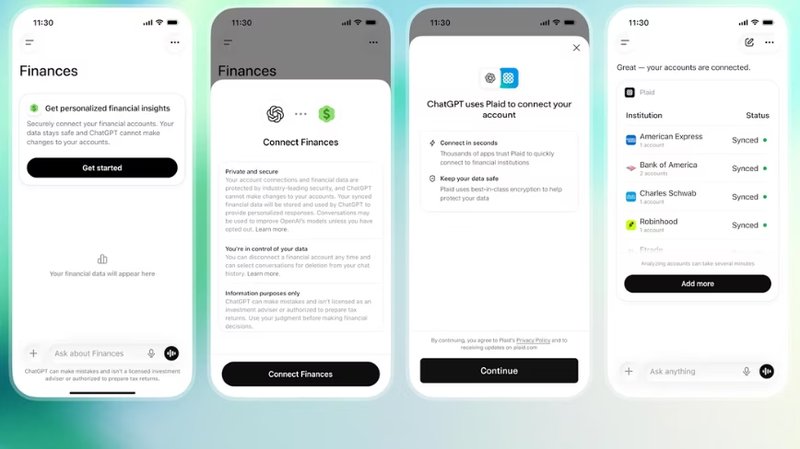
The core of this new functionality lies in the ability for users to directly connect their bank accounts. Once the connection is established, the system presents a comprehensive and personalized dashboard. This dashboard is designed to offer a holistic view of the user's financial situation, aggregating data that would otherwise be dispersed across various banking and investment platforms.
Dashboard Features and Data Sovereignty Challenges
The ChatGPT personal finance dashboard offers a range of key features. Users will be able to view their investment portfolio performance, track spending, manage active subscriptions, and monitor upcoming payments. This aggregation of information aims to simplify financial planning and enhance users' economic awareness by providing data-driven insights.
However, the introduction of a service that requires access to such sensitive financial data raises crucial questions regarding data sovereignty and compliance. For companies and individuals operating in regulated sectors or with stringent privacy requirements (such as GDPR in Europe), managing such information through third-party cloud services can pose a challenge. The decision to entrust banking data to a cloud-based LLM requires careful evaluation of security policies, server location, and the guarantees offered by the provider regarding data protection and non-use for purposes other than those declared.
LLMs in Finance: Requirements and Deployment Considerations
The application of LLMs to personal finance highlights the growing trend of using artificial intelligence for analyzing and managing complex data. For services that process real-time information and require rapid responses, the performance of the underlying infrastructure is critical. While OpenAI operates on cloud infrastructures, for organizations looking to develop similar solutions internally, the hardware requirements for LLM inference can be significant, demanding GPUs with high VRAM and computational capabilities.
The choice between a cloud deployment and a self-hosted or on-premise solution becomes particularly relevant in contexts where data sensitivity is highest. An on-premise deployment, or in air-gapped environments, offers direct control over data security and residency, mitigating the risks associated with transmission and storage on external platforms. This approach, while potentially incurring a higher initial TCO in terms of CapEx for hardware acquisition and infrastructure management, can offer long-term benefits in terms of compliance, security, and operational control.
Future Prospects and the Importance of Control
OpenAI's initiative foreshadows a future where LLMs will be increasingly integrated into our daily lives, managing complex aspects such as personal finances. For enterprises observing this evolution and considering the adoption of AI technologies for similar services, the key lesson concerns the need to balance innovation and control. The ease of use and accessibility of cloud services contrast with the enhanced security and data sovereignty offered by self-hosted solutions.
AI-RADAR focuses precisely on these dynamics, providing analysis and frameworks to evaluate the trade-offs between on-premise and cloud deployment for AI/LLM workloads. The ability to keep sensitive data within one's own infrastructural boundaries, while ensuring high performance and regulatory compliance, remains a top priority for many tech decision-makers. Strategic deployment choice is crucial to leverage the potential of LLMs without compromising security and privacy.







💬 Comments (0)
🔒 Log in or register to comment on articles.
No comments yet. Be the first to comment!