OpenAI Unveils New Image Model with Enhanced Reasoning Capabilities
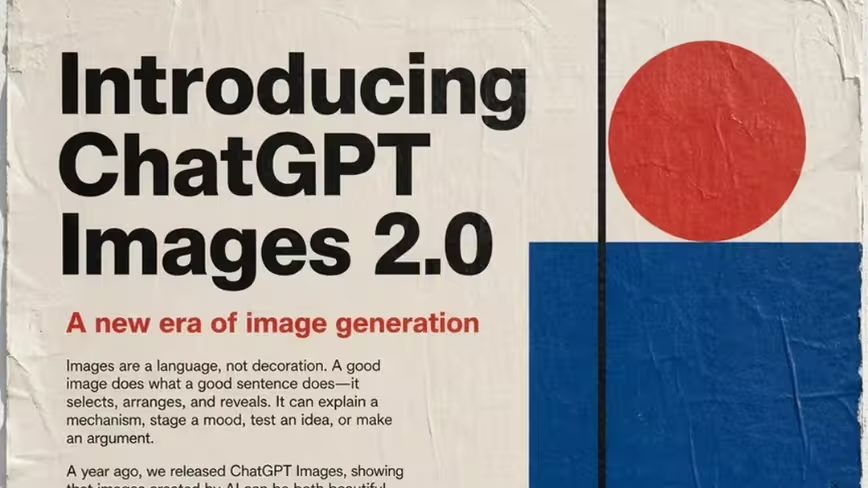
OpenAI has recently introduced a new image generation model, marking a significant evolution in the field of generative artificial intelligence. This new iteration stands out for its ability to integrate "compositional reasoning" before proceeding with visual creation, an approach that promises to improve the coherence and relevance of the generated images.
The model does not merely interpret the prompt superficially; it extends its functionalities by including contextual web search. This integration allows it to draw upon a vast range of information to enrich its understanding of the requested context, leading to more accurate and detailed results. Another notable feature is its capacity to generate up to eight coherent images from a single prompt, offering users a greater variety of creative options.
Technical Details and Key Innovations
The ability to "reason about composition" represents a qualitative leap compared to previous image generation models. Instead of assembling visual elements in a purely statistical manner, the model appears to process a deeper understanding of the spatial and semantic relationships between objects and concepts described in the prompt. This algorithmic approach aims to reduce inconsistencies and produce more realistic and logically structured scenes.
An area where previous models often showed limitations is the accurate reproduction of text within images. OpenAI's new model addresses this challenge with remarkable success, demonstrating near-flawless accuracy in rendering text, particularly in non-Latin scripts. This functionality is crucial for applications requiring the integration of complex textual elements, such as creating multilingual marketing materials or generating localized content. Its debut was met with enthusiasm, reaching the top position on the Image Arena leaderboard within 12 hours of launch, by the largest margin ever recorded.
Context and Implications for Enterprise Deployment
The introduction of image generation models with such advanced capabilities raises important considerations for companies evaluating deployment strategies. While the source does not specify the deployment context of this OpenAI model, the evolution of such systems towards greater computational complexity is a clear trend. For organizations that need to maintain control over their data, ensure regulatory compliance, or operate in air-gapped environments, the self-hosted deployment of LLMs and generative models becomes a priority.
Running models with integrated reasoning and web search functionalities requires significant hardware resources, particularly in terms of VRAM and computational capacity for Inference. Evaluating the Total Cost of Ownership (TCO) for on-premise solutions, which includes initial costs for hardware (high-end GPUs like A100s or H100s), energy, cooling, and maintenance, becomes fundamental. AI-RADAR offers analytical frameworks on /llm-onpremise to help evaluate these trade-offs, comparing the benefits of data sovereignty and control with the challenges related to scalability and local infrastructure management.
Future Prospects and Technological Challenges
The capabilities demonstrated by this new OpenAI model indicate a clear direction for the future of image generation: increasingly intelligent systems, capable not only of creating but also of understanding and contextualizing. This evolution will open new frontiers for sectors such as graphic design, architecture, advertising, and multimedia content development, enabling the rapid creation of complex and personalized visual assets.
However, the increasing complexity of models also brings technological challenges. The need to optimize Inference to reduce latency and increase throughput on specific hardware, the search for more efficient Quantization techniques, and the development of robust Frameworks for managing complex generation pipelines will be crucial. The choice between cloud deployment, with its flexibility and on-demand scalability, and on-premise deployment, offering greater control and potential long-term TCO optimization, will remain a strategic decision for many companies.


💬 Comments (0)
🔒 Log in or register to comment on articles.
No comments yet. Be the first to comment!