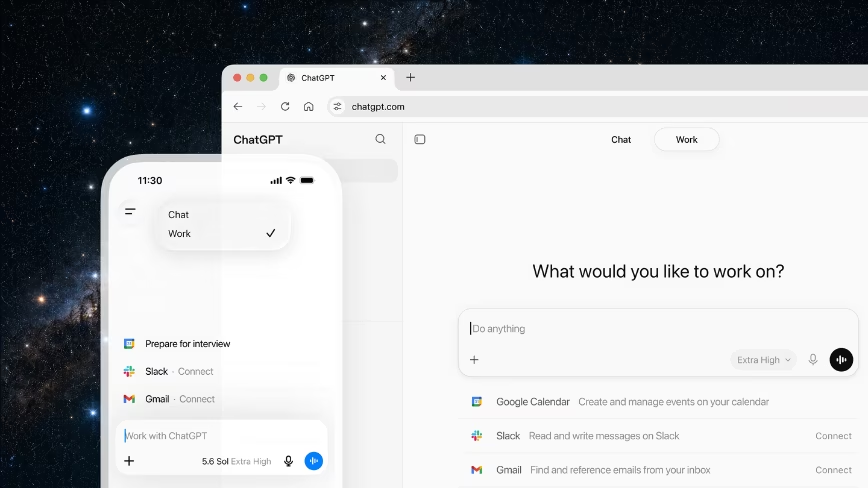
OpenAI has introduced ChatGPT Work, an agent built into the ChatGPT platform that can directly operate on a user's applications and files, and stay engaged with a project for hours. It's no longer about a model answering isolated questions: the system now takes the initiative, completes complex tasks, and, in the company's vision, finishes the job for the user.
The move marks a turning point for the industry, accelerating toward agentic AI after two years of purely conversational language models. But behind the novelty lies an architectural challenge already familiar to those tracking on-premise deployment dynamics: to function, such an agent must access files, interface with other applications, and often remain active for hours. In the current version of ChatGPT Work, all these operations remain tied to OpenAI's cloud infrastructure.
For a bank, a public administration, or any company bound by data residency requirements, the problem isn't theoretical. Letting an external agent act on one's documents means entrusting a cloud service not only with conversation content but also with control over actions taken on internal repositories. European regulations and traditional security policies demand that data and commands stay inside certified perimeters — a requirement that a cloud agent cannot guarantee by contractual promises alone.
OpenAI's message is clear: the next frontier isn't answering, but executing. And it delivers that within the most widely used platform today. This forces organizations evaluating local stacks for LLMs to face a difficult question. On one hand, tools like ChatGPT Work raise the productivity bar, making it hard to justify more conservative solutions. On the other, dependency on the cloud for autonomous actions becomes a concrete risk factor, especially as agents start touching critical systems.
Those designing on-premise deployments of language models today will need to ask whether self-hosted agentic frameworks — still maturing — will be able to offer comparable capabilities without sacrificing sovereignty. Competitive pressure is mounting on tools like crewAI, AutoGPT, and the extensions of major inference runtimes, which will have to close the gap with prompt orchestration and secure integrations with local file systems.
OpenAI's announcement adds no new technical details about consumption or latency, but it signals a market direction that redefines the total cost of ownership for enterprise AI. If the only way to have a truly effective agent is through a cloud subscription, the TCO for large-scale operations risks spiraling out of control. And those who have already invested in hardware for local inference may find their machine fleet underutilized, while the most valuable part of automation remains out of reach.
The discussion extends to the broader AI economy: agents promise to reduce human workload, but at the cost of a new dependence on a single provider for actions. It's no longer just about where models run, but about who controls the last mile of execution. For this reason, the ability to bring similar agents onto local infrastructure will not be an optional nice-to-have, but a prerequisite to continue doing AI in regulated environments.
For those weighing the trade-offs between cloud and on-premise, AI-RADAR tracks emerging frameworks and architectures for agentic orchestration on owned hardware, providing analytic tools to compare costs, latency, and compliance requirements.




💬 Comments (0)
🔒 Log in or register to comment on articles.
No comments yet. Be the first to comment!