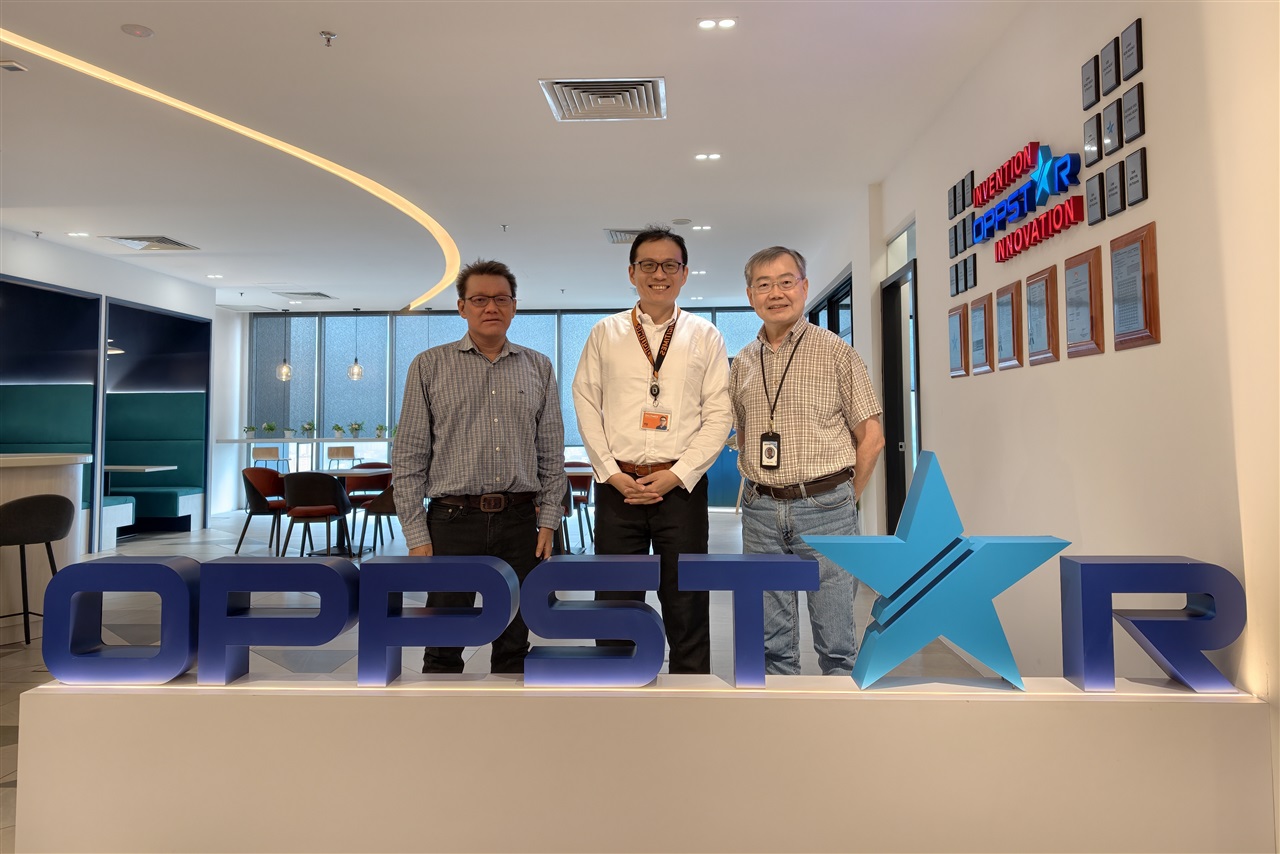
A trio of moves to embed itself in Asia’s semiconductor fabric. In an interview with DIGITIMES, Oppstar co-founder Meng Thai Ng outlined plans to open a Taiwan office and deepen collaboration with clients in Japan and South Korea. Analyst Yen Chou and CFO Fung Wei Chin, who joined him, painted the picture of a company scaling from IC design toward a more structured regional presence.
A three-pronged direction: Japan, Korea, Taiwan
Oppstar is a known name for those tracking the ASIC (Application-Specific Integrated Circuit) space – chips built to perform a dedicated function, often in areas where power, efficiency, and thermal control outweigh flexibility. The company built its reputation serving clients that need solutions outside generalist catalogs. The interview now confirms that the most substantial orders come precisely from Northeast Asia: Japan, with its precision electronics industry, and South Korea, a hub for advanced memory and logic, represent the two poles. Opening an office in Taiwan – the global foundry heartland with TSMC and a packaging and testing ecosystem – completes the logistical and commercial triangle.
Why ASICs have never been more relevant
The news comes as the custom chip market experiences a second youth. The explosion of AI inference workloads, the spread of quantized LLMs, and the need to run them in self-hosted environments push many enterprises to consider ASICs as an alternative to GPUs. A well-designed ASIC can deliver extremely high throughput per token and low power consumption, driving down TCO in on-premise deployments. In regulated settings – from healthcare to finance – where data sovereignty requires local processing, the custom chip becomes an architectural lever. Oppstar doesn’t fabricate, but its design role places it at the junction between client specifications and the choice of manufacturing node, often at the very Taiwanese foundries it now seeks to get closer to.
An ecosystem to cultivate locally
Setting up a Taiwan office isn’t just about foundry proximity. It means real-time dialogue with process engineers, faster prototyping cycles, and a supply chain with less friction. For Japanese and Korean clients, moreover, a Taipei time-zone office cuts decision latency. Through the AI-RADAR lens, the move signals how the custom accelerator pipeline is building a physical geography that mirrors on-premise deployment requirements: chips built to spec, validated near the foundry, then shipped to enterprise data centers or edge servers running air-gapped.
Beyond the news: what it means for on-premise evaluators
For organizations weighing local compute platforms, the growth of players like Oppstar adds options to a landscape dominated by a few general-purpose silicon vendors. Certainly, choosing an ASIC comes with constraints: the upfront development cost (NRE) can be high, and the design freezes functionality; any algorithm update requires a chip respin. But when the workload is stable and inference volumes justify it, the operational savings can outweigh the initial investment. In this light, Oppstar’s expansion into East Asia’s most mature markets suggests that demand for custom-designed chips – and thus for architectural control – is set to grow. For those tracking self-hosting logic, that’s a signal worth noting.








💬 Comments (0)
🔒 Log in or register to comment on articles.
No comments yet. Be the first to comment!