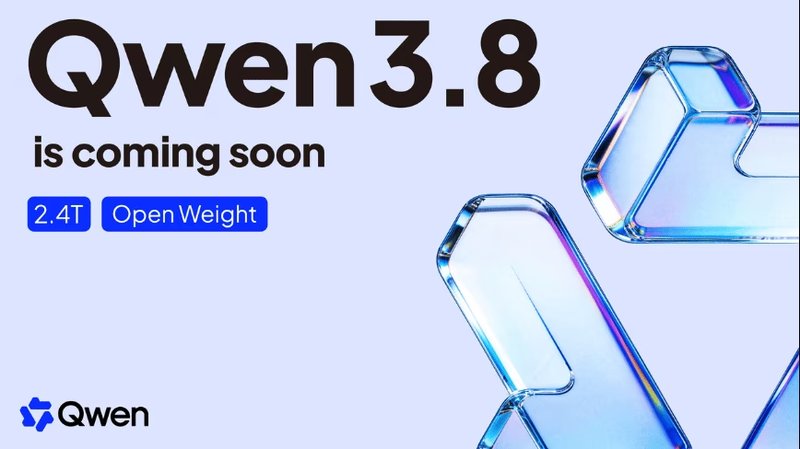
An open source gathering in Shanghai isn't just a community blip. It's a signal, amplified by Qwen's immediate move with version 3.8. Alibaba's team chose that stage to accelerate, and the timing is no coincidence.
Qwen is no outsider. For some time, Qwen-family models have been vying with Llama and Mistral for the title of best open LLM for production use. The Apache 2.0 license, availability of checkpoints at multiple scales, and native support for quantization techniques push many teams to consider it as an alternative to the Californian giants. But there's a factor that weighs more than benchmarks: provenance.
For European and Asian organizations operating under strict GDPR or local data regulations, hosting a model developed in China can offer a non-trivial compliance advantage. Less dependency on US infrastructure, less risk of exposure to extra-EU jurisdictions. That explains why, while Silicon Valley debates AGI, in Shanghai the focus is on turning self-hosted AI into an even more accessible commodity.
From a hardware perspective, China's open source push has a frequently overlooked second-order effect. Qwen is one of the models best suited to non-CUDA backends: it runs on Huawei Ascend chips and other domestic platforms, reducing lock-in to NVIDIA. For anyone planning large-scale on-premise deployments, the ability to choose alternative hardware – from Biren to Moore Threads – becomes real negotiating leverage and a way to contain TCO, especially when Western GPUs are scarce or hit by export restrictions.
The Shanghai gathering, with Qwen's push, sends a clear message: the open source ecosystem is fragmenting along geopolitical lines. It's no longer just a race between models, but between entire stacks encompassing silicon, inference frameworks, and serving libraries. The losers are vendors banking on a de facto monopoly of the American path to cloud AI. The winners are teams that already treat technological sovereignty as an architectural requirement, not a nice-to-have.



💬 Comments (0)
🔒 Log in or register to comment on articles.
No comments yet. Be the first to comment!