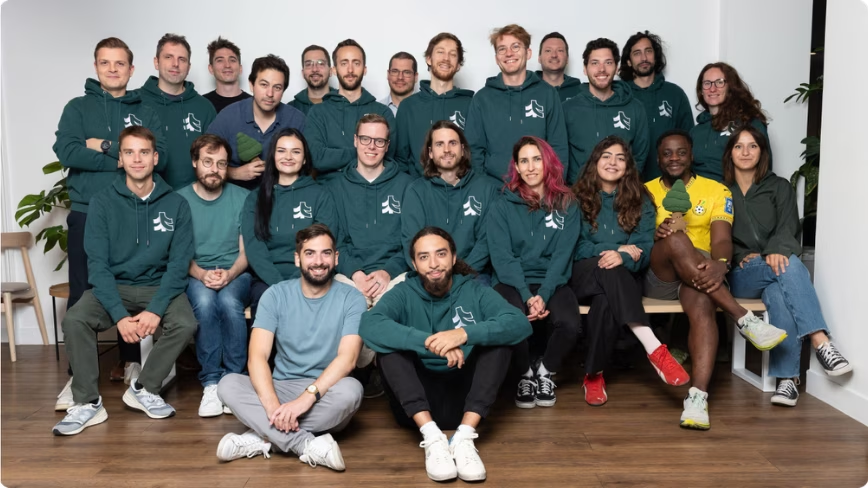
In the observability space, few names carry the weight of Datadog. Two former Datadog engineers, however, have decided that the era of AI agents and Large Language Models demands a radical rethink. Their new venture, Tsuga, has just closed a $35 million Series A — barely six months after emerging from stealth — to push forward a deceptively simple yet disruptive idea: keep observability inside the customer’s own cloud, not in the vendor’s SaaS.
Why classic observability buckles under AI
Traditional observability, built on metrics, logs, and traces, was born in a world of microservices and deterministic workloads. But AI workloads — agents, chained inference, LLM calls — generate unprecedented telemetry volumes. A single agent interaction can produce hundreds of events, and each inference session multiplies data on performance, latency, and response quality. Under widespread per-byte pricing models, this boom threatens to send costs through the roof and make data governance unmanageable.
Tsuga proposes a shift in perspective: instead of shipping mountains of telemetry to an external SaaS, its platform runs directly inside the customer’s infrastructure — whether that’s a public cloud, a private VPC, or a hybrid environment. This means the data stays under the company’s control, with clear advantages in compliance, data residency, and cost predictability. In practice, it’s a move from variable, often eye-watering OpEx to a more linear TCO, where scaling monitoring does not become a linear tax.
The price of data sovereignty in the agent age
It’s no accident the founders hail from Datadog: they know the limits of the centralized paradigm firsthand. In enterprise settings, especially regulated sectors like finance, healthcare, and defense, the prospect of exporting detailed telemetry about models and agents to a third-party service raises red flags around privacy, GDPR, and trade secrets. The ability to keep the entire observability stack within the organization’s trust perimeter — self-hosted or in its own cloud tenant — becomes an enabler for AI projects that would otherwise remain stuck.
Seen in this light, Tsuga’s move signals something broader: the maturation of a second wave of cloud infrastructure where data sovereignty is not a nice-to-have but the minimum requirement for operating AI workloads. The explosion of on-premise inference and hybrid architectures with local GPUs requires observability tools that don’t expand the attack surface or introduce runaway egress costs.
Implications for those choosing local deployments
For organizations evaluating on-premise or air-gapped LLM deployments — an increasingly common scenario for latency, security, or compute cost reasons — Tsuga’s proposition hits a raw nerve. Moving observability client-side means using the same monitoring pipelines for both legacy services and new AI workloads, without complex contract negotiations or audits over data location. It also opens the door to leveraging dedicated hardware (GPUs, accelerators) for local processing of telemetry streams, reducing dependency on external services.
Of course, self-hosting adds operational complexity: running an observability stack in your own cloud demands skills and resources. Yet the evolution of frameworks and Kubernetes operators has lowered that barrier, and long-term savings — combined with compliance peace of mind — can flip the TCO equation, especially as telemetry volumes balloon.
A bet on the future of enterprise AI
Tsuga arrives just as companies are rethinking the entire AI data supply chain. The $35 million financial backing suggests investors see a window to dismantle SaaS observability monopolies by riding the need for customer-side solutions. If the trend holds, we might witness an ecosystem where control over telemetry becomes an integral part of digital sovereignty, alongside models and training data. In this scenario, tools like Tsuga cease to be just a technical alternative and become a strategic piece for any organization serious about self-managed AI.








💬 Comments (0)
🔒 Log in or register to comment on articles.
No comments yet. Be the first to comment!