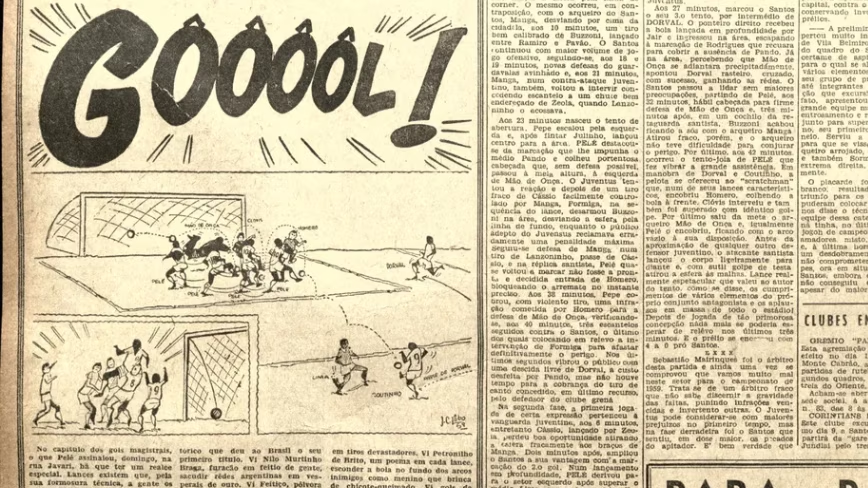
On August 2, 1959, at the Rua Javari stadium in São Paulo, Pelé scored what he himself called the most beautiful goal of his career: three consecutive sombreros over defenders, a knee flick to beat the goalkeeper, and a header into the net, with the ball never touching the ground. No film of it exists. For 67 years, the goal survived only in the memories of those who saw it and in retold stories. Now Google has reconstructed it, using a combination of Veo, its generative video model, and Gemini, the multimodal Large Language Model.
The feat is more than a sports curiosity. It marks a turning point in how the AI industry approaches the reconstruction of undocumented historical events, while also making tangible a tension AI-RADAR has long tracked: the gap between the capabilities concentrated in large cloud providers and the feasibility of similar workloads in on-premise or self-hosted environments.
A computational load that speaks for itself
Generating high-quality synthetic video, even for a few seconds, demands hardware resources far beyond what a typical enterprise server can offer. Video models like Veo operate on spatio-temporal representations that quickly saturate the VRAM of even the most capacious GPUs. At inference time, producing a smooth clip without artifacts requires pipelines that coordinate multiple accelerators in parallel, with memory bandwidths of hundreds of gigabytes per second. Multiply that by the many refinement passes needed to maintain visual coherence and faithfully follow the text prompt.
Google hasn't disclosed details of the infrastructure used, but it is likely that the reconstruction ran on clusters of TPUs or cutting-edge GPUs orchestrated through its internal services. For any organization wanting to replicate a similar workflow in-house, Total Cost of Ownership would immediately spike: not just hardware, but also the energy to power and cool it, plus the specialized personnel to build a distributed inference pipeline. Moreover, models like Veo are not open source; they remain confined within the walled gardens of large providers. Those who prioritize data sovereignty and control over every link in the chain face a dilemma: accept the lock-in or invest heavily for an autonomy that today looks more like an ideal than a practical reality.
Who controls memory, controls the narrative
Pelé's goal is innocent, but the technology to reconstruct scenes that were never filmed can be applied to far more sensitive contexts: forensic imagery, documentation of human rights violations, evidence in legal proceedings. In these scenarios, data residency and compliance with regulations like GDPR become central. Entrusting the reconstruction to an external cloud means temporarily giving up control over source information, with all that entails for audit trails and chains of custody.
Google's reconstruction is a reminder of how much power to shape—and potentially rewrite—collective memory now rests in the hands of very few players. It is not a matter of trusting any single vendor, but of structural incentives: as long as the cost and complexity gap between cloud and on-premise for generative video remains this wide, the market will push toward further concentration. The implications for source plurality and technological independence are profound, and deserve to be weighed long before the next reconstruction concerns something more sensitive than a goal.






💬 Comments (0)
🔒 Log in or register to comment on articles.
No comments yet. Be the first to comment!