MachinaOS: The Intent-Driven Operating Layer — Introductory Guide
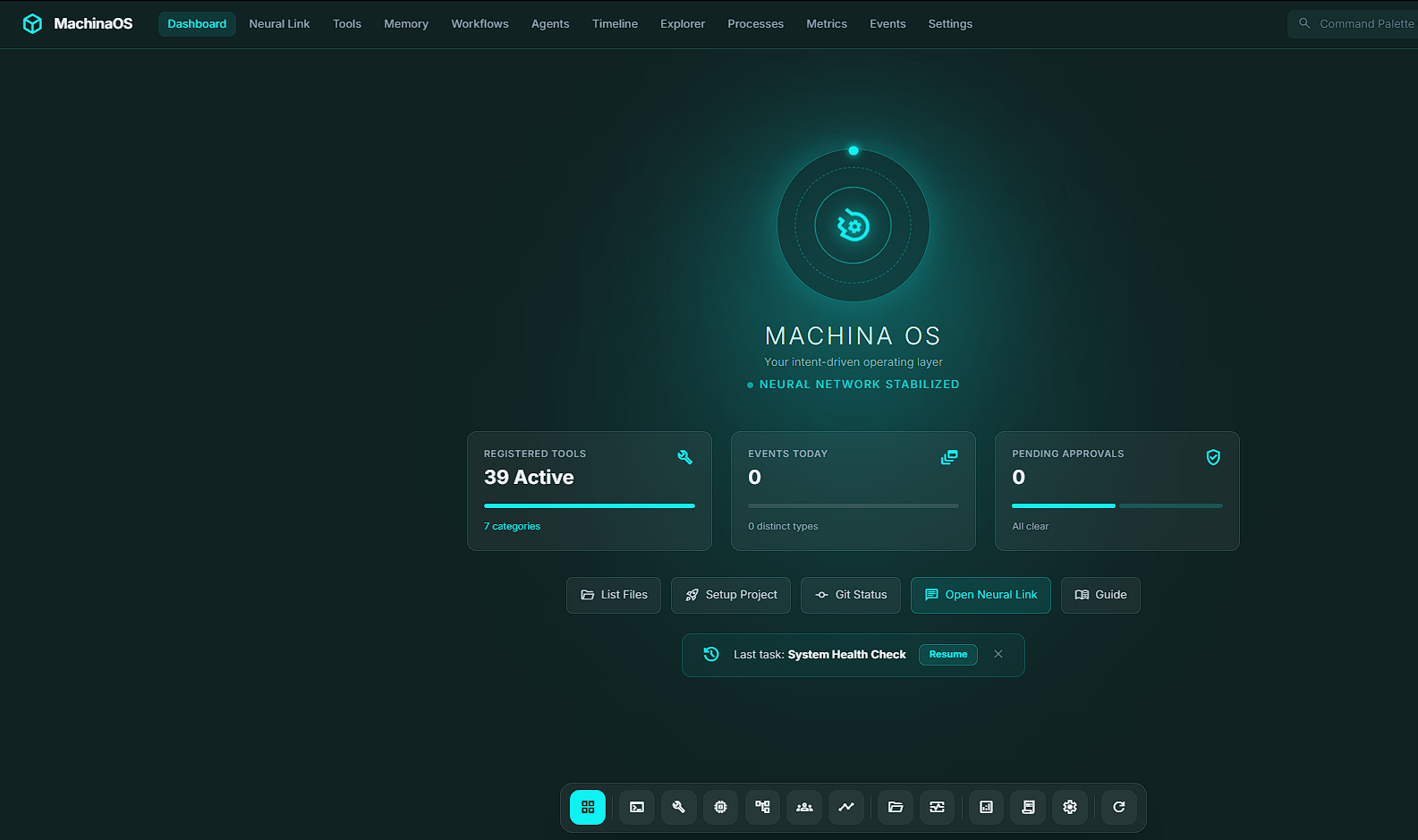
- Executive Introduction: Defining the AI-Native Operating Environment
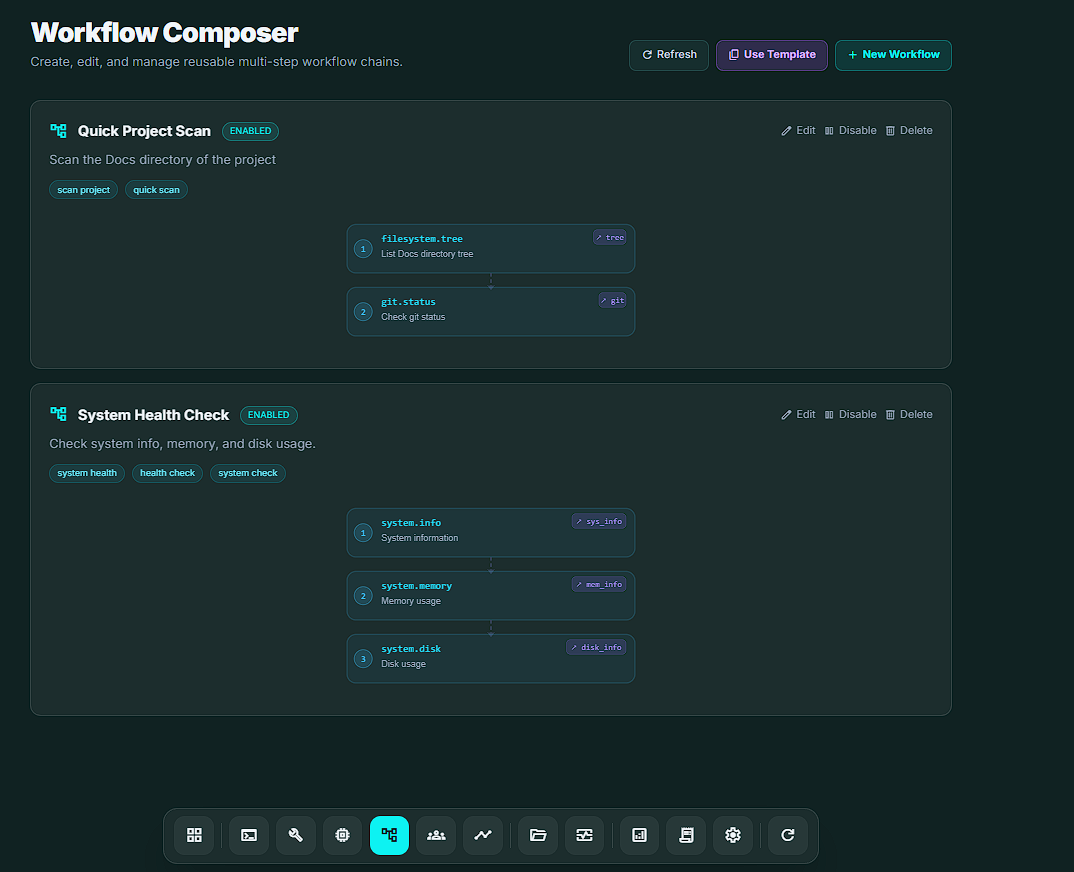
MachinaOS is a local-first, intent-driven operating layer designed to function as a semantic interface between users and existing operating systems (Windows, Linux, macOS). Rather than a traditional kernel, MachinaOS introduces a higher semantic layer between the user and the host OS. This "semantic shell" allows the system to reason about high-level goals, tasks, and project states, transforming natural language into safe, deterministic system actions.
The core mission of MachinaOS is to behave as an operating environment that understands intent, plans multi-step actions, invokes verified tools, and manages persistent memory locally. By moving beyond the limitations of simple chatbots, the system anchors every model suggestion in tool-verified reality and system truth.
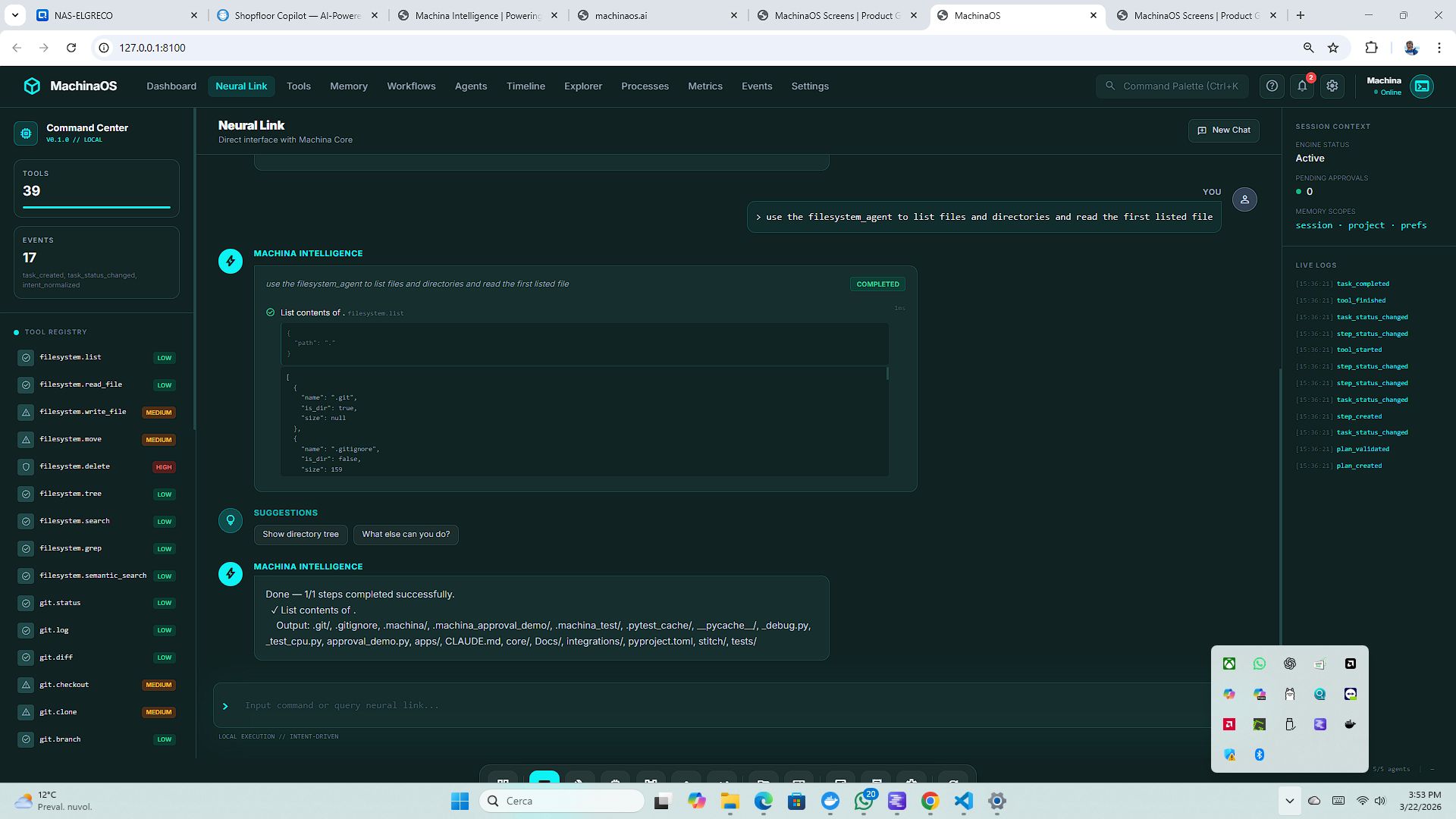
Canonical One-Sentence Summary Machina OS is a local-first, intent-driven operating layer that turns natural-language goals into safe, inspectable system actions.
Product Vision MachinaOS is designed to:
Understand high-level goals.Decompose them into executable tasks.Choose the appropriate tools for the job.Execute steps sequentially or in parallel.Ask for confirmation only when risk is non-trivial.Maintain context, preferences, and outcomes across sessions.
--------------------------------------------------------------------------------
- The Nine Fundamental Engineering Principles
MachinaOS operates under an "Anti-Hype Doctrine," prioritizing reliable narrow competence over broad, unreliable AI theater. Our philosophy is to stay brutally practical, enforced through nine core principles:
Local-first Execution: All user files, task states, memory, and orchestration run locally by default to ensure privacy and offline reliability.Explicit Tool Boundaries: The model must never "pretend" to act; every system change must map to a real, verified tool invocation.Human Approval for Risky Actions: Operations involving destructive file writes, shell execution, or credential use require explicit human-in-the-loop confirmation.Deterministic Logs: Every meaningful action is recorded in structured event logs to ensure full auditability.Planner/Executor Separation: Planning and execution are distinct modules; deterministic templates for known intents are used to bypass the LLM for common tasks.Composable Memory: Memory is structured into distinct, layered partitions: session, episodic, semantic, and user preferences.Graceful Degradation: If the AI model is unavailable, the system remains functional, providing access to logs, state, and manual tool execution.No "AI Magic": Behavior must be inspectable and transparent, avoiding opaque "magic" in favor of verifiable system states.Reversibility: Mutations must be reversible; filesystem writes automatically create .machina_bak files, and Git operations utilize mandatory diff previews.
--------------------------------------------------------------------------------
- Architectural Framework: The 8-Layer Semantic Runtime
The MachinaOS architecture is organized into eight primary layers that decouple user intent from host-OS execution:
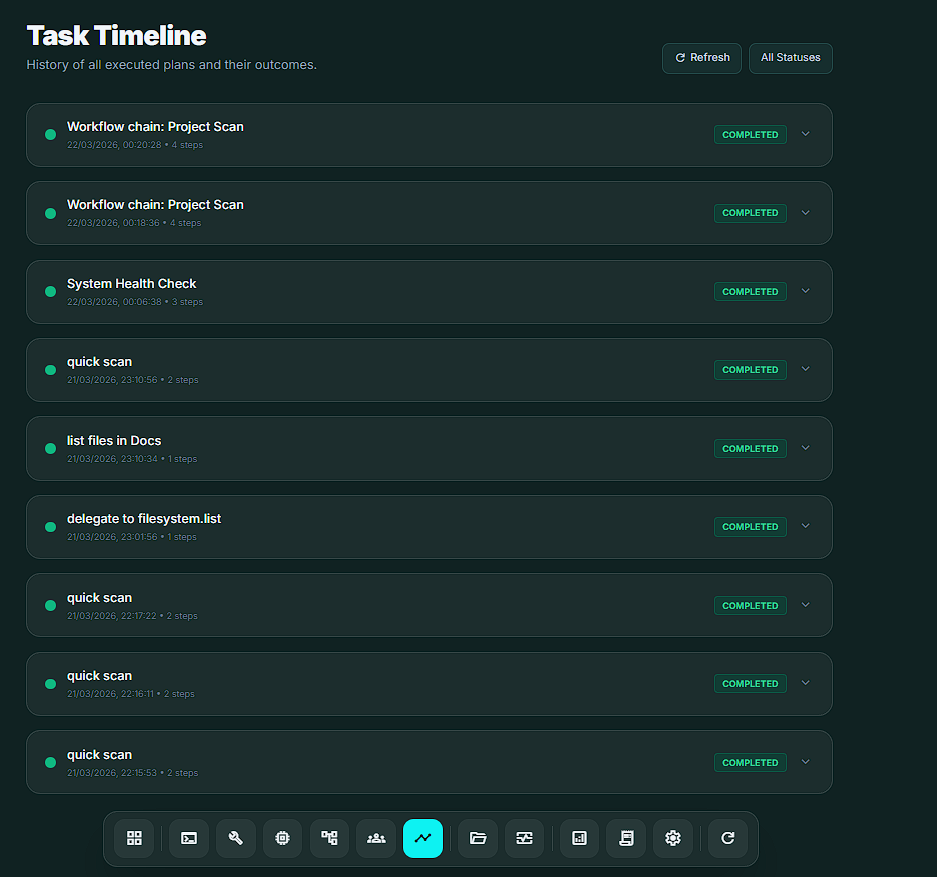
Presentation Layer: The visual operating surface (Dashboard, Timeline, Approval Center) designed to make the runtime state fully inspectable.Neural Interface Layer: The conversational surface that accepts natural language and normalizes intent without triggering direct system effects.Intent & Planning Layer: Extracts intent, detects constraints, and generates validated execution plans via the Intent Intake and Planner.Policy & Trust Layer: The governance engine (Risk Classifier and Policy Engine) that manages permissions and triggers human approval.Execution Layer: The deterministic engine consisting of the RuntimeExecutor and TaskRuntime that coordinates tool invocations and recovery.Tool Layer: The mechanism for system change, utilizing tools with typed inputs, machine-readable outputs, and mandatory event emission.System Adapter Layer: A translation layer that isolates platform differences (Windows, Linux, macOS) to ensure consistent tool semantics.State/Memory/Event Layer: The system's "nervous system," utilizing a dual-write system of SQLite (WAL mode) for structured history and JSONL for event streams.
The Canonical 12-Step Runtime Flow
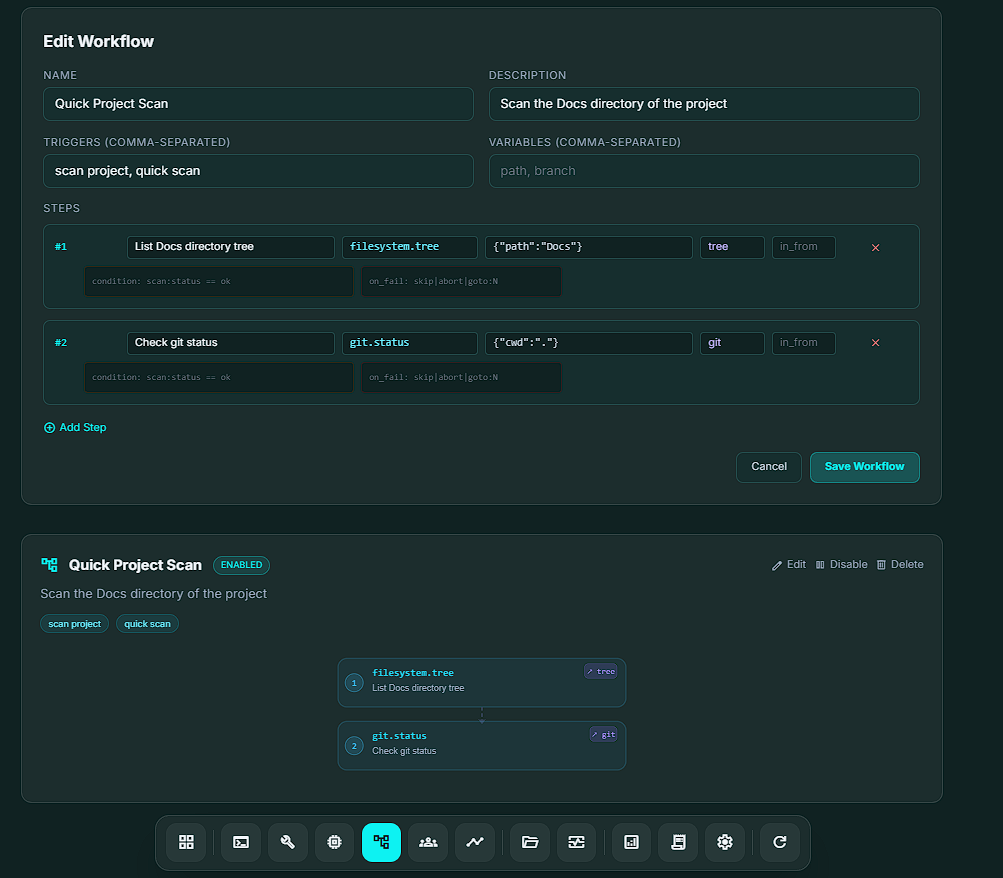
Intent Intake: User submits raw intent via the Neural Link.Forwarding: Neural Link forwards the request to the core.Extraction: Intent Intake extracts structure, entities, and constraints.Planning: The Planner generates a step-by-step execution plan.Validation: The Plan Validator ensures the plan meets schema requirements.Policy Check: The Policy Engine evaluates risk levels for each plan step.Approval Gate: The Approval Manager pauses for user consent on high-risk actions.Execution: The RuntimeExecutor invokes tools and collects results.Tool Output: Tools return structured, machine-readable results.Event Emission: Detailed execution events are emitted to the bus.Memory Update: Task history and workspace context are updated in the persistent stores.UI Refresh: The Presentation Layer updates the timeline and dashboard state.
--------------------------------------------------------------------------------
- The Tool Registry and System Capabilities
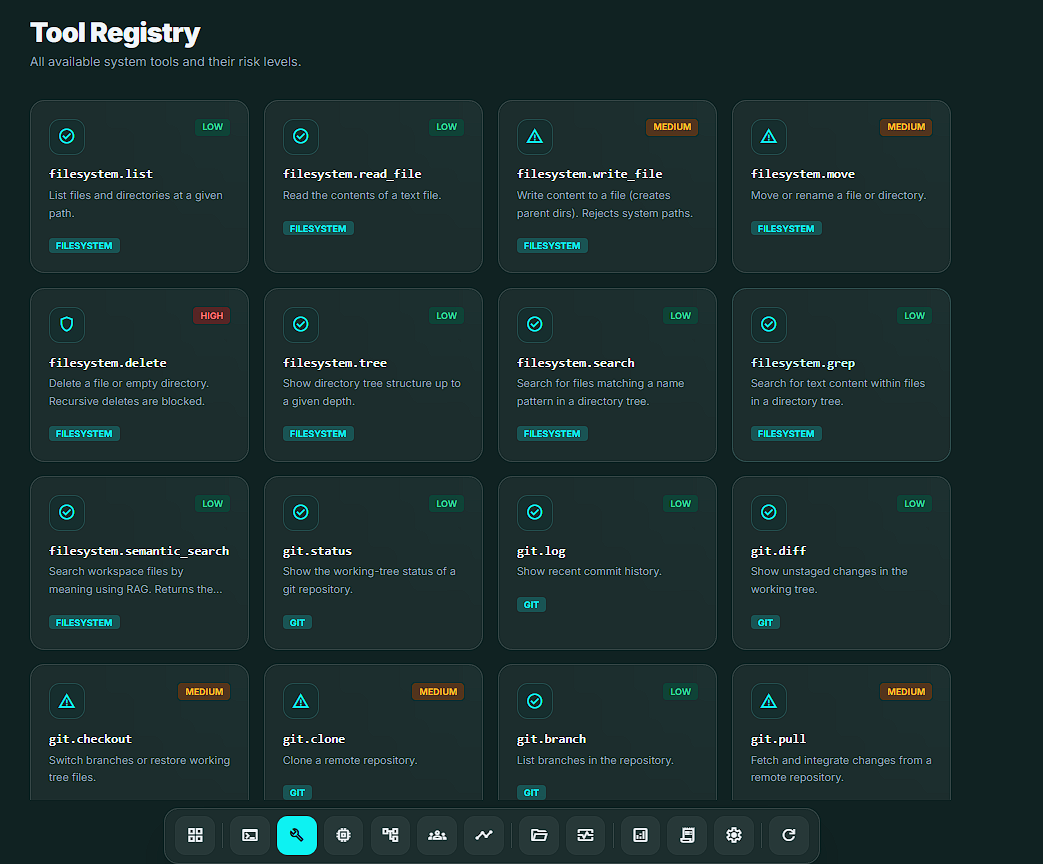
MachinaOS currently features 40 active tools distributed across 7 domains. All tools must comply with the Tool Protocol, which mandates structured error codes (e.g., FILE_NOT_FOUND, PRIVILEGE_ESCALATION), a 120s execution timeout, and a 1MB output size limit.
Primary Tool Domains
| Domain | Key Tools | Primary Function |
|---|---|---|
| Filesystem | list, read, write, grep, tree | File manipulation with path safety and .machina_bak support. |
| Shell | run, run_safe | System command execution with privilege escalation blocking. |
| Process | list, info, start, stop | OS-level process monitoring and control. |
| Git | status, log, diff, commit, pull | Comprehensive repo management (10 tools total). |
| VS Code | open_workspace, read_diagnostics | Integration with workspace diagnostics (LSP/Linters). |
| Browser | open_url, search_files | Basic automation for external information retrieval. |
| System | info, memory, disk, status | Hardware and OS introspection via standard libraries. |
Safety and Guardrails
MachinaOS enforces strict code-level boundaries. Path Safety rejects access to sensitive system directories, while Shell Safety blocks destructive pipelines and privilege escalation (e.g., sudo, runas).
Critical Blocks: Recursive root deletes and credential exfiltration are hard-blocked by the Policy Engine and never allowed to run.
--------------------------------------------------------------------------------
- The Multi-Agent Ecosystem and Coordination
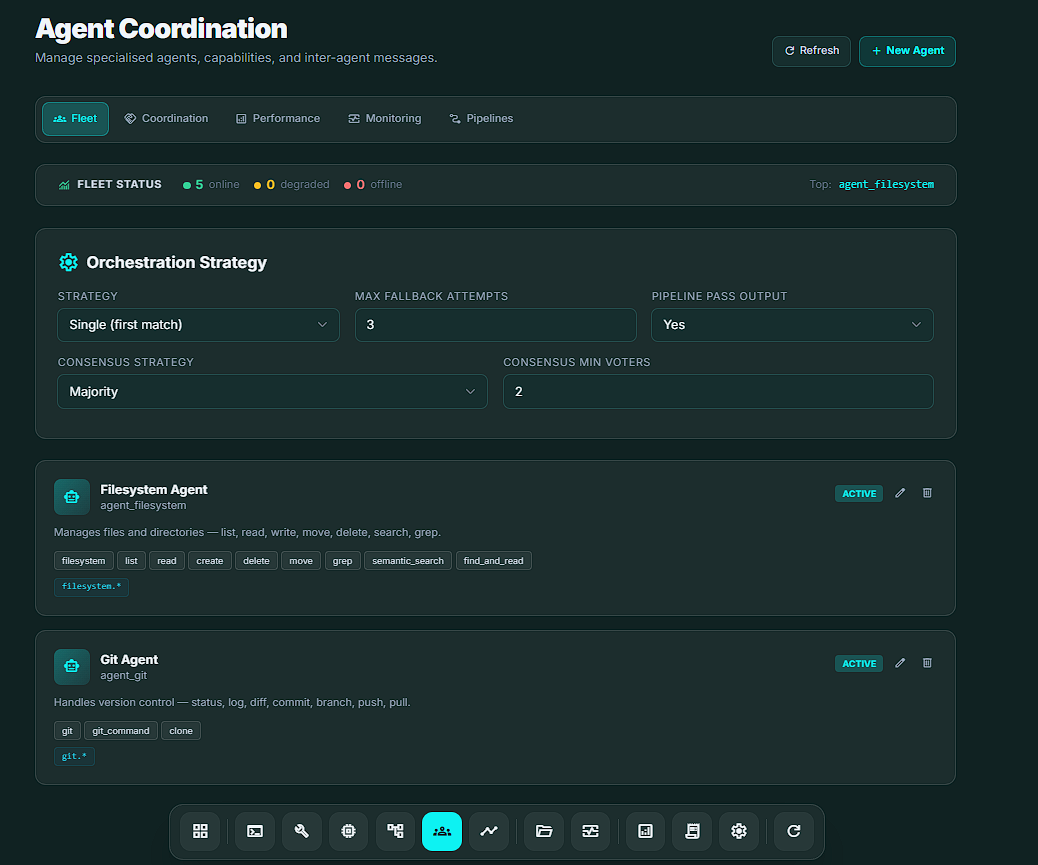
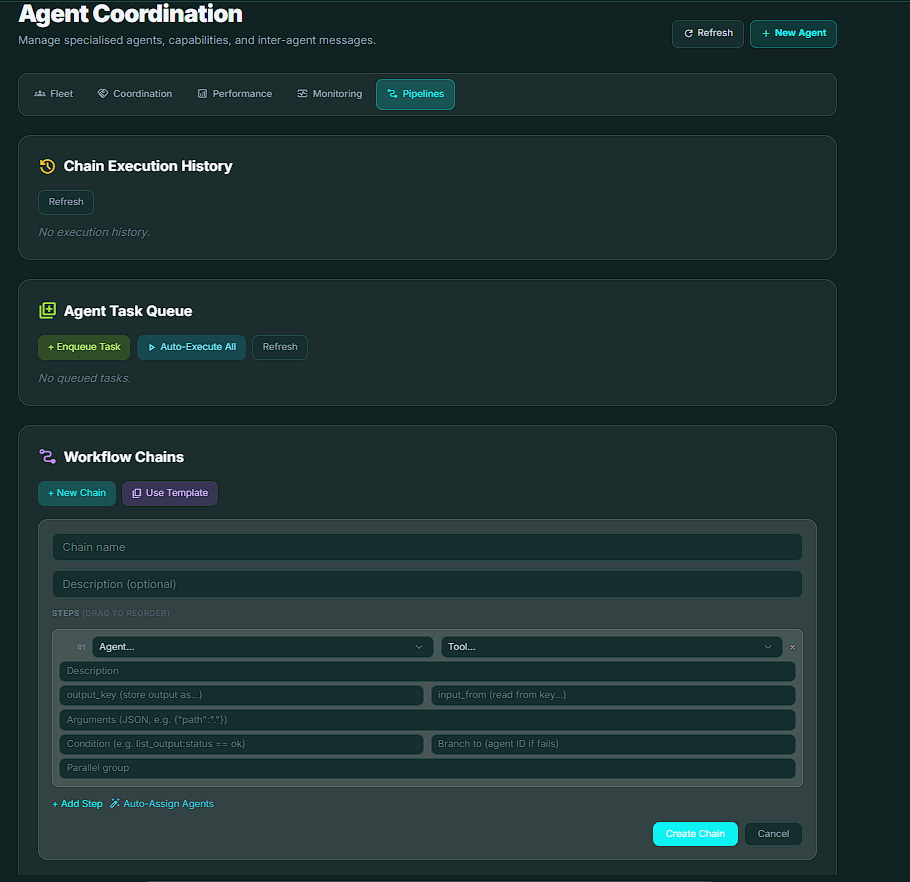
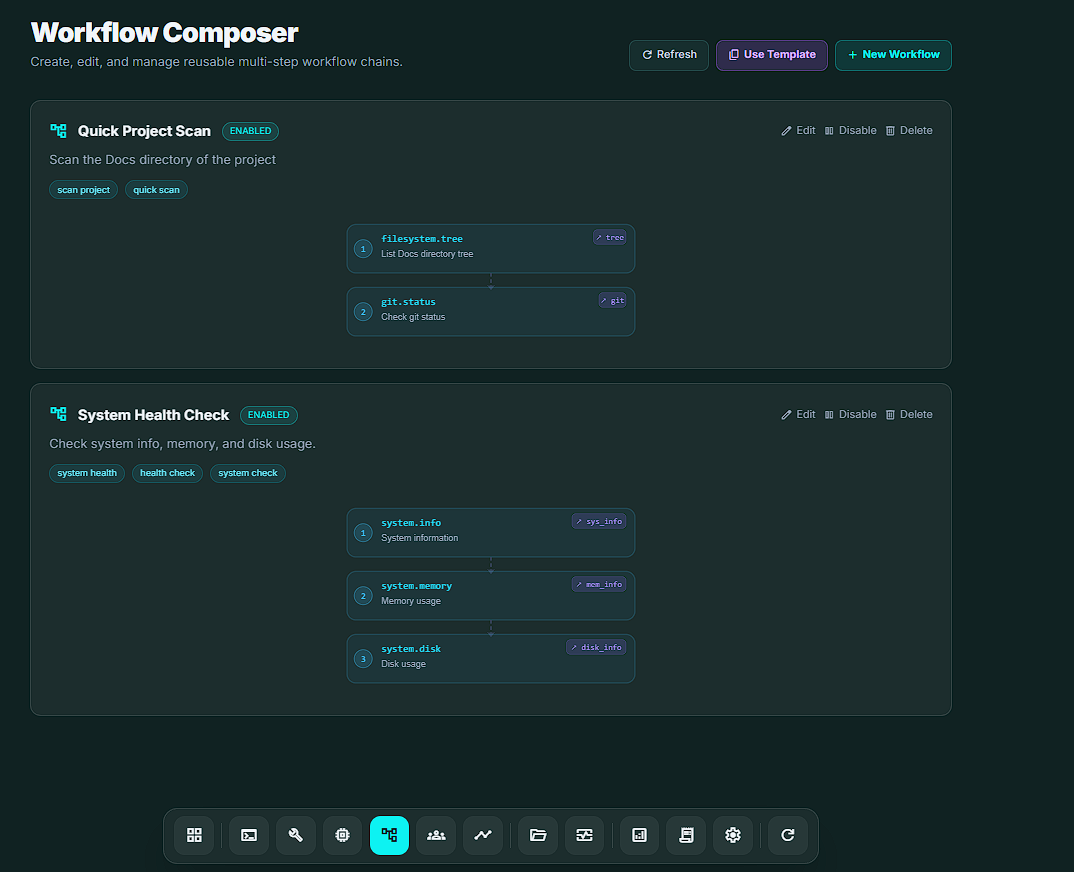
MachinaOS utilizes specialized builtin agents—Filesystem, Git, Shell, and System—which coordinate via the AgentBus using structured protocols.
Orchestration and Routing
The AgentPool selects agents based on five strategies: SINGLE, ROUND_ROBIN, CAPABILITY_SCORE, FALLBACK, and PIPELINE.
Specificity Scoring: When selecting agents, the system applies weights: Exact Match (1.0), Prefix Glob (0.3+), and Open Filter (0.1).
Coordination Protocols
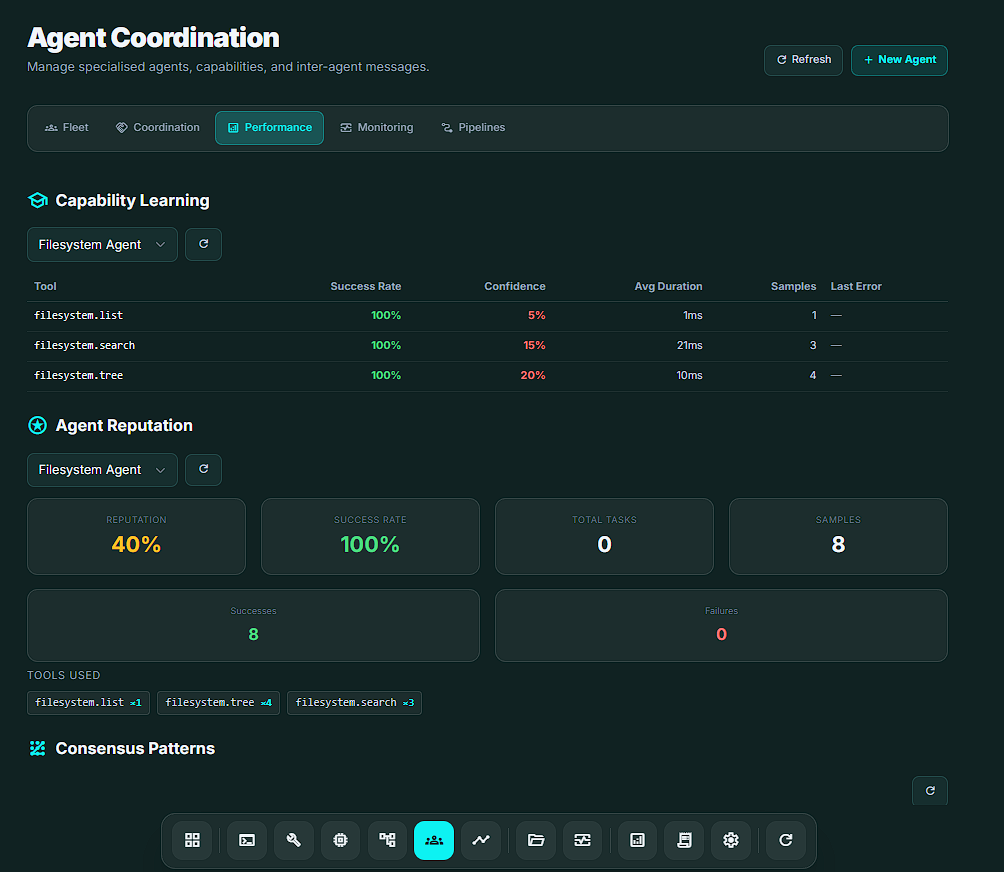
Consensus & Voting: Critical decisions are put to a vote among candidate agents using Majority, Unanimous, or Weighted strategies.Consensus Skip Rule: If a tool pattern has ≥10 evaluations and a >95% approval rate, consensus is automatically skipped to reduce overhead.Negotiation Protocol: Agents enter a proposal flow to resolve tool ownership. Disputes are resolved by the Negotiation Priority (Critical, High, Normal, Low), where the lower priority value wins.Capability Learning & Reputation: The system tracks success/failure rates to generate a Reputation Score, calculated as: (40% Lifetime Success + 60% Recent Performance) × Sample Confidence.Task Handoffs: Agents can transfer responsibility mid-task using the HandoffRequest model, which includes specific preconditions and constraints fields.
--------------------------------------------------------------------------------
- Safety, Governance, and Trust Boundaries
The fundamental truth of MachinaOS architecture is that prompts are guidance; boundaries must be enforced in code. The system maintains four critical trust boundaries:
The Model Is Not Trusted for Effects: Suggestion \= Execution.Tool Outputs Over Narration: System state is derived from tool results, not model descriptions.Human Overrides: User approval is mandatory for any "High" or "Critical" risk.Adapters Enforce Constraints: System adapters, not the LLM, enforce security boundaries.
Risk-Level Policy Engine
CRITICAL: Action is hard-blocked (e.g., recursive root deletes).HIGH: Requires explicit user approval and a command/effect preview.MEDIUM: Actions like shell.run_safe (read-only) may require approval depending on user preference profiles.LOW: Safe actions (e.g., filesystem.list) may auto-run.
--------------------------------------------------------------------------------
- Development Roadmap: Strategy and Milestones
MachinaOS is developed in three distinct stages:
Stage 1 (Machina Core): Local agent orchestrator for planning and tool execution.Stage 2 (Machina Shell): Introduction of the workspace interface and visual task timelines.Stage 3 (Machina OS Layer): Deep integration with background services and a semantic filesystem.
Current Status: As of Sprint 35, the "Machina Seed" milestone has been achieved. The system is highly stable, with 1,579 tests passing and 382 build items complete.
--------------------------------------------------------------------------------
- Conclusion: The Evolutionary Path of the Developer Cockpit
MachinaOS targets Developer Environment Orchestration as its first mature workflow. By mastering the sequence of repository inspection, diagnostic analysis, and safe patching, the system provides a high-value, transparent environment for technical work.
Example MVP Commands
MachinaOS is verified to reliably execute the following commands:
"Open my MES training workspace""Summarize this project folder""Create a Python app skeleton with tests""Prepare the repo and run the dev server""Find the last report I edited and open it"
MachinaOS represents a trustworthy operating layer where models reason, tools act, and humans remain in absolute control.
## https://machinaos.ai





💬 Comments (0)
🔒 Log in or register to comment on articles.
No comments yet. Be the first to comment!