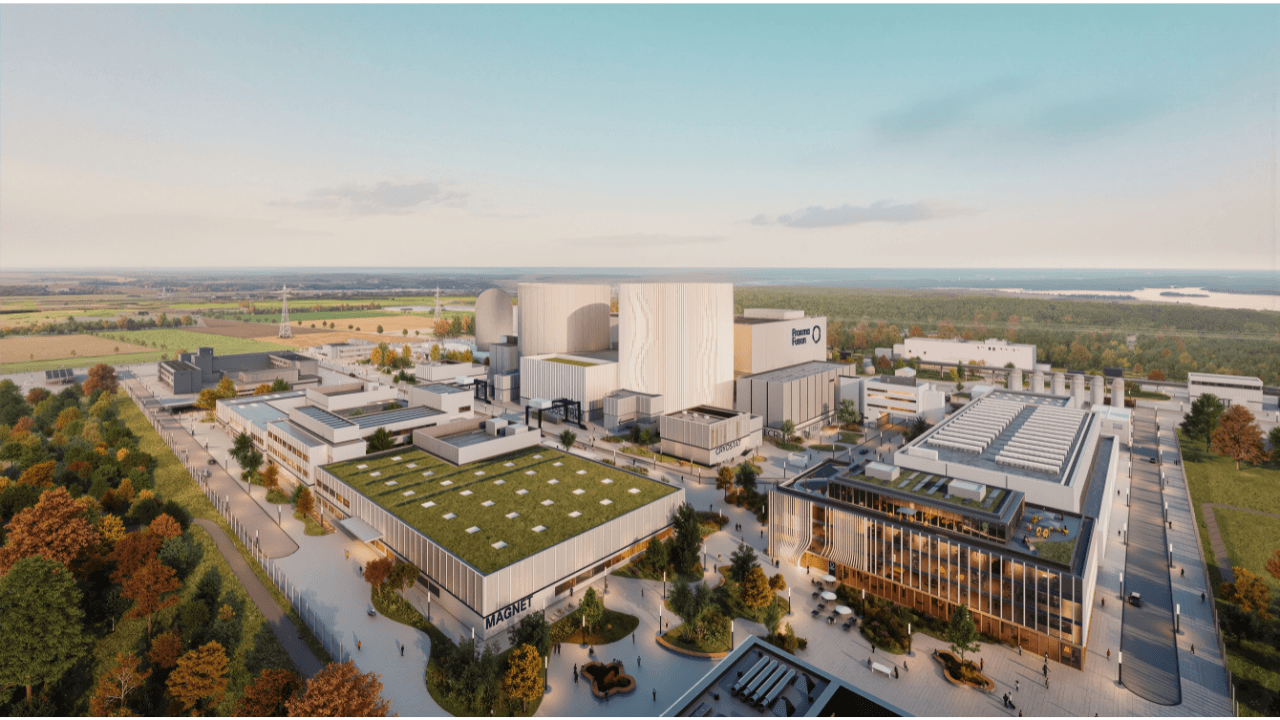
Proxima Fusion has signed an agreement with the Free State of Bavaria, RWE, and Max Planck Institute for Plasma Physics (IPP) to put the world’s first commercial stellarator fusion power plant on the grid in Europe.
A roadmap to fusion
This agreement marks Europe’s first major step toward commercial fusion power, as the continent’s leadership in fusion research moves into industrial deployment. The Memorandum of Understanding (MoU) outlines a roadmap to commercial fusion in Europe that begins with building demonstration stellarator Alpha near the Max Planck Institute for Plasma Physics (IPP) in Garching.
Goals and timelines
When operational in the 2030s, Alpha will become the first stellarator to demonstrate net energy gain, meaning its plasma will generate more energy than it consumes. The demonstration stellarator will additionally allow Proxima and its partners to test and validate key fusion technologies under real-world conditions and in shorter development cycles, accelerating the path to building the first stellarator fusion power plant, Stellaris. The Stellaris commercial power plant is planned for the site of a former nuclear fission power plant in Gundremmingen, currently being decommissioned by RWE.
Economic and strategic impact
Alpha and Stellaris will together create thousands of jobs and supplier contracts for European manufacturers and engineers, from construction and manufacturing to advanced electrical, magnet systems, and more. The long-term aim is to make fusion an integral part of Europe’s energy system, reduce dependence on imported energy, and, for the first time, apply Europe’s fusion expertise to a grid-connected commercial project.








💬 Comments (0)
🔒 Log in or register to comment on articles.
No comments yet. Be the first to comment!