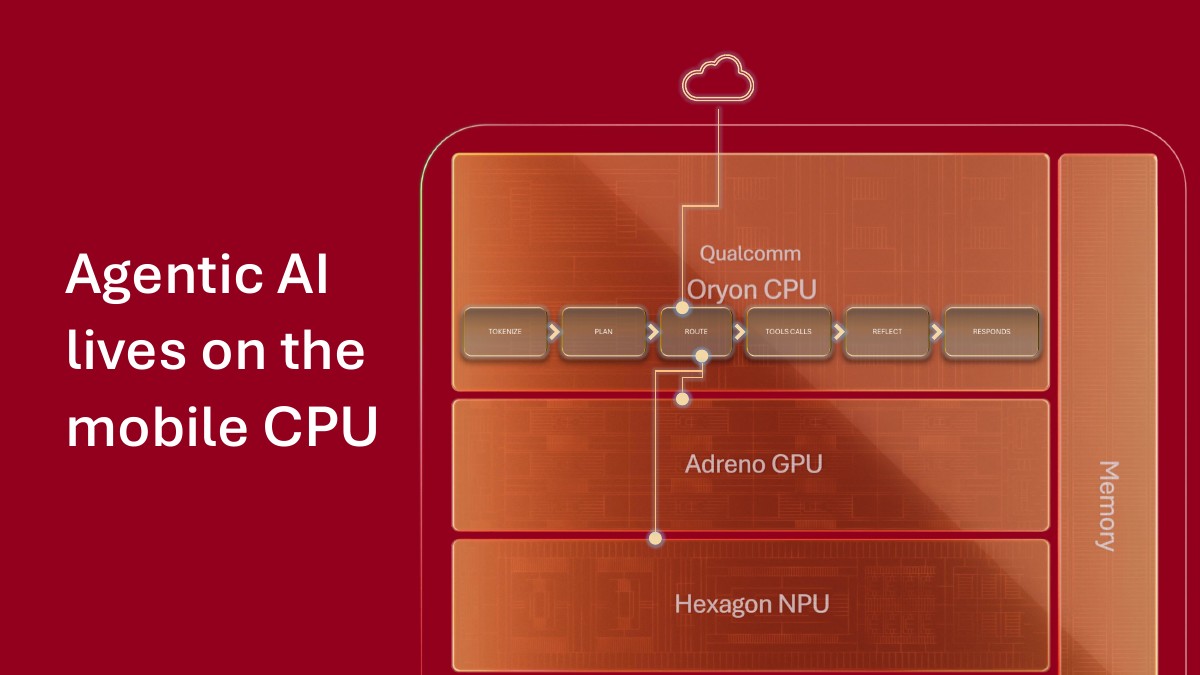
It isn't a roadmap in the traditional sense. When Qualcomm talks about the next generation of Oryon CPU, Adreno GPU, and Hexagon NPU as a coherent package, it is describing an architecture where local inference is no longer an occasional workload but the organizing principle of the whole SoC. The three engines, presented together, point in a precise direction: on-device model execution will not depend on a single specialized unit, but on continuous work distribution across blocks with different power profiles and numerical precision.
The Oryon CPU handles orchestration, control flow, and memory access; the Adreno GPU absorbs parallel workloads and dense operations; the Hexagon NPU executes low-precision matrix multiplications typical of transformer models with much lower energy consumption. This division of labor is not entirely new in mobile processors, but having Qualcomm discuss it as a unified package signals a phase shift: client hardware is being designed with real-world tokens per second in mind, not demos.
The second-order consequence is that software now matters as much as silicon. A model that runs well on a data center GPU does not automatically fit a three-engine system with different memory capacity and quantization support. Execution frameworks and optimization pipelines will need to partition the compute graph across CPU, GPU, and NPU, choosing the right numerical precision for each layer. This moves a significant part of the value from model hyperparameters to deployment engineering.
There is also a broader stake. The more inference moves to the device, the less organizations depend on cloud APIs for sensitive or low-latency tasks. For teams evaluating self-hosted or on-premise deployments, client chips with integrated NPUs lower the minimum viable threshold for compact, quantized models, but they do not remove the VRAM and bandwidth constraints for large models. The trade-off remains between accuracy, power draw, and memory availability. AI-RADAR provides at /llm-onpremise analytical frameworks to assess where local inference is practical and where a server node is still required.
Structurally, Qualcomm's move puts pressure on the economics of centralized inference. If a meaningful share of queries can be absorbed by a laptop or mobile device, per-token pricing for some cloud services loses ground. Silicon vendors that control CPU, NPU, and software benefit, as do enterprises with data sovereignty requirements that want to process regulated information without leaving their own perimeter. Providers optimized only for data centers, and startups whose entire business model assumes sending every request to the cloud, are exposed.
The point isn't whether edge will replace cloud. It is that the balance between the two shifts as local hardware becomes efficient enough to make a network round-trip look pointless when the answer can be generated on device. By talking about Oryon, Adreno, and Hexagon as a single system, Qualcomm is taking a position on that shift before benchmarks even reach the market.






💬 Comments (0)
🔒 Log in or register to comment on articles.
No comments yet. Be the first to comment!