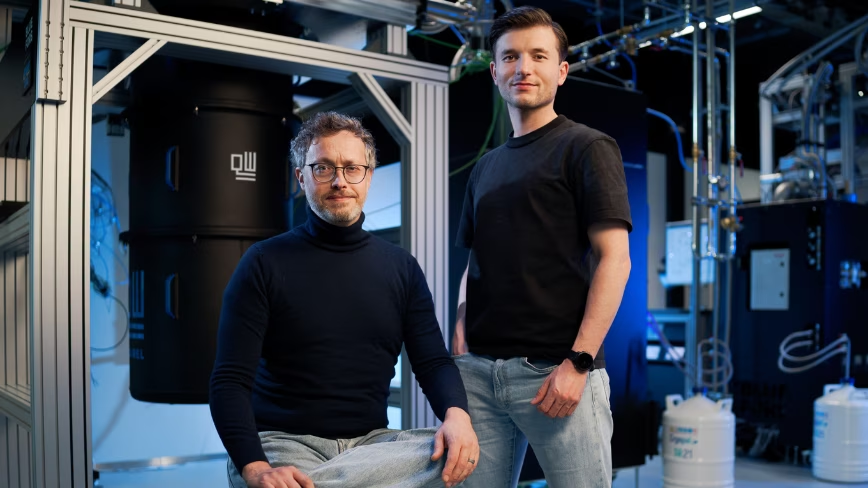
Record Investment for the Future of Quantum Computing
QuantWare, a Dutch deeptech company, has announced the closing of a Series B funding round totaling €152 million. This significant investment marks the largest ever secured by a deeptech company in the Netherlands and the most substantial private funding round for a company solely dedicated to quantum processors. The operation underscores investors' growing confidence in the potential of quantum computing and QuantWare's ability to drive innovation in this emerging sector.
The raised funds will be allocated to the construction of the world's largest open-architecture quantum processor fab, to be located in Delft. This ambitious project aims to solidify QuantWare's position as a key player in providing quantum hardware, a fundamental component for the development and deployment of future advanced computing applications. New investors joining the syndicate include prominent names such as Intel Capital, In-Q-Tel, and ETF Partners, alongside existing backers FORWARD.one and Invest-NL.
The Open-Architecture Strategy and Market Impact
QuantWare's choice of an open architecture for its quantum processors is a distinctive and strategic element. In the context of quantum computing, an open architecture can offer greater flexibility and interoperability, allowing researchers and developers to more easily customize and integrate processors into various frameworks and research pipelines. This approach contrasts with proprietary systems, which often limit configuration options and can lead to technological lock-in for users.
For companies evaluating the adoption of advanced computing technologies, including Large Language Models (LLMs) and other AI workloads, the availability of open-architecture hardware is a crucial factor. It enables greater control over the underlying infrastructure, facilitating performance optimization, security management, and a reduction in the long-term Total Cost of Ownership (TCO). The Delft fab, focused on this philosophy, could therefore become a benchmark for innovation and standardization in the quantum processor sector.
Implications for Infrastructure and Technological Sovereignty
The construction of a quantum processor fab of this scale in Europe has significant implications for the continent's technological sovereignty and digital infrastructure. The ability to locally produce critical hardware reduces dependence on external supply chains and strengthens strategic resilience. This is particularly relevant for sectors requiring high standards of security and data control, such as finance, defense, and scientific research, where air-gapped or self-hosted deployments are often prioritized.
While quantum computing is still in an early stage of development compared to traditional silicio-based AI, investment in such production infrastructure lays the groundwork for future computing capabilities. For CTOs and infrastructure architects, understanding hardware evolution is essential for long-term strategic planning, including the integration of new forms of computing into hybrid or on-premise environments. The availability of quantum processors could, in the future, unlock new possibilities for optimizing complex algorithms and solving problems currently intractable for classical supercomputers.
Outlook and Challenges in the European Deeptech Landscape
The investment in QuantWare is part of a broader context of growth and maturation within the European deeptech sector. The ability to attract such substantial capital for high-risk, long-term projects demonstrates increasing confidence in the continent's innovative ecosystem. However, the path to large-scale commercialization of quantum computing still presents considerable challenges, ranging from qubit stability to system scalability and the availability of adequate software and frameworks.
Despite these challenges, QuantWare's funding represents a fundamental step towards realizing a robust and accessible quantum infrastructure. For those evaluating on-premise deployment of emerging technologies, the creation of local hardware production centers like the Delft fab is a positive sign of a strengthening ecosystem, potentially offering more options and control in the future. AI-RADAR continues to monitor these developments, providing analysis on the trade-offs and constraints companies must consider in their technology adoption strategy.



💬 Comments (0)
🔒 Log in or register to comment on articles.
No comments yet. Be the first to comment!