A model that no longer just generates text
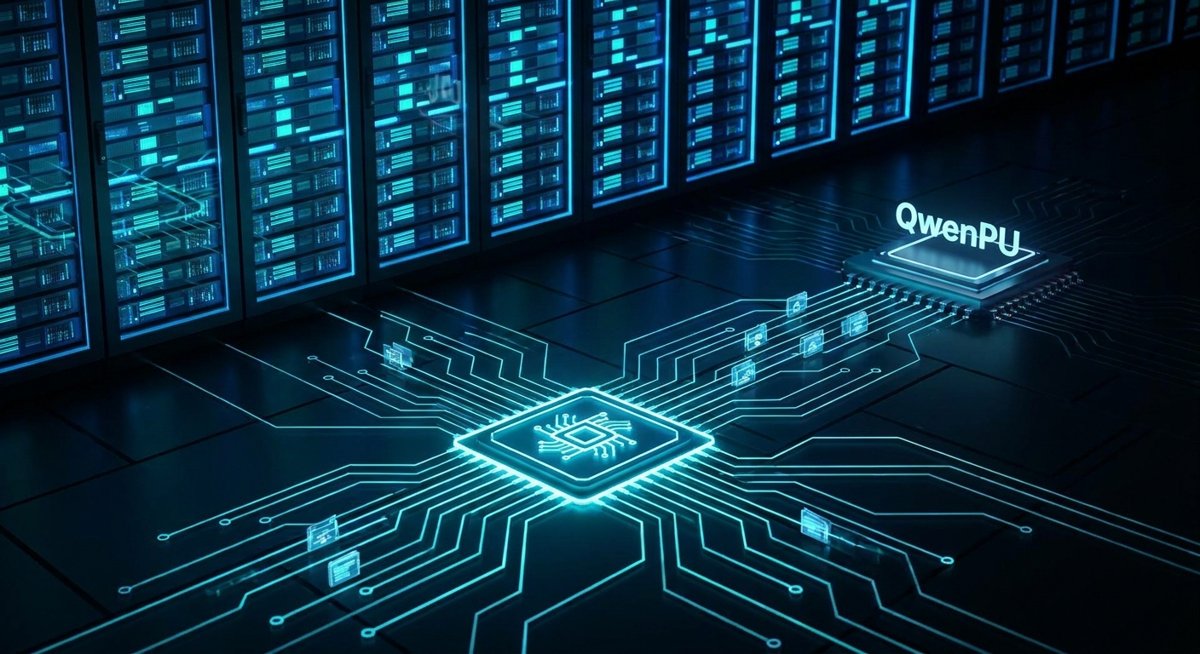
The researcher who previously inserted a RISC-V CPU into the weights of a model has now published QwenPU: an NPU compiled inside Qwen 3.5-4B. This is not an external engine called by the model, but a computing machine encoded as a pattern of activations and weights. When Qwen processes tokens, that NPU exists; when generation ends, it disappears. It is a substantial difference from traditional emulation.
The point is not performance, but the redefinition of the boundary between model and execution platform. A 4-billion-parameter LLM is used as a computational substrate, not only as a text generator. For teams managing self-hosted deployments, every additional component – inference server, NPU runtime, orchestration – expands the attack surface and increases operational complexity. Here the execution logic is embedded in the same model artifact, with no external dependencies.
In a local stack, reducing dependencies has value: fewer processes to update, fewer endpoints to protect, fewer contracts with runtime vendors. But there is a trade-off with model capacity, because the nested system consumes part of the outer LLM's capacity. AI-RADAR observes these compromises when discussing frameworks for on-premise LLMs: the choice is never simply between more or fewer components, but between controllability, isolation, and operational burden.
This experiment signals that open models are becoming general platforms, not just language systems. The fact that stories260k – Andrej Karpathy's small model – runs inside Qwen without external tools indicates that model weights can host executable software. For those building local infrastructure, this changes how to think about updates, rollbacks, and lifecycle management.
Bit-exact: encoded computation, not emulation
The most relevant detail of QwenPU is that stories260k is a C program. To make it run inside Qwen, the author compiled an NPU into the outer model's weights, capable of executing matmul, softmax, and attention bit-exactly. The nested model's matrices reside in Qwen's memory, with no calls to separate runtimes. There is no interpretation layer: computation happens as part of the larger model's operations.
This approach has deep implications for deployment. In a traditional stack, LLM inference requires a server, a hardware acceleration runtime, and orchestration tools. Here, execution logic is compiled directly into the weights. If the outer model is sufficiently deterministic, the nested program can produce results identical to a separate executable. Bit-exact is a strong property: it means we are not talking about a statistical approximation, but verifiable computation.
For a team managing self-hosted models, this property could reduce variability between development and production environments. Weights downloaded from Hugging Face would become both model and runtime. But bit-exact verifiability concerns the result, not the overall behavior: it remains difficult to inspect how computation is distributed across billions of parameters. Complexity shifts from infrastructure to the model itself.
Another point is the absence of separate runtimes. In many on-premise contexts, NPU runtimes are proprietary components or come with specific licenses. QwenPU suggests a path where the open model also embeds execution logic, eliminating the need to install and maintain additional layers. However, it does not remove hardware dependency: you still need a GPU or accelerator with enough VRAM to run the outer model and the nested NPU.
Fewer components, more opacity: the dark side of nesting
The first implication is a reduced attack surface. Fewer servers, fewer APIs, fewer processes: for a regulated environment or one with data sovereignty requirements, every removable component is one less surface to defend. But the second implication is second-order: a system nested inside weights is less inspectable than a separate executable. Audit and maintenance change nature.
Those who must ensure compliance of a self-hosted model today can examine runtime code, containers, and dependencies. With QwenPU, the executed program is distributed in the weights. There is no binary file to sign, no repository to clone, no build pipeline to verify. The logic exists only during inference: when the model is not processing tokens, the NPU is not observable. This makes it harder to understand what actually happens inside the system.
The trade-off is clear. On one hand, it eliminates the need to maintain a separate runtime, with its security updates and known vulnerabilities. On the other, it shifts the trust problem to the model itself. Weight provenance becomes even more critical: downloading a model from a public repository means accepting not only its outputs, but also the code it might execute internally.
For organizations operating in sectors with strict audit requirements, this evolution raises an uncomfortable question: how do you certify a model that is also a computer? Documentation can describe the architecture, but it cannot make the distribution of computation across parameters transparent. Until specific inspection tools emerge, adoption of nested systems will remain limited to contexts with high risk tolerance or formal verification capabilities.
Weights as a software distribution vector
Today stories260k is an experiment. Tomorrow the same pattern could encapsulate compliance filters, parsers, or small automations inside self-hosted models, without additional containers. This is the second implication: open model weights become a distribution vector for software that runs only during inference.
For those managing local stacks, the appeal is evident. Instead of deploying a separate microservice for data filtering or post-processing, one could update the model and get the new logic as well. The release cycle shrinks: a single artifact to version, sign, and distribute. Data sovereignty benefits because the logic does not need to leave the inference perimeter.
But this distribution model also carries risks. A payload nested inside weights is harder to isolate or disable. If the embedded software has a bug or vulnerability, the remedy is not updating a container, but replacing the entire model, with regeneration or re-download costs. Maintenance changes: one no longer manages a catalog of services, but an ecosystem of models that may contain hidden or obsolete functionality.
The lack of transparency is a supply-chain security problem. When we download a model from Hugging Face, today we evaluate benchmarks, license, and provenance. Tomorrow we will also need to ask what it executes internally. This shifts the center of trust from the runtime to the weight producer and opens the door to new audit approaches specific to self-executable models.
Hardware, TCO, and who really benefits
QwenPU does not only change software architecture: it shifts computational cost. A 4-billion-parameter LLM already consumes resources; making it run another model bit-exactly moves cost from managing separate services to the single inference session. For an on-premise team, TCO does not necessarily decrease: licenses and orchestration shrink, but load on GPU, VRAM, and compute time increases.
Who benefits from this approach are those with strong sovereignty and isolation constraints. In air-gapped or regulated environments, eliminating an external runtime can simplify certification and reduce the number of components to maintain. But the operational gain must be compared with the loss of controllability: if something goes wrong, you cannot intervene on a separate module. You must regenerate or replace the weights.
For teams currently evaluating self-hosted deployments, QwenPU is a signal to monitor rather than a ready technology. Full documentation is still in progress, and the author himself indicated that optimizations and size reductions are underway. Its current value is conceptual: it shows that the boundary between model and platform can be crossed without introducing external components.
In the broader AI infrastructure picture, this experiment fits a convergence trend: more functions are absorbed by models, reducing the number of specialized machines. But convergence does not eliminate trade-offs; it shifts them. The choice between a separate runtime and a nested NPU is not neutral: it changes risk profile, audit costs, and the skills needed to manage the system.
What to watch in the coming months
The first signal to monitor is the release of complete documentation. The author said he is ill and that the material is still in progress. The demonstration is public, but the full reasoning will come later. When it arrives, it will be important to understand how matrices are distributed in the weights and what constraints they impose on the outer model's precision and size.
The second signal is community reaction. If other researchers manage to replicate the experiment with different models or encapsulate more complex workloads, QwenPU will stop being a curiosity and become an architectural pattern. Conversely, if compilation complexity remains prohibitive, it will remain a proof of concept.
The third signal concerns inspection tools. Today there are no simple ways to verify whether an open model contains nested code. The emergence of techniques to extract or analyze these payloads will indicate the phenomenon's maturity. Without audit tools, adoption in regulated environments will stay limited.
Finally, the underlying question remains open: if an LLM can run another LLM, when does it stop being a model and become a computer? For those building local stacks, the answer is no longer theoretical. QwenPU is not a ready solution, but a signal that the next layer of AI infrastructure may not be a new runtime, but the ability of weights to take charge, autonomously, of their own execution.


💬 Comments (0)
🔒 Log in or register to comment on articles.
No comments yet. Be the first to comment!