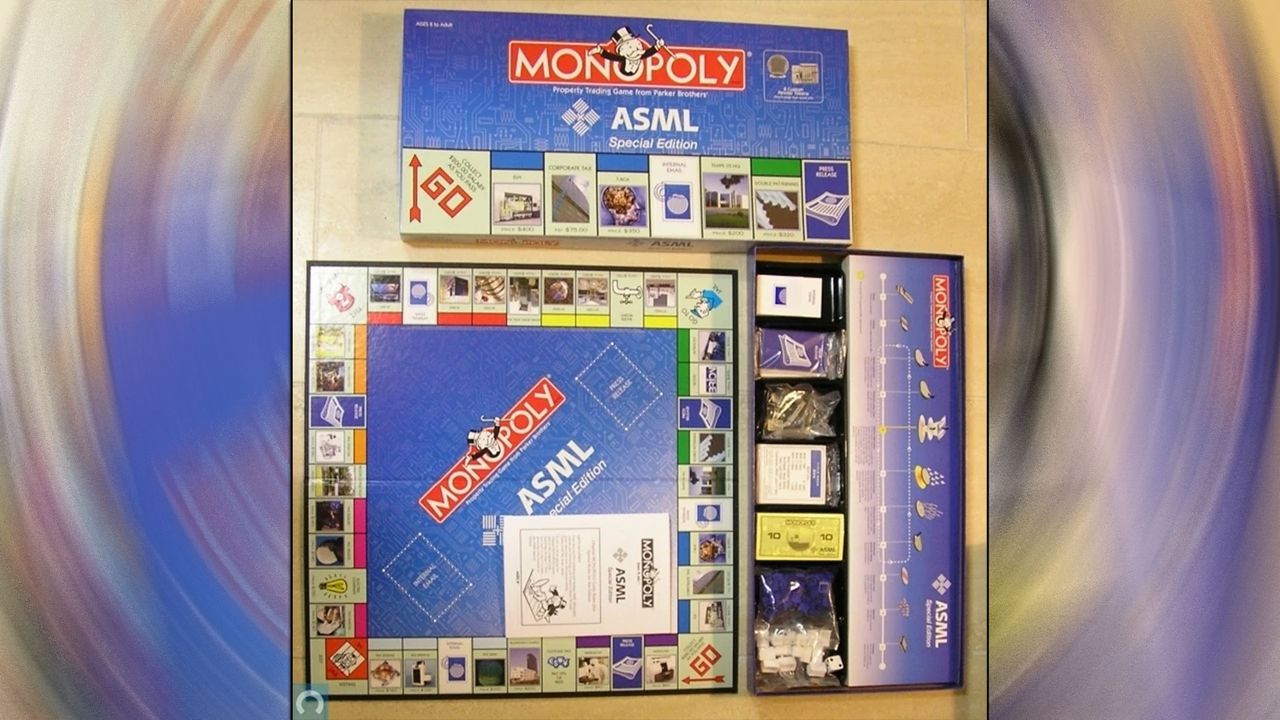
A piece of corporate history resurfaced in the less-traveled corners of tech social media: an extremely rare special edition Monopoly board, distributed by ASML to its employees in 2007, was offered and traded on a social platform for a LEGO kit of the company’s High‑NA EUV lithography system. The swap is more than a quirky barter between enthusiasts – it mirrors a tech culture that celebrates and mythologizes the physical building blocks of digital innovation.
From Monopoly to the future of semiconductors
ASML might not appear inside any data center, yet without its machines there would be no GPUs for training and serving Large Language Models. The Dutch company is the sole supplier of extreme ultraviolet (EUV) lithography scanners, a process that etches circuits onto silicon wafers with a precision smaller than the wavelength of visible light. The commemorative 2007 Monopoly set belongs to an era when EUV was still a pioneering project; after more than a decade, that technology has given birth to High‑NA EUV, the next generation capable of pushing resolution even further, shrinking transistors to a few tens of atoms across.
The counterpart in the trade, a LEGO High‑NA EUV kit, is no mere toy: it reproduces in scale the colossal EXE:5000, the first commercial High‑NA system – a 150‑ton behemoth that ASML is now delivering to Intel and other chip giants. For the tech insiders’ community, owning its LEGO version is like safeguarding a symbol of the coming era of processors.
EUV lithography and its impact on AI hardware
The connection to on‑premise artificial intelligence is direct and tangible. Chips such as NVIDIA H100s, B200s or AMD Instinct, which are the backbone of inference and fine‑tuning for self‑hosted LLMs, are built with manufacturing processes entirely dependent on ASML’s EUV lithography. The adoption of High‑NA EUV promises denser process nodes (beyond 2 nm), meaning more transistors per die, higher VRAM bandwidth, and better energy efficiency. For anyone evaluating the Total Cost of Ownership of an on‑premise cluster, each foundry generational leap translates into either a lower cost per token or a greater compute density per watt.
It is no coincidence that bottlenecks in ASML’s supply chain – Zeiss lens delivery times, assembly complexity – are watched with the same attention as NVIDIA’s roadmaps. Delays in High‑NA EUV adoption directly affect the availability of advanced silicon and, in turn, the upgrade timelines of on‑premise infrastructure.
What it means for those choosing self‑hosted infrastructure
Anyone designing a local deployment of generative models knows that hardware choice is never neutral. A platform with 512 GB of VRAM and NVLink 4.0 can sustain low‑latency inference workloads without resorting to third‑party clouds, preserving sovereignty and data control. The arrival of processors manufactured with High‑NA EUV could bring doubled memory density on the same package, accelerating the adoption of air‑gapped solutions in regulated sectors such as finance or healthcare, where GDPR compliance and data residency requirements make the cloud a challenging path.
At the same time, the unit cost of each wafer lithographed with High‑NA is steep, and the generational shift will not happen overnight. The market is watching a delicate equilibrium: will the technology mature quickly enough to impact the price of GPUs destined for on‑premise clusters? The answer will come in the next 24‑36 months, when the first production volumes emerge from Intel and TSMC fabs equipped with the new scanners.
Tech culture and symbolic value
Returning to the swap, the story reveals something subtler: a community that cherishes physical artifacts of the tech industry as testimony to an evolutionary path. The 2007 ASML Monopoly, surviving nearly twenty years in a box, and the LEGO High‑NA EUV kit, available only through internal channels, condense the same promise: that mastery of matter at the atomic level is the key to tomorrow’s artificial intelligence. And in an era where every generated token rests on increasingly extreme lithographies, even a board game can remind us of that.







💬 Comments (0)
🔒 Log in or register to comment on articles.
No comments yet. Be the first to comment!