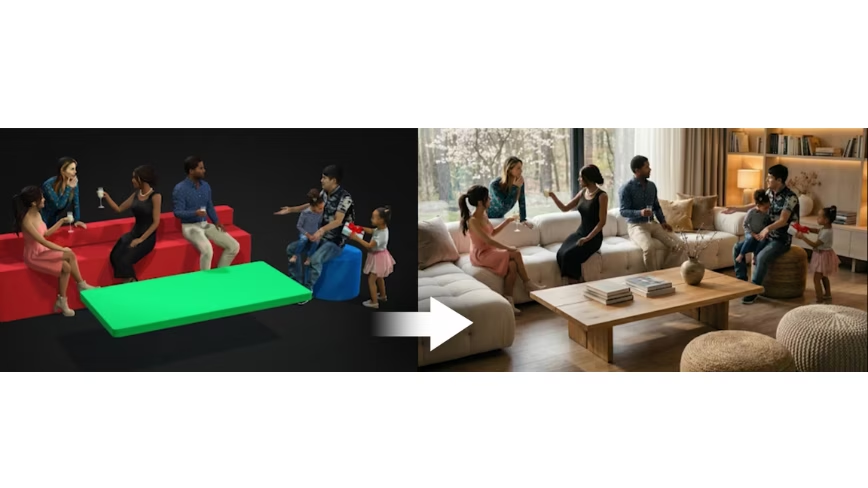
Reallusion AI Studio: A Bridge Between Traditional 3D and Generative AI
Reallusion, a company known for its 3D animation software such as iClone and Character Creator, has introduced AI Studio, a new production platform. This initiative aims to merge the established practice of 3D scene-building with the emerging capabilities of generative artificial intelligence models for video creation. Central to this offering is a direct integration with ByteDance’s Seedance 2.0, a model that ranks at the top of Artificial Analysis's leaderboard in the AI-generated video sector.
Reallusion's value proposition is clear: to enable 3D artists to take a direct directorial role over AI models. This approach seeks to overcome the limitations often encountered with text prompts alone, offering more granular control and greater creative fidelity for professional filmmaking productions.
The Role of Generative AI in Video Production and Technical Challenges
The integration of generative AI models into the video production pipeline represents a significant evolution. While text prompts offer a quick starting point, their ability to maintain visual consistency, style, and narrative control over complex video sequences can be limited. Reallusion's approach, which allows artists to "direct" AI through pre-built 3D scenes, aims to address these issues, ensuring greater creative control and better quality of the final output.
However, running advanced AI video models like Seedance 2.0 entails substantial computational requirements. These models, often based on complex architectures, demand significant hardware resources, particularly in terms of VRAM and GPU compute capabilities, to ensure acceptable throughput and latency. Optimization for inference, including quantization, becomes crucial to balance performance and operational costs, whether in cloud or self-hosted environments.
Implications for On-Premise Deployments and Data Sovereignty
For companies in the video production sector considering the adoption of platforms like AI Studio, important deployment considerations arise. The use of leading AI models, especially when handling sensitive data or intellectual property, raises questions of data sovereignty and regulatory compliance. The choice between a cloud deployment and an on-premise or hybrid solution depends on a careful evaluation of TCO, security, and data control.
An on-premise deployment, while requiring an initial investment in infrastructure (GPUs, storage, networking), can offer advantages in terms of direct environmental control, data security, and potential reduction of long-term operational costs for intensive workloads. The ability to perform inference locally, even in air-gapped environments, is a decisive factor for sectors with stringent privacy and security requirements. For those evaluating on-premise deployments, AI-RADAR offers analytical frameworks on /llm-onpremise to assess the trade-offs between costs, performance, and control.
Future Prospects and the Evolution of AI-Driven Filmmaking
Reallusion's initiative with AI Studio marks a significant step towards a future where artificial intelligence is not limited to generating content from scratch but acts as a powerful tool in the hands of creative professionals. The ability to combine the precision of traditional 3D with the speed and versatility of generative AI could redefine production pipelines, accelerating timelines and reducing costs while maintaining high quality standards.
Future challenges will include further optimization of models for hardware efficiency, the development of increasingly intuitive user interfaces, and scalability management for large-scale productions. The evolution of platforms like AI Studio highlights the growing need for robust and flexible infrastructures capable of supporting complex AI workloads, both in development and final production contexts.


💬 Comments (0)
🔒 Log in or register to comment on articles.
No comments yet. Be the first to comment!