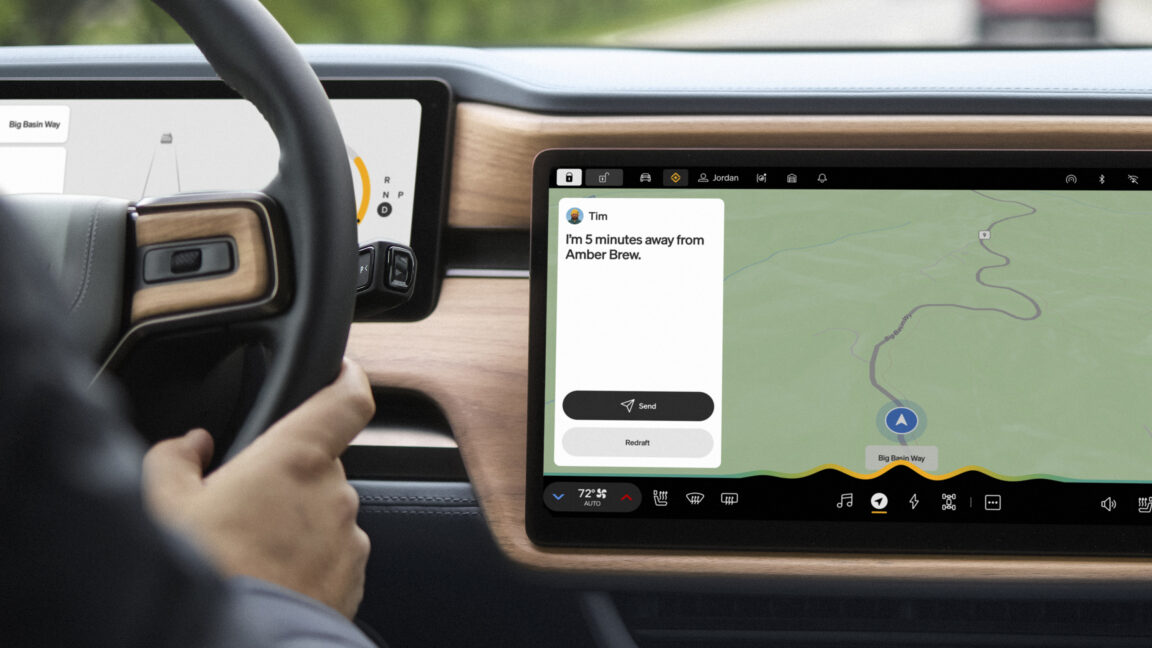
The Evolution of Rivian's Vehicle Software
Rivian has quickly established itself as a leader in the automotive industry regarding in-vehicle software. Its clean-sheet approach to electric vehicle electronic architecture attracted a $5 billion investment from the Volkswagen Group, highlighting confidence in its technological capabilities. Rivian's in-house infotainment system is highly regarded by owners, despite the company having no plans to support phone mirroring through Apple CarPlay or Android Auto.
In this context, Rivian has now introduced a new AI-powered digital assistant with its latest software update. This strategic move aims to bridge the gap left by the absence of mirroring functionalities, which would otherwise allow hands-free use of voice assistants like Siri or Google Assistant while driving. The integration of its own AI assistant further reinforces Rivian's vision of maintaining end-to-end control over the in-vehicle digital experience.
Technical Details and Rivian Assistant Features
The Rivian Assistant was rolled out with software update 2026.15 and is available to all owners with a subscription or trial for Connect+, Rivian's connectivity services suite. Compatibility extends to both older Gen1 Rivian models (model-year 2024 and older) and the more recent Gen2 models, ensuring broad adoption of the new feature.
Activating the assistant follows common patterns for digital voice systems: it can be invoked via a button on the steering wheel, a dedicated icon on the infotainment display, or through specific trigger phrases such as "Hey Rivian" or "OK, Rivian." The AI's deep integration into the car's systems is a key aspect, suggesting that the assistant is not limited to simple voice commands but can interact meaningfully with the vehicle's specific functions and data, offering a cohesive and personalized user experience.
Implications for AI Deployment at the Edge
The implementation of an AI assistant directly onboard a Rivian vehicle represents a significant example of artificial intelligence deployment at the edge. This approach, which involves running AI models directly on the end device rather than on remote cloud servers, offers several crucial advantages for the automotive sector. These include reduced latency, essential for immediate responses in driving contexts, and ensuring data sovereignty, as sensitive information can be processed locally without needing to travel over external networks.
For companies evaluating AI solutions, edge deployment entails a series of trade-offs. While it provides greater control and can address more stringent compliance requirements, hardware constraints must be considered. Vehicles, despite becoming increasingly powerful, have limited computational resources and VRAM compared to data centers. This necessitates optimizing Large Language Models (LLM) or other AI models through techniques like Quantization to ensure adequate efficiency and performance in resource-constrained environments. Rivian's choice of a self-hosted deployment highlights a strategy aimed at maximizing autonomy and user experience customization.
Future Prospects and Ecosystem Control
Rivian's decision to develop and integrate its own AI assistant, rather than relying on third-party solutions like Apple CarPlay or Android Auto, reflects a clear strategy of controlling the entire vehicle's software ecosystem. This approach allows Rivian to customize the user experience more deeply, integrating the AI directly with specific vehicle functionalities and potentially offering capabilities that mirroring solutions could not match.
For technical decision-makers, this strategy highlights the value of a proprietary architecture and control over one's technology stack. Although in-house development requires significant investment, as demonstrated by Volkswagen's interest, it offers flexibility, security, and the potential for market differentiation. The Rivian Assistant is not just a new feature, but a fundamental building block in the company's vision for a connected and intelligent driving experience, managed entirely at a local level.




💬 Comments (0)
🔒 Log in or register to comment on articles.
No comments yet. Be the first to comment!