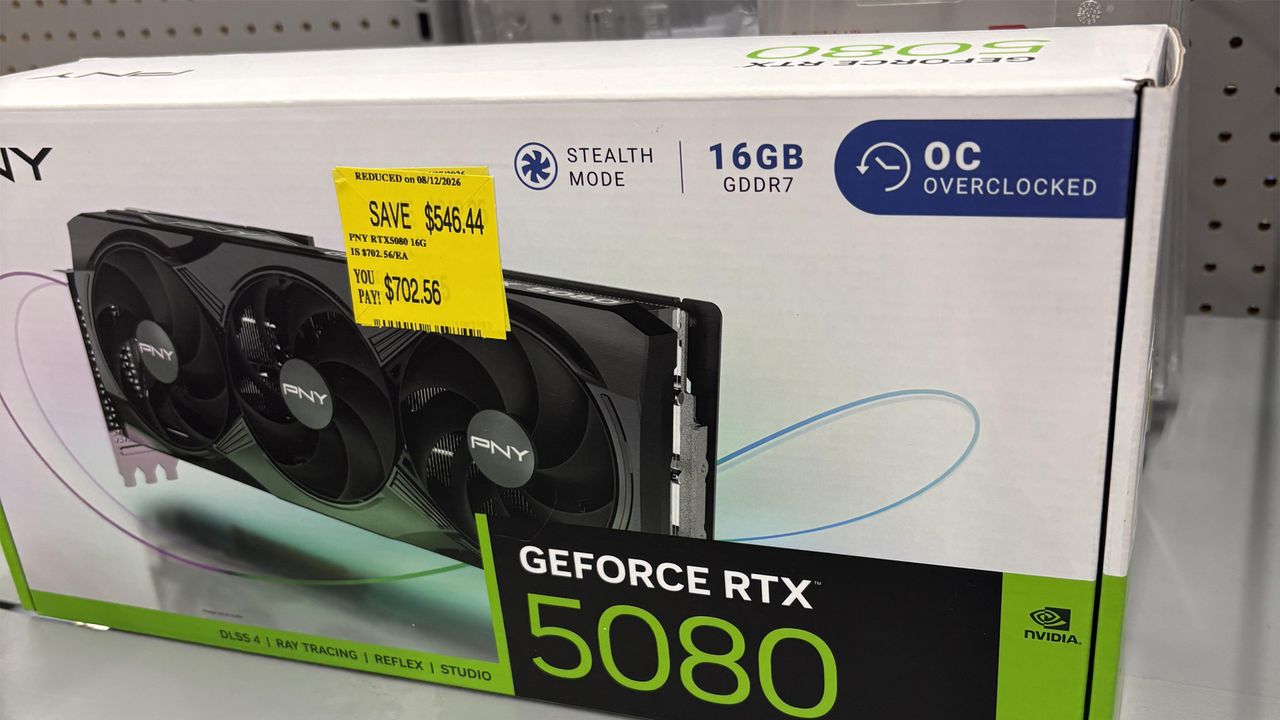
A lucky shopper walked out of a Walmart with a GeForce RTX 5080 for $702, saving nearly $800 compared to current retail prices. Taken alone, that sounds like a bargain-hunting story. But for anyone building local LLM inference nodes, that number is a market thermometer.
The RTX 5080 is one of the most sought-after consumer cards for running language models without server-grade infrastructure. When street prices approach $1,500, as the reported savings suggest, every machine destined for self-hosted inference becomes an investment to scrutinize. A unit at $702 flips the calculation: the cost of silicon drops below the psychological threshold that makes a small local cluster worthwhile compared to renting GPUs in the cloud.
The point is not the deal itself, but the distance between official pricing and what the market actually charges. If a buyer can find the same card at less than half the price, it means the retail channel is applying a premium with no technical justification, only speculative pressure. This creates a perverse incentive: teams planning on-premise deployments cannot do predictable budgeting because hardware costs fluctuate erratically. The winners are deal hunters and those with time to monitor listings and stock. The losers are organizations that need to make fast purchasing decisions or cannot afford to wait for a lucky break.
There is a second-order consequence. Inflation on consumer GPU prices pushes many evaluators toward cloud APIs, which seem simpler because they turn CapEx into OpEx. But that shortcut comes at a cost in data sovereignty and control. The occasional availability of honestly priced hardware, as in the Walmart case, reopens the door to the self-hosted option, especially for small teams and independent researchers who do not need industrial clusters but only one or two cards to run inference on quantized models.
The third level of reading concerns market structure. If the retail market tolerates such inflated prices, it is because demand for local LLM compute is inelastic enough to accept them. But every downward price anomaly acts as a test: it shows there is a segment of buyers ready to purchase as soon as the price drops, signaling to vendors that demand is not infinite. In the long run, this can encourage a price correction or push manufacturers to differentiate consumer lines from professional ones, leaving the former mainly for gaming and limiting the temptation to use them for artificial intelligence workloads.
The story of the lucky Walmart customer is not just an anecdote. It is proof that the real cost of a GPU for local inference can be much lower than the market wants you to believe. For those evaluating on-premise deployments, that gap is both a risk and an opportunity: today TCO depends more on procurement skill than on technical specifications.





💬 Comments (0)
🔒 Log in or register to comment on articles.
No comments yet. Be the first to comment!