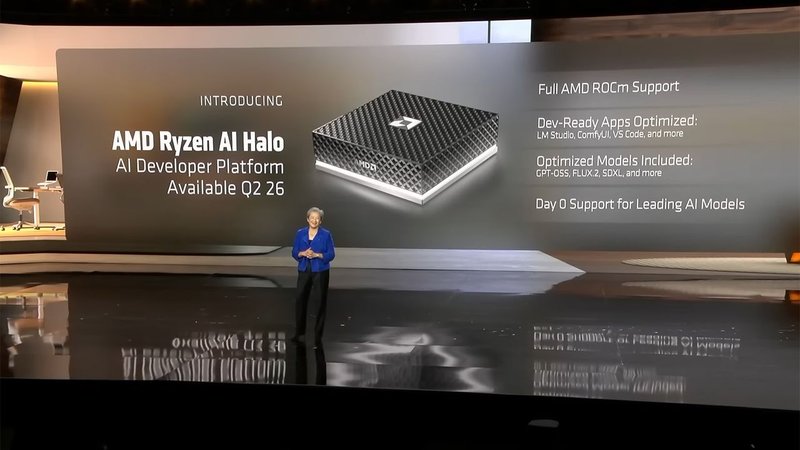
Last week saw the first shipments of the AMD Ryzen AI Halo mini PC, a compact machine built around the powerful Ryzen AI Max+ processor with integrated CPU, GPU, and NPU cores. What catches the attention of a certain developer niche isn't the NPU teraFLOPS or memory bandwidth, however, but a surface-level hardware detail: the driver for the RGB LED strip has yet to be merged into the mainline Linux kernel.
Known as 'Strix Halo', this SoC is AMD's most aggressive push for on-premise AI computing in a small form factor. Designed for workstations, mini PCs, and eventually laptops, it promises to run large language models entirely locally, slashing cloud costs and putting data control back in the user's hands. Such a device appeals to those developing sensitive applications—from healthcare data analysis to industrial automation—where latency and data sovereignty are non-negotiable.
Out-of-the-box Linux support, via the 'Ryzen AI Developer Platform' Debian-based OS, is solid. But anyone who prefers to run their own standard x86_64 distribution with a vanilla kernel from kernel.org finds the shiny LED strips remain dark. The driver to control them, though available as an external patch, hasn't been proposed for mainline merging yet. Sources close to the project say the code is under review and will be submitted for inclusion soon.
The news might seem cosmetic, but in the Linux world, mainlining a driver is a serious step. It means the manufacturer commits to maintaining the code according to upstream kernel rules, rather than leaving it in a separate branch that risks breakage with every release. For the local AI ecosystem, where long-term stability is critical, hardware that relies on 100% mainline components becomes more attractive to enterprises planning multi-year deployments. It's no coincidence that AMD GPU support followed the same path: open, mainline-integrated drivers built the trust that today leads many sysadmins to choose Radeon for inference servers.
Looking at the bigger picture, the Ryzen AI Halo mini PC embodies the growing tension between cloud and local compute in artificial intelligence. While major model providers continue to push centralized APIs, the arrival of powerful APUs like Strix Halo challenges the economic and operational assumptions. Those spending hundreds of thousands on cloud GPU time could save by migrating to a fleet of these small machines, provided the software is sound and there are no kernel compatibility surprises. An RGB driver may seem trivial, but it's the final piece of a puzzle that, once complete, will give developers a reliable open-source platform to work with LLMs at arm's reach, without privacy compromises.
AMD has a chance to solidify an edge: while NVIDIA offers discrete, datacenter-optimized solutions, the Sunnyvale giant bets on deep integration, where GPU and NPU share the same CPU package, lowering TCO for the edge. That the RGB LED driver is the last to enter the kernel is almost poetic—the most visible things are often the easiest to postpone—but the signal is clear. AMD is closing the loop.
In the coming days, patches are expected to appear on the linux-kernel mailing list; the open-source community will watch closely, because every approved change is another brick in a mature, independent local AI infrastructure.




💬 Comments (0)
🔒 Log in or register to comment on articles.
No comments yet. Be the first to comment!