When a construction site grinds to a halt over unpaid invoices, the damage isn’t measured in bricks alone. It shows up in missed payroll, sudden layoffs, and small-business owners working without pay just to keep the lights on. For the fourth year running, the UK construction sector has recorded more insolvencies than any other industry: 4,450 firms in 2025, with another 1,180 in Q1 2026. The culprit is rarely a lack of work; it’s the uncollectible credit that piles up across an opaque, fragmented chain of subcontracts.
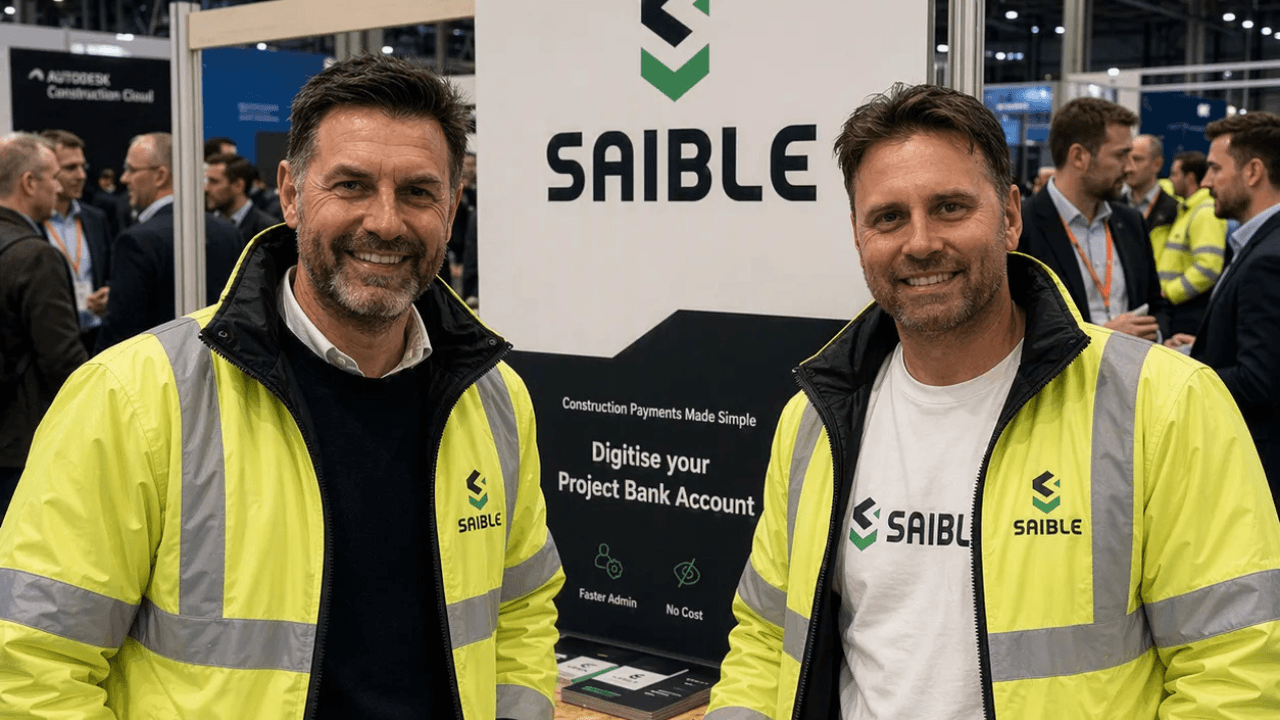
Saible, a UK-based fintech, has just raised £2.9 million from angel investors – £2.1 million already in the bank and a further £800,000 in this round – to scale a payment infrastructure designed to break that spiral. At its core is the Digital Parallel Payment Account (DiPPA): a mechanism that sends money directly from the project owner to every approved firm, across every tier of the supply chain, at the same moment. No cascading flow from contractor to subcontractor; no forced pauses while the tier above passes on the funds. The platform handles approvals, verification and audit trails; the cash sits in a trust with regulated banking partner Griffin.
The entire cost falls on the project owner – a 0.25% fee on the payment value. For the firms doing the work, it’s zero. That’s a radical shift, given that on large projects four or five tiers separate the owner from the smallest supplier, and at each step money can be held back as free credit – or may never arrive, as happened when ISG collapsed in 2024 leaving more than £1.1 billion in unpaid debts.
Saible is already running two public-sector pilots with the Environment Agency and BAM Nuttall. The first, a footbridge replacement worth £1.5–2 million, is due to begin in summer 2026. The initiative grew out of a Cabinet Office-sponsored working group and aims to generate hard data on payment visibility, actual timing and supply-chain reach.
Why this story speaks to the world of AI
The construction industry’s payment architecture is an extreme case of a dynamic familiar to anyone tracking data sovereignty and control: a system where the power to release or withhold value is concentrated in a few intermediary nodes, and the weakest suppliers pay the price of someone else’s liquidity. When we talk about on-premise LLM deployment or self-hosted inference pipelines, the vocabulary differs but the underlying structure is the same. A complex project involves data providers, model builders, integrators, hardware suppliers – and whoever holds the budget can stretch payment timelines, suffocating innovation downstream.
Saible’s answer – a parallel digital account with automatic, auditable release rules – embodies a principle of financial granularity and transparency that the AI world, increasingly obsessed with TCO, open source and technological self-determination, will at some point have to absorb. This is not an isolated case: growing attention to software supply chains, the proliferation of model and compute marketplaces, and demands for contractual guarantees on payment timing all signal that the problem is structural.
The lesson from construction is that without payment mechanisms that bypass intermediaries, financial disasters are cyclical and always hit the most exposed. Translated into the AI domain, it means that without comparable infrastructure – not necessarily bank accounts, but perhaps smart contracts or settlement platforms that tie fund releases to verifiable deliverables – the risk is building a brittle ecosystem where a few large players dictate the pace and niche suppliers (specialized data, annotation services, on-premise model hosting) get crushed. Saible doesn’t solve AI, but it points to a direction of travel: control over payments is a form of sovereignty, and anyone evaluating autonomous deployment strategies must factor the cost of financial dependency on a single client into their TCO calculations.
A limited £50,000 equity crowdfunding round on Crowdcube (15–31 July, reserved for smaller construction firms) is the final piece of a design that seeks consensus from the bottom up. It’s a signal that the real contest isn’t only about banking protocols, it’s about the willingness to redistribute bargaining power along the entire value chain – whether it’s made of reinforced concrete or Transformer layers.










💬 Comments (0)
🔒 Log in or register to comment on articles.
No comments yet. Be the first to comment!