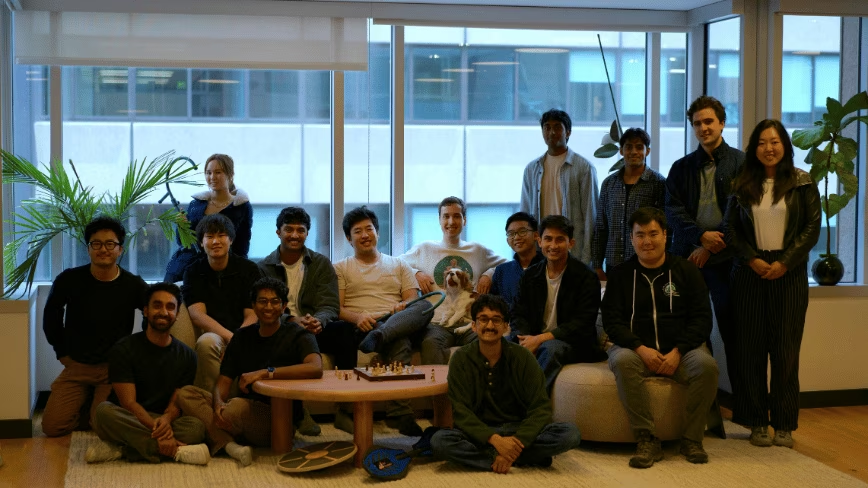
Let an AI agent run for hours and it can burn through billions of tokens. In a world where autonomous assistants start handling emails, bookings, and complex workflows, this hunger for computation poses a significant economic bottleneck. Sail Research, a startup built on top-tier engineering talent, has just raised $80 million to flip the script. Its promise: serve tokens at up to ten times lower cost than current standards.
The invisible appetite of agents
Unlike a single chatbot query, an AI agent can chain dozens or hundreds of calls to an LLM to plan, execute, and verify a task. Every step consumes tokens, and multiplied over weeks or months, the inference bill grows exponentially. Without optimization, both cloud and on-premise infrastructure face bills that are hard to sustain—especially when data must remain under the company’s direct control for privacy or sovereignty reasons.
An $80 million bet
Sail hasn’t yet shared the technical details of its platform, but the founders’ résumés—engineers from Apple and NVIDIA—point to an approach that blends software and potentially deep runtime optimization. Achieving a tenfold efficiency gain in token serving hints at custom compute kernels, aggressive quantization, or dynamic batching techniques.
For IT decision-makers, any reduction in per-token cost directly improves the TCO of self-hosted deployments. Serving fewer tokens—or achieving the same throughput at a lower price—means more compact hardware sizing and a faster break-even point between on-prem operations and consumption-based cloud services.
The on-premise node and data control
If Sail’s technology delivers on its promise, it could remove one of the main obstacles to on-premise AI agent adoption: the fear that operational costs will become unsustainable. Companies in regulated sectors or those handling sensitive data—healthcare, finance, manufacturing—would find it easier to justify local infrastructure investments, keeping tokens and associated information away from third-party servers. The 10x efficiency promise is also a compliance lever: at accessible costs, self-hosting stops being a luxury and becomes a pragmatic choice.
At AI-RADAR we regularly analyze the trade-offs such announcements entail: no optimization, however brilliant, can bypass hardware choices and the maturity of serving software. Whether Sail becomes available on open stacks or in an on-premise delivery model will be the real test.
The race for LLM sustainability
The $80 million round isn’t just a milestone for a startup—it signals a market that has realized the era of autonomous agents requires a new economic foundation. With ever more capable LLMs and extended context windows, the bottleneck shifts from model quality to the feasibility of operating costs. Sail enters a field already crowded with open-source projects like vLLM and llama.cpp, but with a commercial ambition that could accelerate progress if the technology is made available for private, controlled environments.








💬 Comments (0)
🔒 Log in or register to comment on articles.
No comments yet. Be the first to comment!