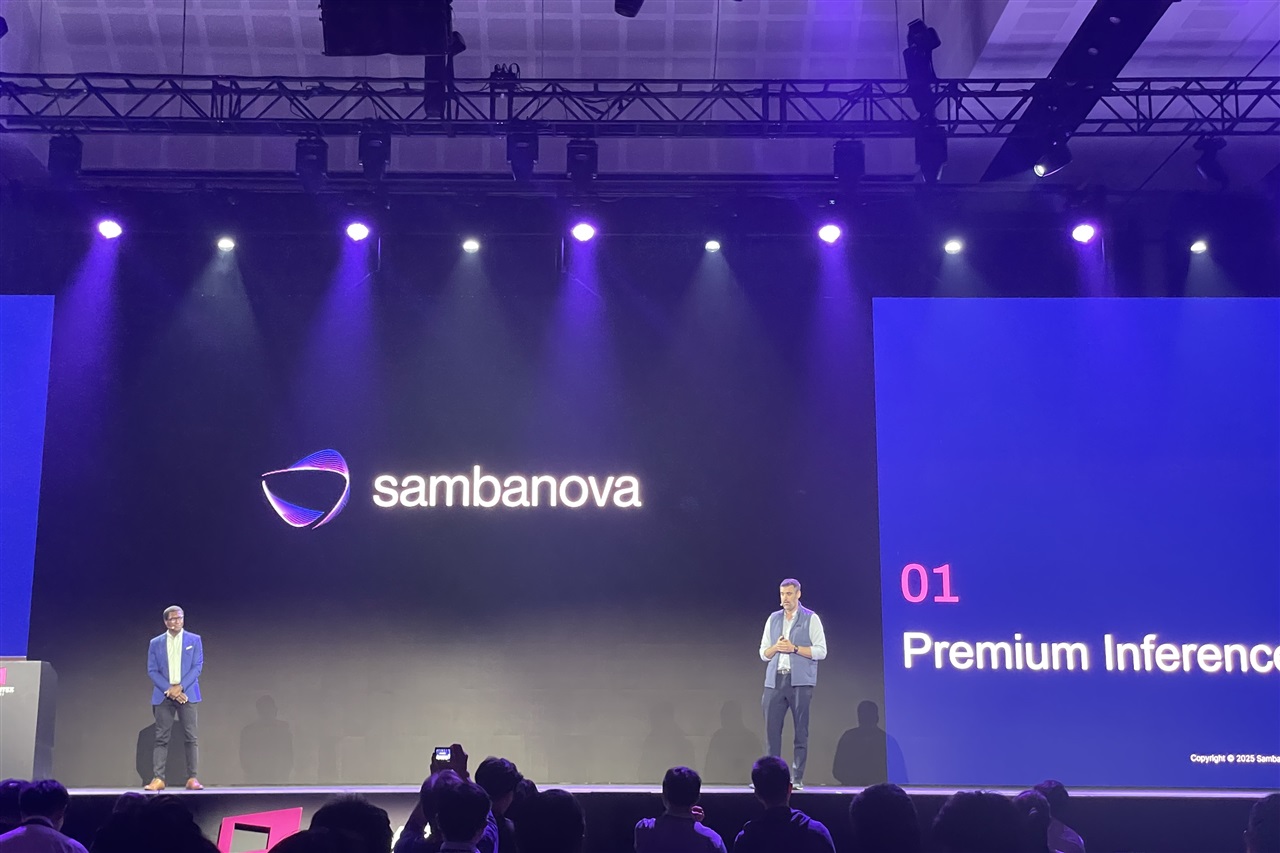
Sambanova and the Challenge to AI Inference
At the recent Computex event, Sambanova captured the attention of the tech industry by announcing its intention to challenge the established dominance of GPUs in AI Inference. This declaration marks a significant moment in a rapidly evolving market, where the demand for efficient computing capabilities for Large Language Models (LLM) is constantly growing. Sambanova's objective is to propose alternative hardware solutions that can offer specific advantages for inference workloads, a crucial aspect for the widespread adoption of artificial intelligence.
Traditionally, GPUs, particularly those from NVIDIA, have served as the backbone for training and inference of AI models. However, the emergence of increasingly complex LLMs and the need to perform inference cost-effectively and with low latency are pushing companies to explore more specialized hardware options. Sambanova's proposal fits into this context, seeking to capitalize on perceived inefficiencies in general-purpose GPU architectures when applied to specific AI inference patterns.
The AI Inference Landscape and Hardware Alternatives
AI Inference, the process of using a trained model to generate predictions or responses, is a critical and often costly phase of the AI lifecycle. With the explosion of LLMs, companies face the challenge of managing increasing volumes of requests, with stringent requirements for throughput and latency. While versatile, GPUs are not always the most optimal solution for every inference scenario, especially for highly specific workloads or deployments with energy and cost constraints.
This is where specialized AI accelerators come into play. These chips are designed with architectures optimized for typical neural model operations, such as matrix multiplication and function activation, often with an emphasis on reduced precision (e.g., INT8 or FP8) to maximize efficiency. The goal is to offer a superior performance-per-watt ratio and a better TCO (Total Cost of Ownership) compared to general-purpose GPUs for certain inference workloads, although they sometimes require a specific software ecosystem and Deployment tools.
Implications for On-Premise Deployments
For organizations evaluating on-premise, self-hosted, or air-gapped deployments, the emergence of alternatives to traditional GPUs is of paramount importance. Hardware choice directly impacts data sovereignty, compliance, security, and, naturally, the overall TCO of the AI infrastructure. Solutions like those proposed by Sambanova can offer greater control over hardware and software resources, reducing reliance on external cloud providers and enabling deeper customization of the technology stack.
Evaluating these options requires a thorough analysis of specific workload requirements, including the LLM models to be run, context window sizes, supported Quantization levels, and expected throughput and latency. For those evaluating on-premise deployments, AI-RADAR offers analytical frameworks on /llm-onpremise to compare the trade-offs between different hardware architectures, considering factors such as available VRAM, memory bandwidth, and energy efficiency. The ability to choose optimized hardware can lead to significant long-term savings and greater operational agility.
Future Prospects and Trade-offs in the AI Hardware Market
Sambanova's challenge at Computex is indicative of a broader trend in the AI hardware market: diversification. While GPUs will continue to play a crucial role, particularly for training large models, the inference segment is becoming a battleground for more specialized solutions. This scenario offers technology decision-makers a wider range of options, but also the need to navigate complex trade-offs.
The choice between general-purpose GPUs and dedicated AI accelerators is not trivial and depends on multiple factors: initial budget (CapEx), operational costs (OpEx), software ecosystem maturity, ease of Deployment, and scalability. A company's ability to integrate and manage these new architectures will be a key factor in determining the success of its AI projects. The market is set to remain dynamic, with continuous innovations promising to improve the efficiency and accessibility of AI Inference.







💬 Comments (0)
🔒 Log in or register to comment on articles.
No comments yet. Be the first to comment!