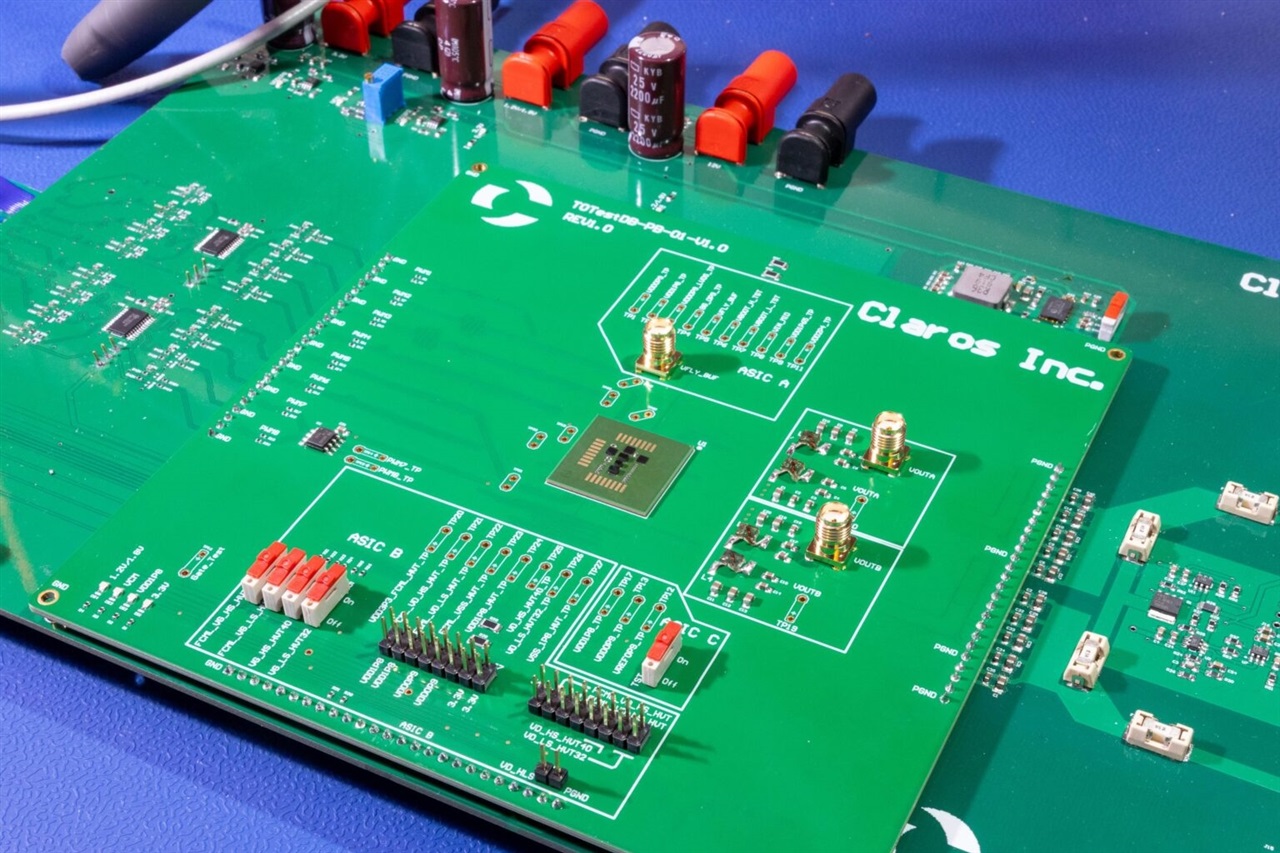
Samsung Foundry announced it will manufacture power-management chips for AI data centers designed by Claros. The news, seemingly niche, highlights a strategic piece: without efficient power delivery, the race to LLMs risks hitting physical and economic limits.
Why AI workloads are energy-hungry
Training and serving Large Language Models (LLMs) is power-intensive. Inference at scale, with thousands of requests per second, turns data centers into digital furnaces. Computation concentrates on GPUs, VPUs, and custom accelerators, but the power infrastructure – conversion, regulation, distribution – directly affects Total Cost of Ownership (TCO). An inefficient power-management chip means extra heat, requiring additional cooling and raising overall consumption, which erodes margins and undermines sustainability.
The role of Samsung Foundry and Claros
Claros designs power-management solutions targeting high density and precision, essential when every watt matters. Tapping Samsung’s foundry allows access to mature process nodes and volume capacity. This isn’t an isolated partnership: Samsung Foundry is broadening its customer base in AI hardware, moving beyond memory (HBM) into analog and mixed-signal chips that govern power. For on-premise infrastructure designers, availability of optimized components from independent suppliers expands options and can reduce dependency on proprietary server-vendor solutions.
On-premise and TCO: why power management matters
Those evaluating on-premise LLM deployments – for data sovereignty, control, or cost predictability – must account for the full physical stack. Electricity and cooling bills often outweigh the purchase price of compute nodes. Advanced power chips promise conversion efficiencies above 90%, lower ripple, and better response to bursty inference peaks. In practice, a private data center training models locally can achieve more competitive TCO and higher rack density without extreme cooling systems. AI-RADAR has repeatedly analyzed trade-offs between cloud and on-premise (/llm-onpremise): energy is one cost item often overlooked in spreadsheet models.
The bigger picture: building blocks for an open AI ecosystem
The Claros-Samsung tie-up signals a trend: the AI hardware ecosystem is no longer GPU-dominant alone. A specialized supply chain is layerin up, covering interconnects, power, and thermal management. For those building infrastructure in-house, the ability to select best-of-breed components is advantageous. Integration remains a challenge – designing a balanced server node requires non-trivial system skills – but the direction points to a less monolithic market where even ancillary chips become differentiators.
Volume production by Samsung could accelerate adoption and lower costs. In a sector where a single percentage point of energy efficiency saves tens of thousands of euros per year for a mid-sized cluster, the news is less minor than it first appears.







💬 Comments (0)
🔒 Log in or register to comment on articles.
No comments yet. Be the first to comment!