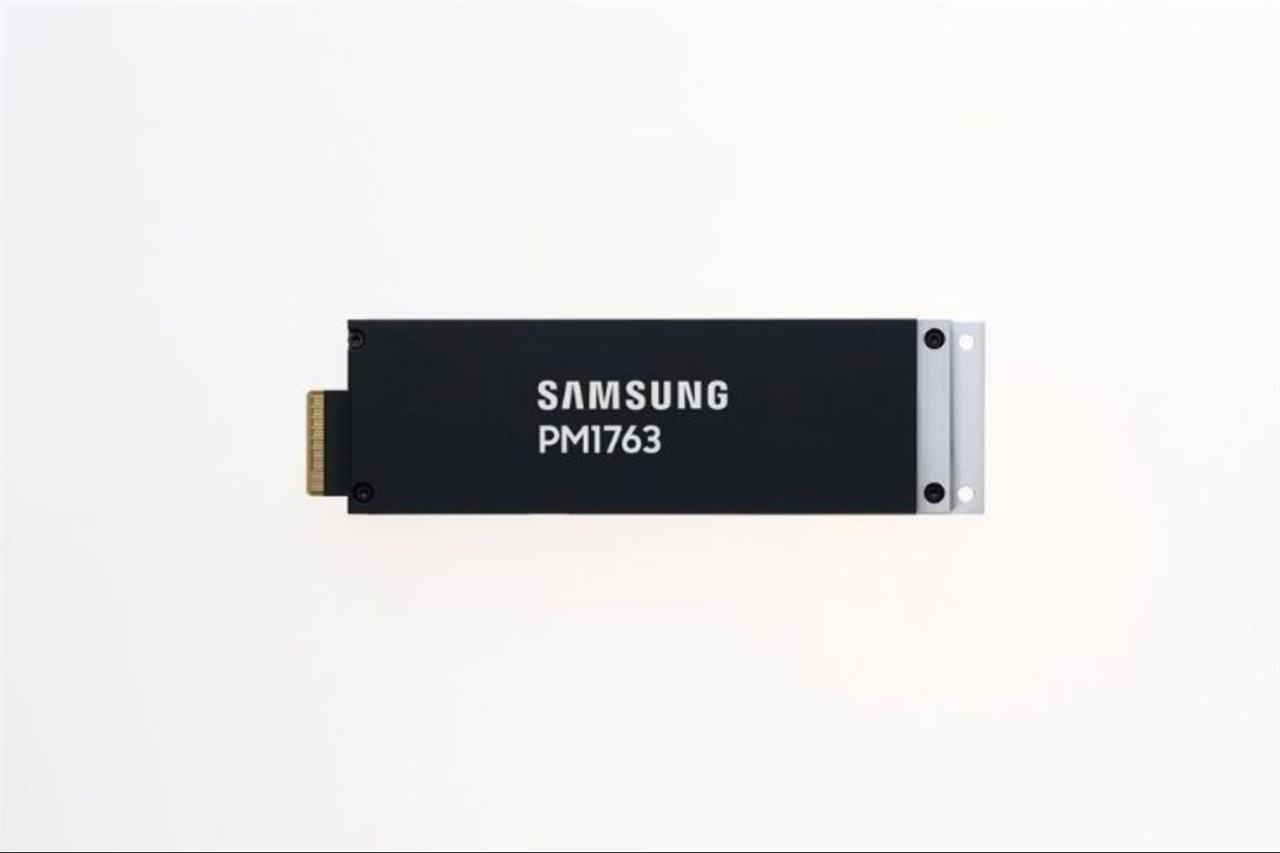
The headline is dry but surgical: Samsung is expanding its memory play for the future Nvidia Vera Rubin architecture with an enterprise SSD on a PCIe 6.0 bus. No benchmarks, no leaked spec sheets. Yet for anyone dealing with physical model deployment, the news carries denser consequences than it appears.
To see why, we need to look at how storage’s role in the AI stack is shifting. Until yesterday, a fast SSD helped load the model into VRAM a little quicker. Today, with hundred-billion-parameter models and mixture-of-experts architectures, the boundary between memory and storage is blurring. Chips are never enough, and VRAM is a tyrannical resource: you either pay for it at GPU gold prices, or you find ways to cheat without killing latency.
Samsung’s PCIe 6.0 eSSD slots right into this gap. By doubling bandwidth over the 5.0 generation, it turns the storage unit into a usable memory tier for layer swapping, weight caching, and instant checkpointing. In practice, it lets a server keep only the bare minimum in VRAM and pull the rest from storage near-real-time. This isn’t fantasy: memory mapping and partial offloading are already used to run LLMs on consumer hardware or low-GPU servers. But here, it moves from a hack to an intentionally designed mechanism, with Nvidia’s blessing and a giant like Samsung’s involvement.
This integration signals a reversal of incentives. So far the dogma was: more VRAM, more speed, more GPUs. But for companies evaluating on-premise deployment—banks, manufacturing, healthcare—multiplying cards means unsustainable CapEx and runaway energy consumption. If the Vera Rubin platform, with its PCIe 6.0 eSSDs, can run large models on fewer GPUs by offloading to cheap storage, the TCO finds its balance again. And with it, data sovereignty: fewer GPUs doesn’t mean giving up power, but being able to exercise it within your own physical boundaries without migrating to the cloud.
There’s a second, more structural effect. Samsung, the memory leader, isn’t just selling a component: it’s setting part of the pace of AI innovation. This move forces flash storage rivals (Kioxia, Micron, Solidigm) to chase on the same track, while telling Nvidia: we can supply the missing piece to make on-premise inference credible without closets full of A100s or H100s. At a time when GPU demand is distorted by expectations and supply bottlenecks, creating an alternative—or rather, complementary—path that reduces VRAM hunger is a powerful market lever.
Of course, unknowns remain: real latency, software code paths, driver maturity. But the direction is clear, and to this writer, irreversible. AI server architecture is morphing into a multi-tier memory system, exactly as happened with caches thirty years ago. PCIe 6.0 storage isn’t the trailing wheel: it’s the new middle tier, and Samsung seems to have grasped it before the race heats up in earnest.





💬 Comments (0)
🔒 Log in or register to comment on articles.
No comments yet. Be the first to comment!