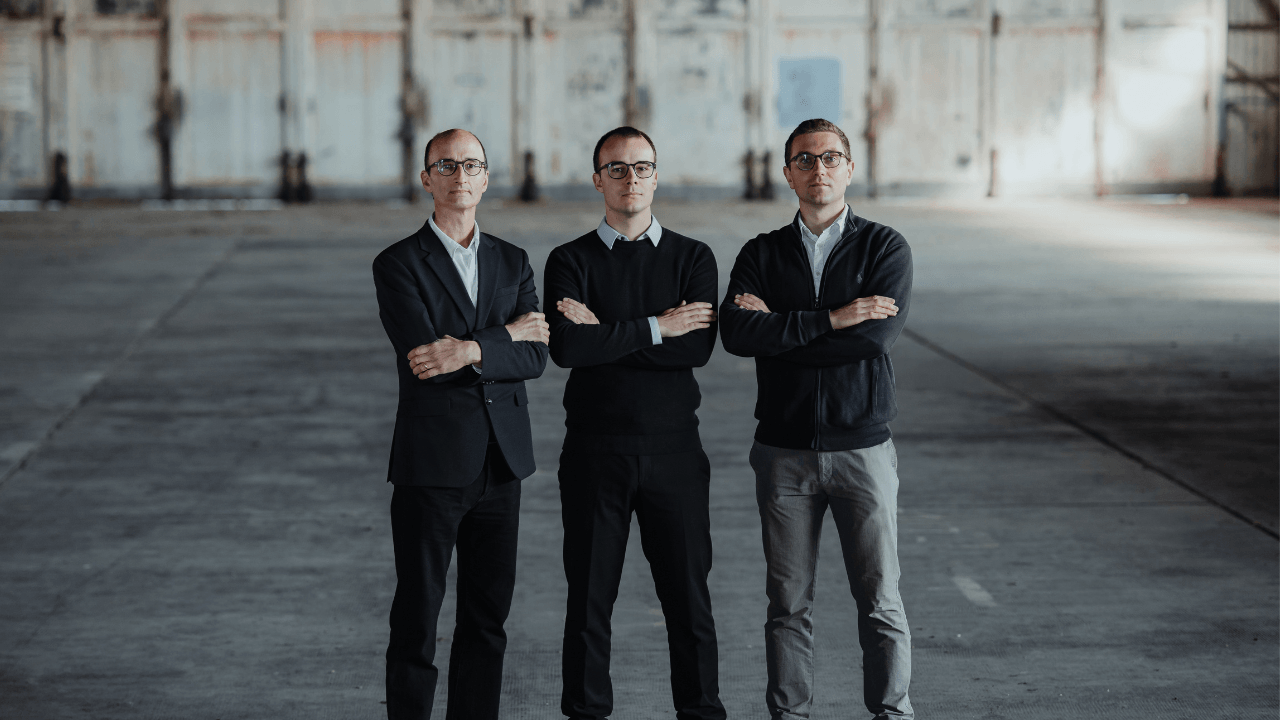
When a drone stops following a preprogrammed route and starts reasoning about the three-dimensional world around it, the shift is operational even before being technological. It’s the promise of SE3 Labs, a German startup founded by Lukas Koestler, Simon Klenk, and Daniel Cremers, which today emerges from stealth with a funding round led by Lakestar, Seedcamp, and EWOR – and with an already active customer: the German Bundeswehr.
Beyond perception: discernment
SE3’s platform does more than fuse raw sensor data. It adds a “spatial AI” layer that turns readings into shared understanding and coordinated action. In environments where GPS is absent or jammed – under active electronic warfare, for instance – the system uses visual-inertial odometry and real-time map matching to maintain continuous localisation. Every platform builds and updates its own spatial picture as it moves, recalculating routes without human intervention.
On top of this resilient foundation runs a perception stack that identifies terrain, elevation, and points of interest with sub‑meter accuracy, and localises objects in 3D space. The picture is shared across all swarm nodes: every platform converges on the same target, giving the operator a real‑time 3D common operating picture.
Commanding a swarm in natural language
Interaction breaks with traditional dashboards. The operator speaks intent in natural language, and the system translates those sentences into spatial behaviours distributed across aerial and ground drones. AI agents run continuously, analysing the scene and reasoning about what they see: priorities, threats, correlations. The result is a force multiplier: a single operator directs a mixed swarm without needing additional pilots.
“Perception alone doesn’t make a system autonomous,” said Carlos Eduardo Espinal, Managing Partner at Seedcamp. “The harder problem is discernment: knowing what matters, separating the urgent from the important, and ranking intentions against the mission.”
European sovereignty and on‑premise deployment
Klaus Hommels’ statement (Lakestar) ties the investment to European technological sovereignty. And the link isn’t rhetorical: SE3’s platform is designed to run on‑edge, on hardware chosen by the customer, with no dependency on external clouds. It’s a self‑hosted approach that keeps spatial and targeting data under full operator control – a non‑negotiable requirement for the armed forces and an increasingly relevant one for critical civilian infrastructure.
For those tracking the trends in on‑premise AI deployment, SE3 is an emblematic case. Defence is pushing for modular, hardware‑agnostic stacks with local inference and minimal latency – the very same pattern applied to Large Language Models when they must operate in air‑gapped or regulated settings. This isn’t about LLMs, but the constraints are identical: limited onboard compute, the need for aggressive optimisation (akin to the quantization or pruning we know), and an architecture designed to function without external connectivity. Staying hardware‑agnostic also signals a deliberate strategy to avoid vendor lock‑in, a hot topic for anyone calculating the Total Cost of Ownership of an autonomous fleet.
A frontier team with boots on the ground
Co‑founder Daniel Cremers, who holds the Chair for Computer Vision and AI at TU Munich and presides over the European Computer Vision Association, brings academic rigour: over 400 publications and 87,000 citations. But the startup doesn’t stop at theory: it participates continuously in military exercises across Europe and has already won several defence contracts. In those exercises, the time from detection to engagement has dropped by an order of magnitude. A result that sounds like a warning: the race for machine cognitive autonomy will be won by those who merge frontier research with operational deployment, on hardware that Europe controls.







💬 Comments (0)
🔒 Log in or register to comment on articles.
No comments yet. Be the first to comment!