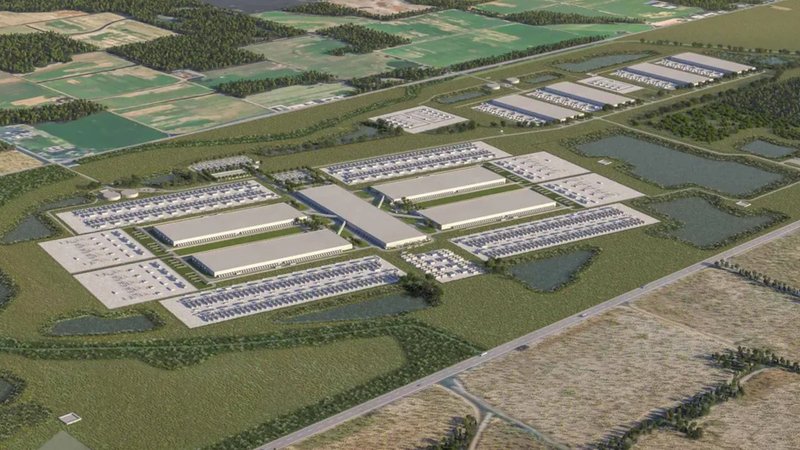
Shopee is putting down its own hardware roots. The Singapore-based e-commerce platform, part of Sea Limited, is expanding its proprietary data centers across Southeast Asia with the stated goal of boosting its supply chain operations through artificial intelligence. The news, reported by DIGITIMES, marks a turning point for the region's tech infrastructure: one of the largest online sales platforms is progressively leaving the public cloud behind to embrace a large-scale on-premise model.
The decision isn't driven solely by cost. The AI workloads that power modern e-commerce — recommendation systems, search ranking, dynamic pricing, demand forecasting, and logistics route optimization — are extremely demanding. They operate on real-time data volumes, require minimal latency to avoid degrading the user experience, and involve sensitive consumer information. In this scenario, direct hardware control becomes a competitive advantage.
On-premise architecture allows customizing the hardware stack for specific inference workloads, avoiding the markup of cloud instances and the operational cost variability that, at such a wide geographical scale, can erode business margins. Crucially, it ensures data remains within national borders — an increasingly stringent requirement in Southeast Asia's fragmented markets, where regulations like Thailand's PDPA or data sovereignty rules in Indonesia and Vietnam are starting to bite.
But Shopee's move must also be read as a structural signal. The region is retracing a path already seen in China and the United States, where big tech operators internalized AI infrastructure after an initial phase of cloud dependency. Baidu, Alibaba, and Tencent built GPU clusters for their deep learning models. Meta, Google, and Amazon do the same to train and serve LLMs. Now it's the turn of Southeast Asia's regional champions, who are reaching the critical mass needed to justify investment in proprietary data centers.
This has second-order implications for the tech ecosystem. For global cloud providers, losing a customer like Shopee — which handles millions of daily transactions — is not just lost revenue but a precedent that could encourage other local platforms to follow suit. For hardware manufacturers, on the other hand, it represents an opportunity: demand for GPUs and AI-optimized storage systems could grow further in markets previously dominated by infrastructure outsourcing.
There is also the aspect of technical expertise. Building and managing proprietary data centers requires a talent pool specialized in systems engineering, cooling, high-speed networking, and AI workload orchestration — skills not always easy to source. Shopee, however, is large enough to attract these profiles and invest in training. In this sense, its investment will help develop an on-premise skills ecosystem across Southeast Asia, with benefits extending beyond the company's boundaries.
For organizations evaluating a similar path, Shopee's decision offers a concrete case study. AI-RADAR provides analytical frameworks and assessment tools for those needing to weigh trade-offs between cloud and on-premise, analyzing aspects such as total cost of ownership, latency requirements, and regulatory compliance constraints. There is no universal solution, but the moves of major players indicate that for high-intensity, large-scale AI workloads, on-premise computing is gaining ground.
Shopee's data center expansion is therefore more than a logistics upgrade: it is a symptom of an industry that is internalizing artificial intelligence not just as software, but as a physical asset. And in the fragmented landscape of Southeast Asia, where distances and regulations make centralized cloud less efficient, local hardware could become the key to competitiveness.




💬 Comments (0)
🔒 Log in or register to comment on articles.
No comments yet. Be the first to comment!