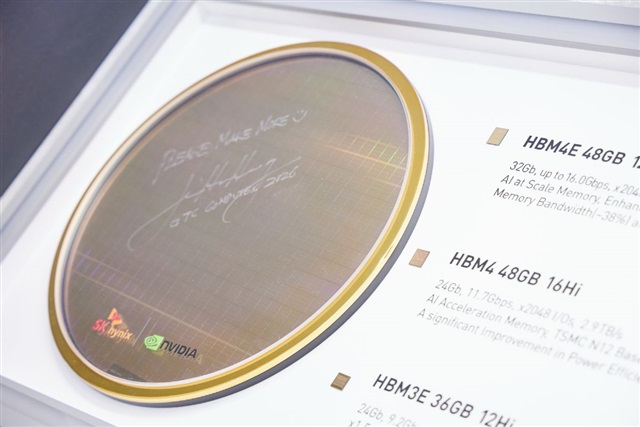
The news, reported by DIGITIMES, is thin on details but dense with meaning: SK Hynix has reportedly begun delivering the first HBM4 modules to Nvidia, ahead of the production ramp originally scheduled for September. This is more than a simple generational leap. It is a strong signal that the hardware pipeline underpinning the entire artificial intelligence ecosystem is entering a new phase, and that the availability of next-generation data center GPUs might arrive sooner than expected.
High Bandwidth Memory of the fourth generation is the most critical component for graphics chips used in training and inference of Large Language Models. Compared to its predecessor, HBM4 promises a jump in bandwidth and capacity per stack, allowing GPU designers to push tokens-per-second thresholds further and manage ever-larger context windows without bottlenecks. In a landscape where every watt and every data transfer counts, memory is not a mere accessory: it sets the pace at which the largest models can operate in real-world environments.
That SK Hynix is moving the first boxes weeks ahead of schedule is good news for Nvidia, but it also shifts the calculus for anyone evaluating on-premise infrastructure investments. Companies that prefer to keep physical control of their data – whether due to compliance constraints, digital sovereignty, or a simple TCO analysis – depend on the availability of up-to-date hardware. Every month of delay in the supply chain pushes even well-equipped organizations toward the cloud. An early start to HBM4 shipments reduces this risk and makes it more plausible to bring the latest accelerators into one’s own racks before the performance gap becomes unbridgeable.
There is also a subtler contest, entirely internal to the memory market. SK Hynix cements its role as the reference supplier for Nvidia, while Samsung struggles to keep pace on advanced packaging technologies and Micron tries to carve out a space of its own. This asymmetry has cascading effects: whoever controls the HBM4 supply effectively influences how quickly the entire industry can refresh its installed base. It is not an exaggeration to read a competitive acceleration here, which downstream means greater negotiating power for system integrators and tighter upgrade windows for those building self-managed clusters.
For operators in regulated sectors – banking, healthcare, public administration – the prospect of next-generation GPUs becoming available earlier than planned carries value beyond raw performance. It means being able to plan on-premise deployments with the confidence that the hardware will not be obsolete the moment it is powered on, and that the investment lifecycle can align with compliance requirements without resorting to forced hybrid setups. At a time when the conversation around data sovereignty is becoming increasingly concrete, the flow of base components like HBM4 serves as a leading indicator of how effectively an organization can retain control over its AI stack without relying on third parties. The report of early shipments, however unofficial, is precisely the kind of signal that infrastructure leaders should watch closely.








💬 Comments (0)
🔒 Log in or register to comment on articles.
No comments yet. Be the first to comment!