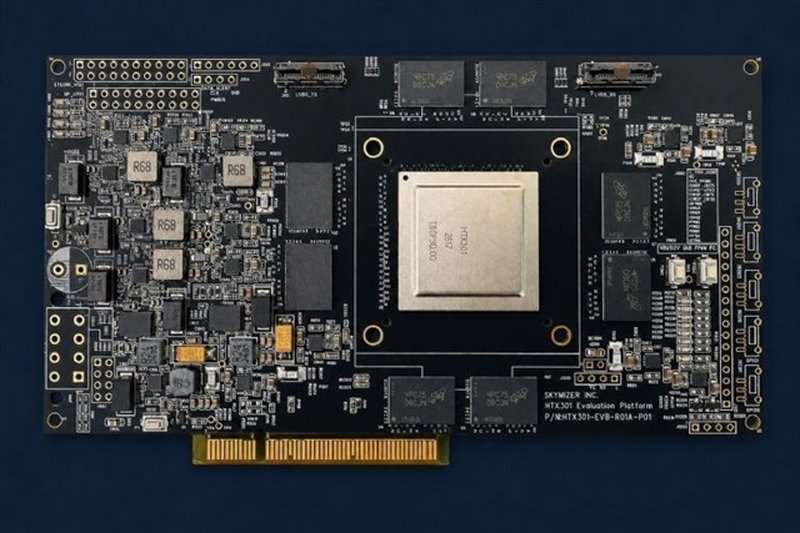
Skymizer Introduces HTX301: A New Option for On-Premise AI
Taiwanese company Skymizer recently announced the HTX301, a new PCIe card dedicated to AI model Inference. This solution aims to redefine the on-premise AI landscape by offering technical specifications designed to address the challenges associated with local Deployment of Large Language Models (LLM) and other intensive AI workloads.
The HTX301 is notable for its significant memory capacity of 384GB and a contained power consumption, estimated at around 240 Watts. These parameters position it as an interesting proposition for organizations seeking to maintain control over their data and infrastructure, avoiding reliance on external cloud services for AI processing.
Technical Details and Implications for LLM Workloads
The most prominent feature of the HTX301 is undoubtedly its 384GB of memory. This capacity is crucial for running large LLMs, which often require significant volumes of VRAM to load model parameters and manage extended context windows. Traditionally, running these models on-premise has necessitated the use of multiple GPUs connected via high-speed interconnects, or the adoption of aggressive Quantization techniques that can compromise model accuracy.
A single card with 384GB of memory can simplify the Deployment architecture, reducing the complexity of the Inference Pipeline and potentially improving latency. The PCIe form factor also facilitates its integration into standard servers, making it accessible to a wide range of existing infrastructures. The consumption of approximately 240 Watts is a relevant factor for TCO, as higher energy efficiency translates into lower operational costs for cooling and power, critical aspects in data centers.
The Value of On-Premise Deployment for AI
The choice of hardware solutions like the HTX301 reflects a growing trend towards on-premise Deployment for AI workloads. The motivations are manifold and include data sovereignty, the need for regulatory compliance (such as GDPR), and the ability to operate in air-gapped environments to maximize security. Companies, particularly those operating in regulated sectors like finance or healthcare, often prefer to keep sensitive data within their own infrastructural boundaries.
Direct control over hardware and software also allows for greater performance optimization and more flexible resource management. While the cloud offers initial scalability and flexibility, the long-term TCO for consistent AI workloads can sometimes favor self-hosted solutions. For those evaluating on-premise Deployment, AI-RADAR offers analytical Frameworks on /llm-onpremise to assess the trade-offs between CapEx and OpEx, and the impact on data sovereignty.
Outlook and Considerations for Tech Decision-Makers
The announcement of the Skymizer HTX301 highlights the continuous evolution of the AI hardware market, with an increasing emphasis on solutions optimized for on-premise Inference. For CTOs, DevOps leads, and infrastructure architects, the arrival of cards with high VRAM capacities in a standard format represents an opportunity to expand internal AI capabilities without resorting to complex cloud infrastructures or extreme multi-GPU configurations.
However, the choice of a hardware solution is not solely based on memory capacity. It is also crucial to consider other factors such as Throughput, latency for specific batch sizes, software support, and compatibility with the existing ecosystem of AI Frameworks and libraries. The HTX301 presents itself as an alternative to be carefully evaluated in the landscape of on-premise AI solutions, offering a balance between memory capacity and power consumption that could prove advantageous for specific Deployment scenarios.






💬 Comments (0)
🔒 Log in or register to comment on articles.
No comments yet. Be the first to comment!