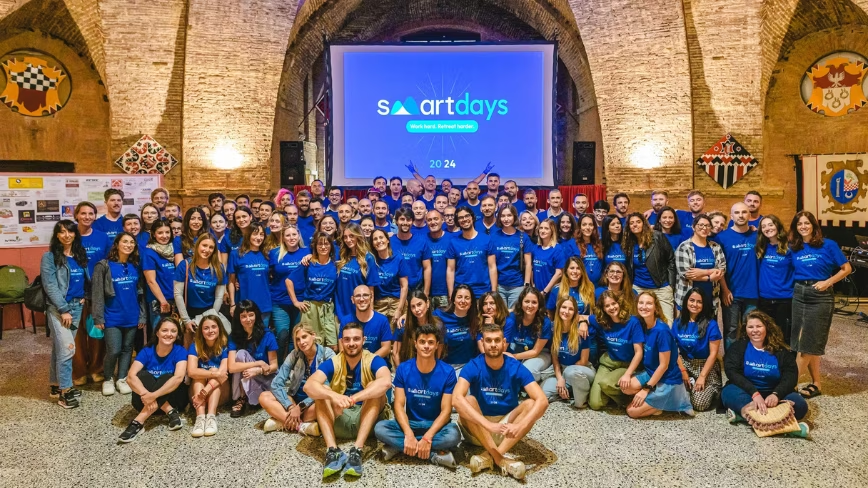
Smartness Raises €47 Million to Boost AI Operations
Trentino-based startup Smartness has announced the closing of a significant Series B funding round, totaling €47 million. This operation, which includes primary and secondary equity as well as debt, represents the largest round ever completed for an Italian vertical Software as a Service (SaaS) company. Smartness, specializing in technology solutions for the travel sector, offers a suite of B2B products designed to optimize the operations of hospitality businesses.
This capital injection is earmarked for a strategic objective: scaling its artificial intelligence operations. This step underscores the growing importance of AI in improving efficiency and service offerings in traditional sectors, pushing companies to invest in advanced computational capabilities and robust deployment strategies.
The Challenges of Large-Scale AI Deployment
Expanding AI operations, particularly those involving Large Language Models (LLMs), requires careful infrastructural planning. Companies aiming to enhance their AI capabilities must make crucial strategic choices regarding deployment. The decision between a cloud-based infrastructure and a self-hosted or on-premise approach is central to these evaluations, directly influencing the Total Cost of Ownership (TCO), data sovereignty, and performance.
For instance, performing Inference with large LLMs can demand significant hardware resources, such as GPUs with high VRAM and computational power. An on-premise deployment offers direct control over hardware and data, a critical aspect for sectors like hospitality that handle sensitive information. However, it also entails managing the acquisition, maintenance, and upgrading of servers, storage, and networking, in addition to specialized skills for optimizing AI software and Frameworks.
Industry Implications and Data Sovereignty
Smartness's investment reflects a broader trend in the technology market, where companies seek to integrate AI not only for automation but also to offer more personalized and predictive services. For businesses operating in the hospitality sector, AI can translate into improved booking management, price optimization, customized customer experiences, and predictive analytics on market trends.
In this context, data sovereignty and regulatory compliance, such as GDPR, become differentiating factors. A self-hosted or air-gapped infrastructure can offer a superior level of control and security, reducing the risks associated with managing data in public cloud environments. This approach is particularly relevant for companies wishing to keep their data within national borders or in completely isolated environments, ensuring maximum protection and adherence to local regulations.
Future Prospects and Strategic Trade-offs
The success of funding rounds like Smartness's highlights investor confidence in AI's potential to transform established sectors. However, scaling AI operations is not without its complexities. Companies must balance the need for high performance with cost constraints and security requirements. The choice between the agility and near-unlimited scalability of the cloud and the granular control and potential lower long-term TCO of on-premise remains a key strategic decision.
For those evaluating on-premise deployment for LLM workloads, AI-RADAR offers analytical frameworks on /llm-onpremise to assess specific trade-offs and requirements, considering factors such as latency, throughput, VRAM capacity, and energy efficiency. Smartness's evolution will be an interesting case to observe, as it will demonstrate how an Italian vertical SaaS company intends to capitalize on AI to consolidate its market position.








💬 Comments (0)
🔒 Log in or register to comment on articles.
No comments yet. Be the first to comment!