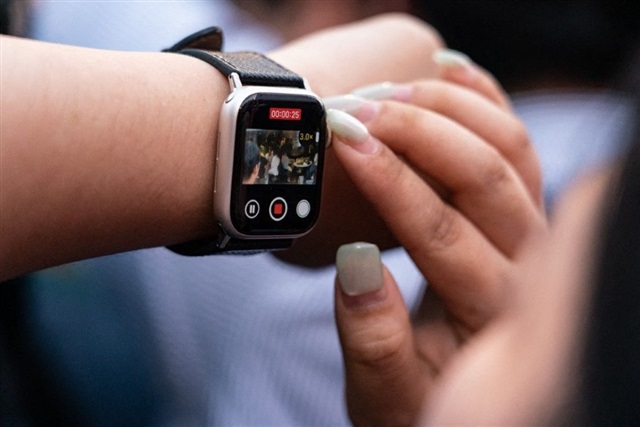
Sales of smartwatches running AI directly on-device have exploded: +70% in the past year, according to data circulating among agencies. This is not a seasonal fluctuation or the effect of a single model. Behind the figure stands Apple, whose Watch has turned health monitoring into a mass-use case while simultaneously raising the bar for privacy. And it is precisely privacy that is silently tilting the entire wearable segment toward local inference.
The leap isn’t just about raw power. The real architectural shift lies in Apple’s vertical integration: the Neural Engine embedded in S-series chips, trained to detect arrhythmias, analyze sleep, or track blood oxygen without ever leaving the wrist. The models run on ultra-low-energy hardware, thanks to aggressive quantization and a design that balances dedicated accelerators with low-power CPUs. Health data, inherently critical, stays encrypted within the Secure Enclave and never transits to cloud servers. This choice makes the device reliable even offline and addresses a growing user anxiety: control over what the body reveals.
This dynamic isn’t isolated. While Apple piles up market share, competitors chase with hybrid solutions that often offload part of the processing to a smartphone or the cloud, sacrificing immediacy and adding latency. Qualcomm pushes its Snapdragon Wear platforms, but without the same proprietary software-hardware ecosystem it struggles to replicate the experience. The market is decreeing that on-device AI isn’t a marketing gimmick but a competitive requirement: if the sensor and the model don’t run within the same security perimeter, user trust wobbles.
The signal coming from users’ wrists carries implications that stretch far beyond the consumer world. The acceleration toward edge AI in wearables confirms a trajectory already visible in enterprise data centers: when data are sensitive and latency is unacceptable, local inference becomes the mandatory choice. Companies today evaluating on-premises deployment of language models or predictive analytics on bare-metal servers or air-gapped clusters face the same trade-offs: compute power vs. consumption, ease of updating vs. sovereignty, cloud flexibility vs. total control. The fact that a watch can execute machine learning models without external API calls proves that AI miniaturization is ready for more complex workloads too, provided there is investment in specialized hardware.
In this scenario, Apple’s move is not merely commercial. It’s a structural indication: the next wave of AI adoption will be propelled by the ability to bring inference as close as possible to the data source. For those designing AI infrastructures, it means that discussions around TCO and speed must include local hardware as a primary variable, not an exception. Health, with its urgency and sensitivity, has just drawn the line that the cloud cannot cross.








💬 Comments (0)
🔒 Log in or register to comment on articles.
No comments yet. Be the first to comment!