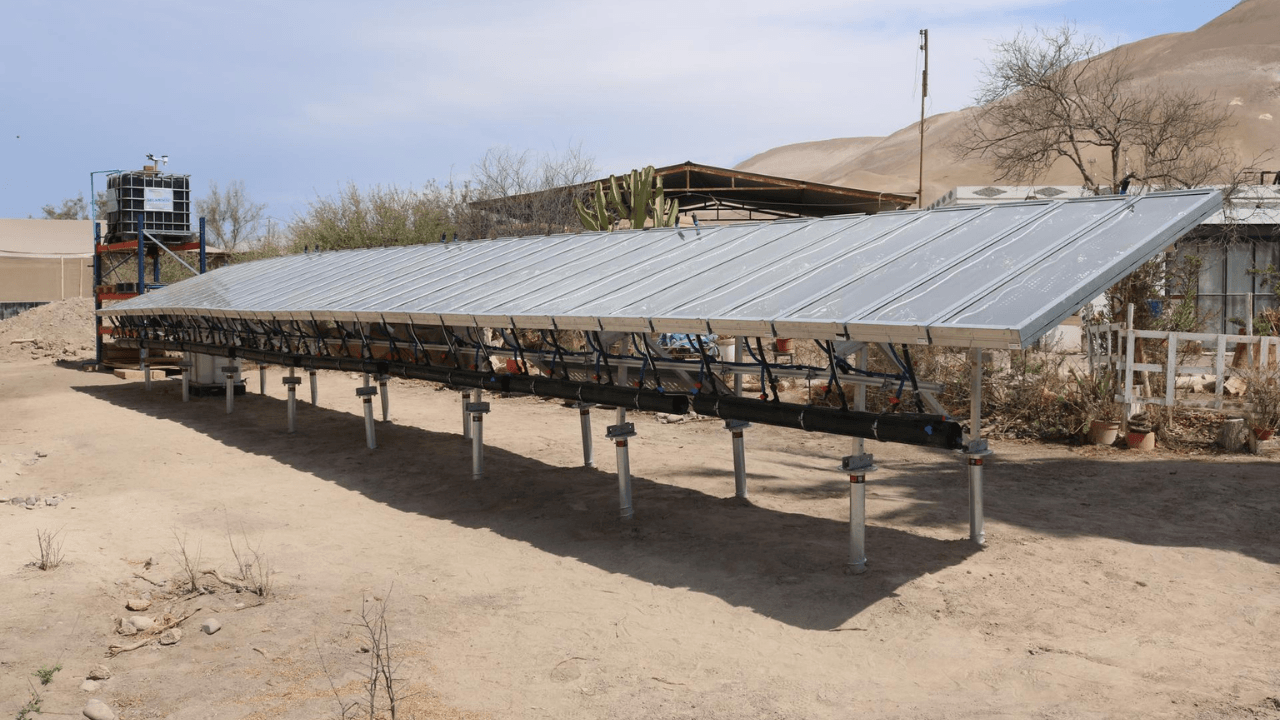
SolarDew: Autonomous Drinking Water for Remote Areas
Dutch startup SolarDew, specializing in the development of innovative solar-powered water purification technology, recently announced it has raised €800K in funding. This investment round was led by Connect the Drops, a Dutch investor focused on early-stage startups in the water sector, and Oost NL, the regional development agency for the Dutch provinces of Gelderland and Overijssel, which supported the company for the second time. SolarDew's ambitious goal is to provide access to clean drinking water to one million people by 2035.
The scarcity of clean drinking water represents a growing global challenge, particularly acute in rural areas, where a significant percentage of the population lacks access to safe sources. Compounding this issue is the progressive increase in salinity and pollution of existing water resources. Market forecasts indicate that by 2030, over 100 million people will require an alternative source of clean drinking water, as highlighted by Alexander van der Kleij, CEO of SolarDew.
A Decentralized and Low-Impact Solution
Current solutions for water scarcity, such as purchasing bottled water or transporting water over long distances, prove unsustainable and fail to offer long-term answers. Furthermore, many existing water purification and desalination technologies are designed for large-scale applications, making them complex to operate and requiring intensive maintenance. This renders them less suitable for small communities, schools, medical clinics, and businesses located in remote, coastal, or arid areas.
SolarDew has developed a water purification technology that utilizes the principles of evaporation and condensation through a membrane. This process allows for the purification of polluted or saltwater, safely producing high-quality drinking water. A crucial aspect of the solution is its autonomy: the system operates exclusively on solar thermal energy and gravity, eliminating the need for high pressure, electricity, or chemicals. This operational simplicity also translates into extremely low maintenance requirements, making the water stations ideal for isolated contexts. Depending on solar irradiation, a station comprising approximately 32 units can produce about 100 liters of clean drinking water per day.
The Value of Autonomous Deployment and TCO
SolarDew's approach, based on autonomous and localized systems, presents significant parallels with the considerations that drive the deployment of advanced technological solutions, such as Large Language Models (LLM), in on-premise or air-gapped contexts. The ability to operate independently of centralized infrastructures, such as the electricity grid or complex chemical supply chains, drastically reduces the long-term Total Cost of Ownership (TCO). For organizations evaluating self-hosted alternatives, whether for water or AI workloads, minimizing external dependencies is a key factor for resilience and operational sovereignty.
Following a series of successful pilot projects, SolarDew began industrial production last year, manufacturing 150 units and establishing a strong supply chain with European manufacturers. The company has also secured a patent for its technology in the Netherlands, with European and international patents expected by the end of the year. The funds raised will be used to further accelerate this industrial production. The first two commercial projects have been realized in Chile, in collaboration with a local hydroponics entrepreneur, and in Greece, together with the Technical University of Crete. SolarDew aims to install the next commercial projects before the end of 2026.
Growth Prospects and Global Impact
Alexander van der Kleij emphasized how the past year has allowed the company to build a strong foundation, thanks to scalable technology, strategic partnerships, and initial projects demonstrating the necessity of their solution. The current goal is to continue scaling and create lasting impact by providing clean drinking water to communities and businesses worldwide, thereby contributing to improved living conditions and economic growth. Jan Otto Ooms of Connect the Drops added that SolarDew has developed a proven, scalable solution for one of the world's most underserved markets, aligning with his fund's mission.
For those evaluating autonomous infrastructure solutions, SolarDew's proposal offers an example of how independence from centralized networks can generate value and resilience, a principle that AI-RADAR also explores in the context of on-premise LLM deployments. Currently, SolarDew is seeking additional funding through a crowdfunding campaign on Republic Europe, demonstrating the continued expansion and interest in this vital technology.







💬 Comments (0)
🔒 Log in or register to comment on articles.
No comments yet. Be the first to comment!