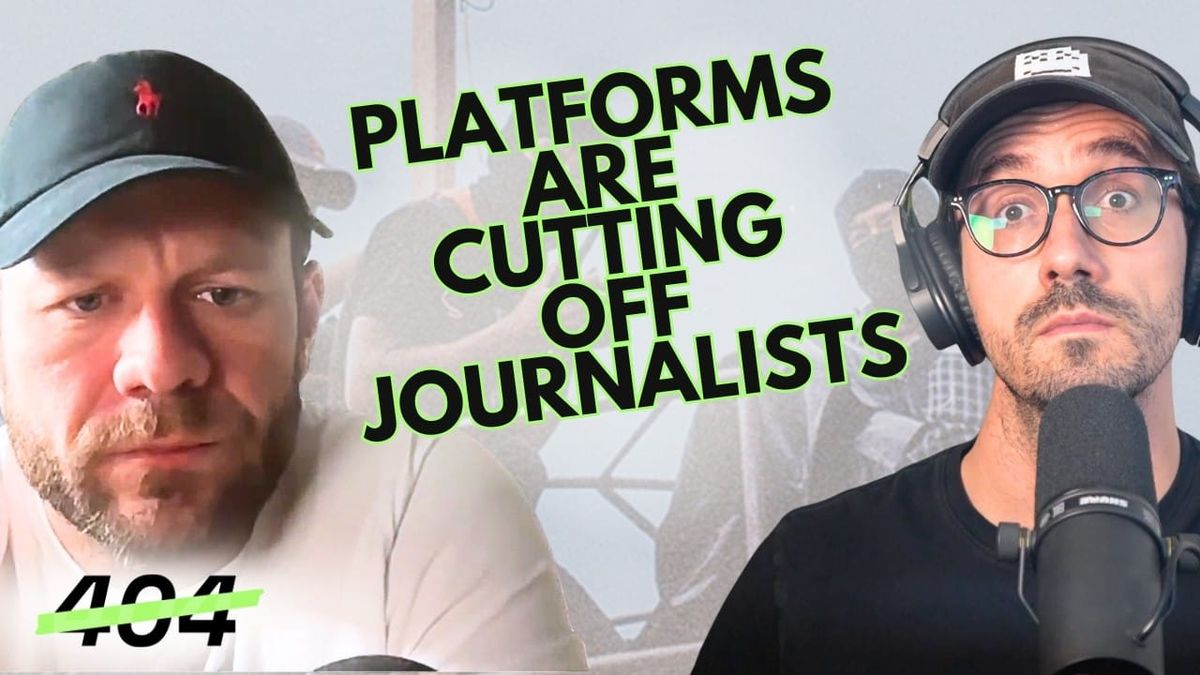
Jake Hanrahan is not a technologist. He is a conflict reporter and founder of Popular Front, an outlet that covers wars and armed tensions with a direct approach far from mainstream spotlights. Yet his testimony, collected in the latest episode of the weekly podcast, opens a window on an issue that directly affects those designing, even in enterprise environments, architectures for artificial intelligence: the dependence on third-party platforms to distribute information and the growing need to regain control of infrastructure.
Explicit shadowbanning or removals are not always required. The recommendation algorithm that penalizes certain content, automatic demonetization, selective obscuring – that’s often enough. YouTube, where many independent journalists build their audience, is an opaque gatekeeper. When Hanrahan describes how it has become harder to get his work noticed, he highlights a structural problem: investigative journalism entrusts its megaphone to players whose commercial interests and compliance constraints often run counter to free expression.
Beyond the platform: the self-hosted stack as a shield
For an outlet like Popular Front, the response is not just technical but political: building proprietary distribution channels, reducing the reliance on YouTube or Facebook. From an infrastructure standpoint, this means moving closer to on-premise or self-hosted models, where the publisher directly manages servers, CDN, podcasting systems, and, increasingly, AI-powered analytics and moderation tools.
No futuristic hardware is needed. A bare metal server with adequate storage and bandwidth can host an entire editorial stack: a CMS like Ghost, membership platforms, podcast feeds via Transistor (as in the case of this very show), and even a local LLM to moderate comments or generate transcriptions without sending data to third parties. The key is the principle: content stays on machines over which the journalist has full legal and physical control.
The cost of freedom: TCO and operational complexity
It must be said upfront that such a choice comes at a cost. Maintaining an on-premise infrastructure is not trivial: security updates, redundancy, backups, monitoring. Total Cost of Ownership (TCO) rises compared to a SaaS subscription, and internal skills or a trusted technical partner are required. This is why many journalistic projects remain anchored to Substack or Patreon, accepting that their archive and subscriber relationships are held by a US provider.
But when the risk is not merely economic but existential – the sudden loss of audience, the inability to publish during a crisis – the calculus shifts. In conflict scenarios or hostile regulatory environments, having a physical server in a trusted data center (or even on-site) becomes a resilience asset. It is no coincidence that activists and independent outlets are looking with interest at solutions like Peertube for self-hosted video streaming or scripts that automatically back up their content from YouTube to local storage.
LLMs and moderation: a boundary to guard
Self-hosting is not just old-fashioned hosting. The arrival of compact open-source LLMs, capable of running on consumer GPUs or even optimized CPUs, allows in-house functions that were once delegated to cloud services: audio transcription, automatic comment classification, even assisted fact-checking. For a journalist operating in sensitive areas, using a local model avoids sending confidential interviews or drafts to external servers, reducing the risks of interception or unauthorized training by the provider.
This is where true digital sovereignty is measured: data never leaves the control perimeter. Of course, inference quality depends on the amount of VRAM and the quality of quantization, but the trade-off between accuracy and privacy is a parameter each organization must calibrate according to its threat model. The Popular Front experience reminds us that technology is never neutral: every architectural choice is also an editorial choice.
Those evaluating an on-premise deployment for their editorial project will not find pre-packaged answers. Every newsroom must weigh latency needs, budget, and skills. But the direction is clear: reclaiming the means of distribution – servers, models, publishing pipelines – is the foundation of truly independent information.








💬 Comments (0)
🔒 Log in or register to comment on articles.
No comments yet. Be the first to comment!