
SpaceX and the Record IPO
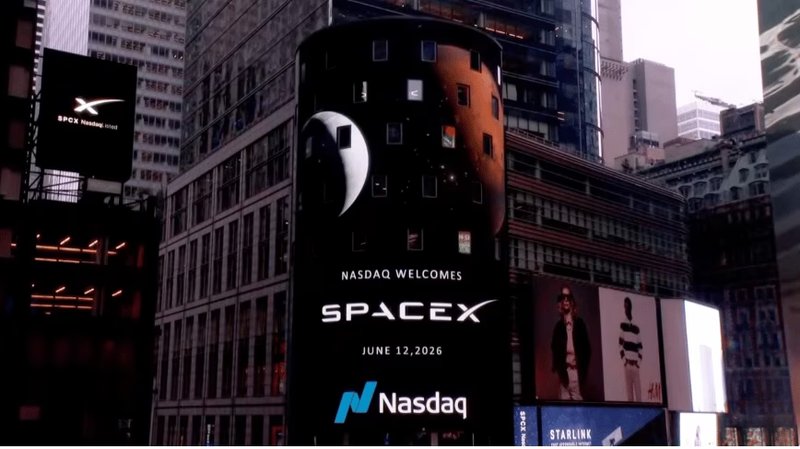
SpaceX, the aerospace company led by Elon Musk, has confidentially filed the necessary paperwork with the Securities and Exchange Commission (SEC) to initiate an initial public offering (IPO). The news, confirmed by multiple sources familiar with the registration, positions this operation as the largest IPO in financial market history. An event of this magnitude could, according to estimates, elevate Elon Musk to the rank of the world's first trillionaire.
The offering, internally identified with the code name "Project Apex," represents a significant moment not only for SpaceX but for the entire technological and financial landscape. The decision to proceed with a stock market listing of this size reflects the extraordinary growth and perceived value of companies operating at the frontiers of innovation, from space technology to artificial intelligence, and investor confidence in their future expansion potential.
Market Context and Technology Investments
Financial events of this magnitude, such as SpaceX's potential IPO, serve as indicators of investor confidence in advanced technology sectors. Although SpaceX primarily operates in the aerospace field, the capitalization of leading tech companies creates a ripple effect across the entire ecosystem. The availability of fresh capital and the attractiveness of investments in high-growth sectors can indirectly influence the resources allocated to research and development in other strategic areas, including artificial intelligence.
In this scenario, the ability to attract large-scale investments is crucial for sustaining innovation. For companies operating in the field of artificial intelligence and Large Language Models (LLM), access to significant capital is fundamental for financing the acquisition of specialized hardware, the development of new Frameworks, and the construction of robust infrastructure, whether in cloud or self-hosted environments. These investments are essential for maintaining a competitive edge and scaling operations.
Implications for AI Infrastructure
Even if SpaceX's IPO is not directly related to LLM deployment or the management of local stacks, the resulting capital flow can have an indirect impact on AI infrastructure. Large investments in the technology sector in general can free up resources or create new opportunities for the development of high-performance computing solutions. This includes the expansion of data centers, the purchase of latest-generation GPUs, and the pursuit of solutions to optimize the Total Cost of Ownership (TCO) of AI workloads, a critical factor for deployment decisions.
For organizations evaluating on-premise LLM deployment, the availability of capital in the tech market can translate into a greater supply of specific hardware and an acceleration in the development of enabling technologies. The choice between cloud and self-hosted solutions, often driven by considerations of data sovereignty, compliance, and control, requires significant initial investments that can be facilitated by a dynamic and innovation-prone financial market.
Future Outlook in the Tech Sector
SpaceX's potential listing is part of a broader trend of high valuations for technology companies pushing the boundaries of innovation. This market dynamism is an enabling factor for the evolution of sectors such as artificial intelligence, where the demand for computational resources and specialized talent continues to grow exponentially. The ability to attract and manage capital on this scale is an indicator of the maturity and growth potential of entire industries.
The ability to finance ambitious projects, whether it's space exploration or the development of advanced LLMs, remains a cornerstone for technological progress. As the market adapts to these new financial realities, the focus on efficiency, scalability, and security of IT infrastructures, particularly for AI workloads, will continue to be a priority for CTOs and system architects who must balance performance, costs, and control.







💬 Comments (0)
🔒 Log in or register to comment on articles.
No comments yet. Be the first to comment!