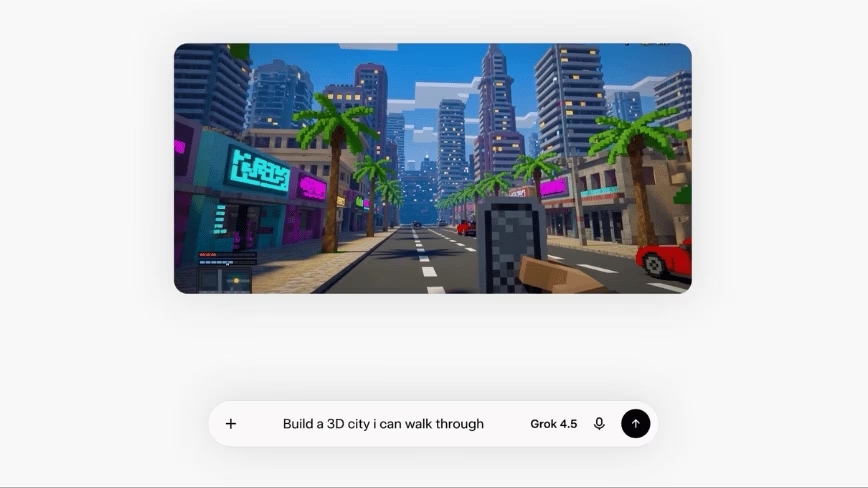
SpaceXAI has unveiled Grok 4.5, its most capable model to date. It lands just weeks after the company went public and acquired Cursor, the AI coding startup that quickly became a go-to for developers. Elon Musk doesn't hide the ambition: Grok 4.5 is an 'Opus-class' model built for coding and agentic workloads, not casual chat.
The 'Opus-class' label is deliberate. It directly echoes Anthropic's Claude Opus, the high-end model designed for complex tasks. But the real battle is over code. With Cursor now under its roof, SpaceXAI can orchestrate an ecosystem where the model and the development tool are steered by the same hand. This is a clear signal: generative AI competition is shifting from general-purpose models to integrated value chains, where controlling both the LLM and the developer interface creates a moat that's tough to replicate.
For software developers, this move has immediate consequences. The assisted coding market is currently fragmented among GitHub Copilot (OpenAI), Cursor (now SpaceXAI), Replit Ghostwriter, and others. A proprietary, code-optimized model delivered through a company-owned IDE can accelerate developer lock-in and squeeze rivals. Anthropic, for its part, pushes Claude Code and IDE integrations but doesn't own an editor like Cursor. OpenAI, with Copilot, has the channel yet must share control with Microsoft.
On the deployment front, the announcement is silent on how Grok 4.5 will be offered. But a model laser-focused on coding and agentic automation raises real questions for organizations handling proprietary codebases. If the model remains cloud-only, data sovereignty and IP protection become blockers. Companies in regulated sectors or with sensitive code may look for self-hosted alternatives. SpaceXAI hasn't disclosed quantization details, VRAM requirements, or on-premise options, but market pressure will inevitably push that way. For those evaluating on-premise deployment, AI-RADAR provides analytical frameworks to navigate these trade-offs.
The bet on agentic work also says something broader about the state of the industry. After two years of chatbots, the shift is toward systems that act: writing code, orchestrating workflows, making decisions. Grok 4.5 embodies that transition, and the fact that SpaceXAI raced to ship it right after the Cursor acquisition points to an accelerated roadmap. The open question is whether model quality will keep pace with vertical integration. A successful closed ecosystem demands not just a capable LLM but a frictionless development experience. If SpaceXAI pulls it off, assisted coding may stop being a market of individual tools and turn into a war of full-stack platforms.



💬 Comments (0)
🔒 Log in or register to comment on articles.
No comments yet. Be the first to comment!