
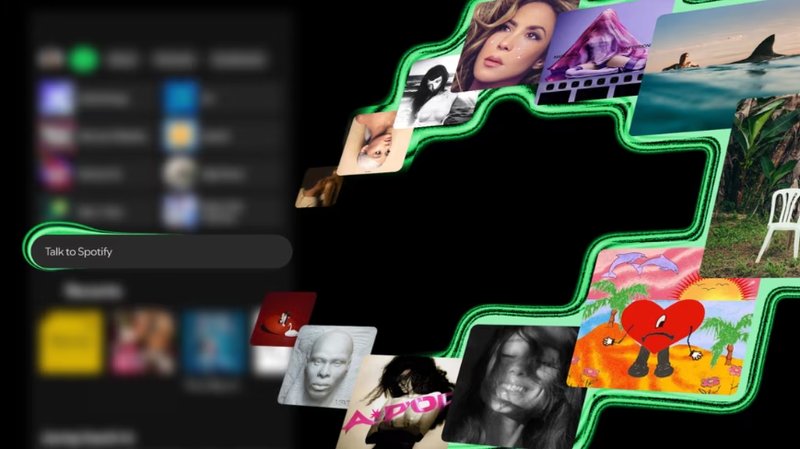
Spotify has begun rolling out a conversational AI assistant that lets Premium subscribers chat with the app to discover music, podcasts, and audiobooks, mimicking the ChatGPT experience. The move isn’t just a UI tweak—it’s a signal that Large Language Models are becoming a standard ingredient in consumer platforms, turning simple browsing into contextual dialogue.
The feature interprets natural language requests, captures intent, and returns relevant content. Behind the scenes, the service runs entirely on third-party cloud infrastructure. Spotify hasn’t disclosed architectural details, but the typical model is an LLM API integrated into the app, far removed from the bare metal servers or air-gapped environments that many of our readers manage to maintain data control.
The architectural choice fits Spotify’s profile: serving hundreds of millions of users without scaling proprietary inference hardware. Yet for those evaluating on-premise deployments, the rollout is an accidental case study. On one hand, it shows how fast a cloud-first product can adopt sophisticated conversational capabilities, leveraging LLM provider flexibility. On the other, it underscores the sovereignty trade-off: every request leaves the app, travels to an external data center, and returns. For finance, healthcare, or defense—where data residency is dictated by regulations like GDPR or strict internal policies—the same approach would be unworkable without a self-hosted version of the model.
There’s a second-order effect. As AI assistants become the norm in consumer apps, pressure mounts on enterprise developers to offer similar experiences in internal or B2B products. It’s no coincidence that the on-premise LLM market is exploring hybrid solutions: quantized models running on corporate GPUs, serving frameworks optimized for constrained environments, and growing attention to Total Cost of Ownership. Spotify, meanwhile, can iterate quickly because it doesn’t face the constraints of physical VRAM limits or audit requirements.
The long-term tension is whether the on-premise sector can match the richness of these experiences without sacrificing control. Today’s music assistant is a cloud luxury; tomorrow it may become yet another benchmark for those building local inference pipelines, spurring innovation in model compression and quantization. Unknowingly, Spotify has raised the bar even for those who have zero intention of handing their data to a hyperscaler.



💬 Comments (0)
🔒 Log in or register to comment on articles.
No comments yet. Be the first to comment!