
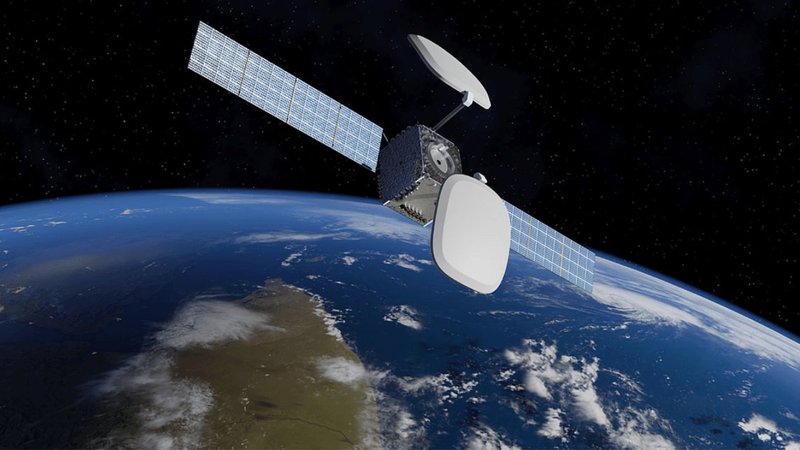
SWISSto12, a Swiss aerospace company founded in 2011, has just closed a $70 million Series C round. The capital will be used to expand manufacturing capacity for its two flagship products: HummingSat, a compact geostationary satellite platform (GEO), and HummingLink, a family of payloads and antennas designed for low Earth orbit (LEO) constellations. The news follows the recent award of $84.8 million from ESA Member States for the ARTES project, which funds the development and in-orbit validation of HummingSat itself.
Behind the numbers lies a concrete commercial trajectory: seven contracts already signed with global operators such as SES and Viasat for HummingSat, over two thousand HummingLink solutions already operational in space, and a growing pipeline of government and commercial programs across Europe and Asia-Pacific.
The structural signal, for those watching digital infrastructure, is the progressive convergence of multi-orbit satellite connectivity and the demand for sovereignty over communication networks. When CEO Emile de Rijk speaks of “sovereign communications infrastructure,” he is not alluding solely to a niche market for defense ministries. He is describing a cross-cutting need for any organization handling sensitive data – from central banks to hospitals, to energy grids – that are now carefully evaluating where and how their data travels.
For those deploying on-premise AI infrastructure or air-gapped environments, the availability of dedicated, non-shared satellite links represents a missing link. In remote areas, oil platforms, mining sites, or military installations, LLM inference cannot depend on a fiber optic cable that doesn’t exist or on a public cloud imposing latency and compliance constraints. An integrated GEO-LEO constellation, as HummingSat and HummingLink promise, would allow critical data to be routed over proprietary channels, reducing the attack surface and simplifying data residency audits.
There is also a second-order effect on the cost of space infrastructure. SWISSto12 uses patented additive manufacturing technologies (3D printing) for its payloads. If production truly scales, the cost per kilogram launched into orbit could drop further, democratizing access to dedicated satellite networks not only for states but also for private industrial consortia. This brings closer a scenario in which companies with strong digital sovereignty requirements – large energy groups, global logistics operators – consider launching private micro-constellations as an extension of their on-premise network, closing the loop between local processing and proprietary connectivity.
The implication for the AI landscape is clear: as model deployment shifts from hyper-scale cloud to local specialization, link resilience becomes as important as compute power. Those currently investing in on-premise inference hardware – GPUs, DPUs, ARM servers – must include in their architecture the question of how data will reach the model, especially when sensors or end users are far from the corporate datacenter.
It is no coincidence that ESA chose to support HummingSat with ARTES funds. The European space game is no longer just about exploration or defense; it is a race to secure alternative layers of connectivity to those dominated by non-European operators. In this framework, SWISSto12 positions itself as a horizontal supplier of building blocks for satellites and payloads, leaving operators the task of packaging services that, in cascade, can enable private 5G networks, distributed edge computing, and precisely AI inference disconnected from the public internet.
The $70 million operation, read through the AI-RADAR lens, signals that space is ceasing to be a mere “third layer” of the cloud and begins to integrate as an active component of distributed computing architectures. For those evaluating trade-offs between TCO, latency, and data control, keeping an eye on the evolution of multi-orbit payloads will be as important as monitoring new GPU releases.









💬 Comments (0)
🔒 Log in or register to comment on articles.
No comments yet. Be the first to comment!