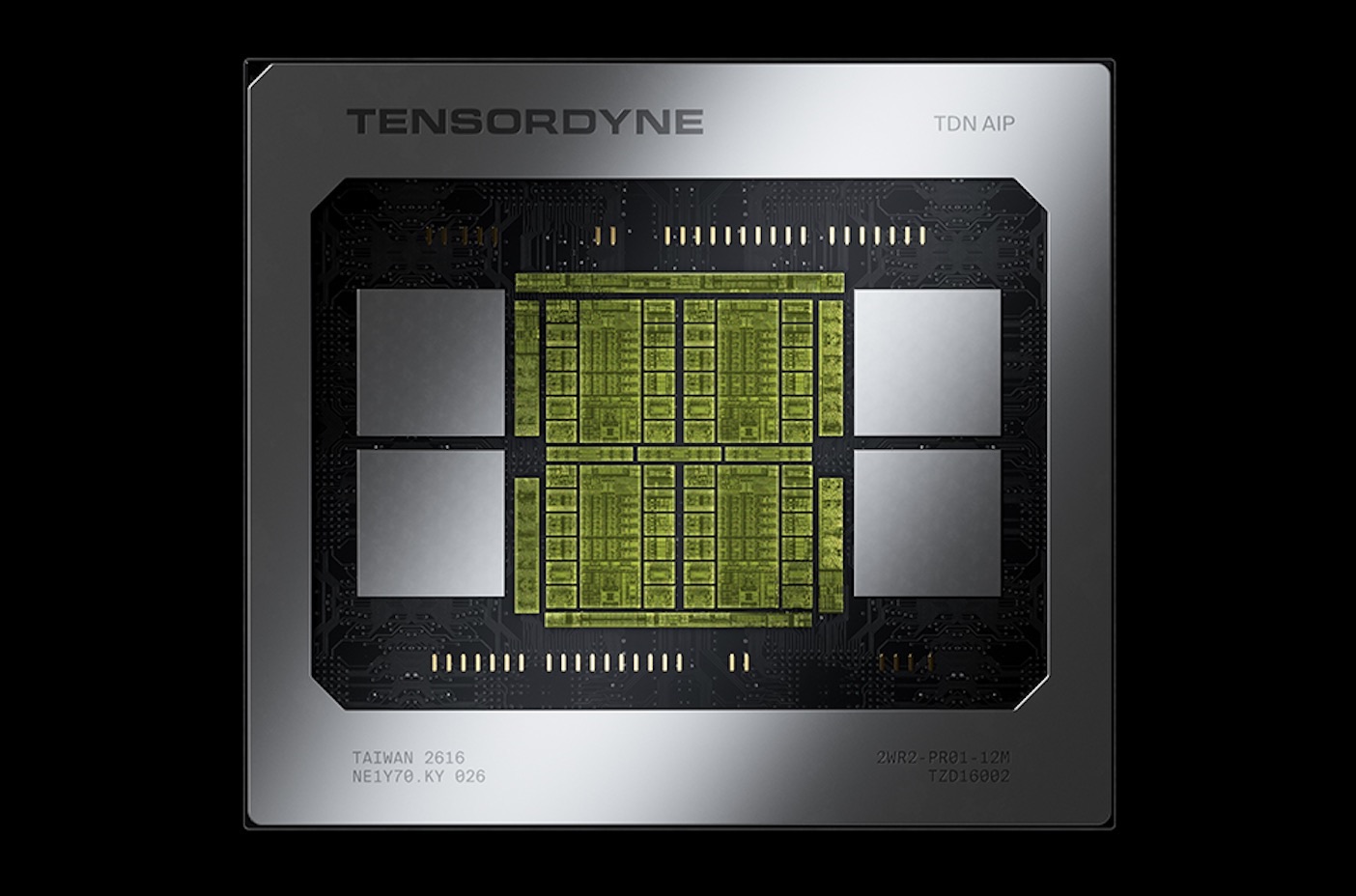
Tensordyne Napier: A New AI Accelerator with Logarithmic Math
Tensordyne has announced the Napier processor, a new artificial intelligence accelerator. This chip stands out for its innovative approach to the mathematical operations underlying AI inference, introducing the use of logarithmic math. The stated goal is to optimize performance and energy efficiency for inference workloads, a crucial aspect for companies managing large models.
The introduction of a new player in the AI accelerator landscape underscores the growing demand for specialized hardware solutions. While general-purpose GPUs have dominated the sector, the emergence of custom chips like Napier reflects the pursuit of efficiency and targeted performance for specific AI tasks, particularly inference, which represents a significant portion of the Total Cost of Ownership (TCO) for many implementations.
Technical Details and Logarithmic Innovation
At the core of the Napier processor is its architecture, which integrates 72 dedicated accelerators. Although specific details of these units have not been fully disclosed, their presence suggests a design oriented towards massive parallelism, typical of modern AI accelerators. This allows for the simultaneous processing of a large number of operations, which is fundamental for reducing latency and increasing throughput during the inference of Large Language Models (LLM) or other complex models.
Napier's most distinctive feature is the adoption of logarithmic math. Traditionally, processors use floating-point formats (such as FP32, FP16, or BF16) to represent numbers. Logarithmic math, however, operates on the logarithms of numbers, which can offer advantages in terms of dynamic range and, potentially, computational efficiency and power consumption for certain classes of operations. This architectural choice could translate into optimized hardware resource utilization, reducing circuit complexity and improving performance per watt, a key factor in large-scale deployments.
Implications for On-Premise Deployments
For organizations evaluating on-premise or self-hosted AI workloads, the arrival of specialized accelerators like Tensordyne Napier is particularly relevant. Dedicated hardware offers greater control over the infrastructure, allowing for optimization of the environment for specific performance, security, and data sovereignty requirements. The ability to integrate chips designed specifically for inference can reduce the overall TCO, shifting investment from variable cloud operational costs to more predictable capital expenditures.
In contexts where regulatory compliance or the need for air-gapped environments are priorities, the availability of silicon optimized for on-premise AI becomes an enabling factor. Energy efficiency and performance per watt, potentially enhanced by logarithmic math, are crucial for the sustainability and scalability of local infrastructures. For those evaluating on-premise deployments, AI-RADAR offers analytical frameworks on /llm-onpremise to assess trade-offs between cloud and self-hosted solutions, considering aspects such as VRAM, throughput, and latency.
Outlook in the AI Accelerator Market
The announcement of Tensordyne Napier fits into a rapidly evolving AI accelerator market, where a growing number of companies are developing custom hardware solutions. This trend is driven by the understanding that the computational demands of AI, particularly for inference, differ from those of graphics or general-purpose computing. Differentiation through innovative approaches, such as logarithmic math, is a way for new entrants to carve out a niche alongside industry giants.
The challenge for Tensordyne, as for other emerging chip manufacturers, will be to demonstrate the concrete benefits of this architecture in terms of real-world benchmarks and integration with the existing software ecosystem. The choice of such a specific architecture suggests a focus on market niches or workloads where the advantages of logarithmic math are maximized. Success will depend on the ability to offer tangible added value compared to established solutions, especially for companies looking to optimize their local stacks for AI.







💬 Comments (0)
🔒 Log in or register to comment on articles.
No comments yet. Be the first to comment!