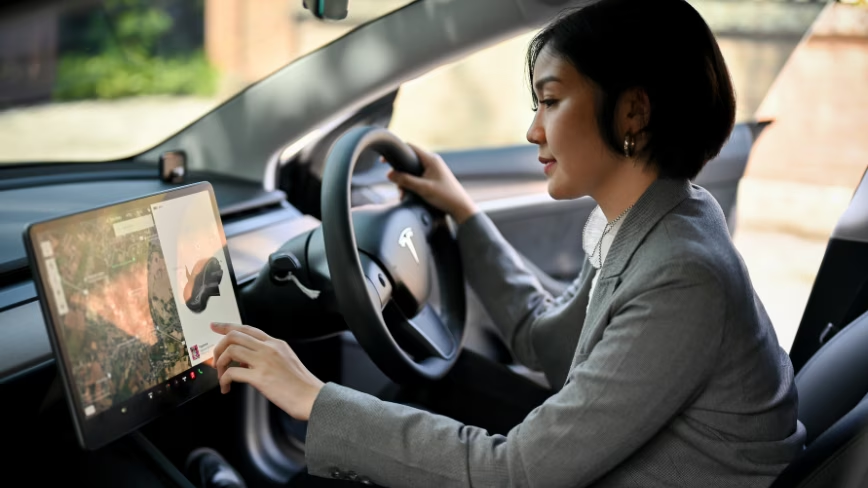
Tesla has silenced one of the most delicate legal proceedings of recent years, but the quiet does not erase the underlying problem. The company reached a settlement to close the lawsuit tied to the fatal 2023 crash where a vehicle using the Full Self-Driving (Supervised) system lost control. Bloomberg first reported the agreement, but no terms were disclosed. The news arrives while a federal investigation by the National Highway Traffic Safety Administration (NHTSA) into similar incidents remains open, signaling that the safety questions around automated driving systems are far from resolved.
Full Self-Driving architecture: on-edge inference and proprietary black box
Tesla’s Full Self-Driving (Supervised) package is a driver-assistance system based on neural networks that performs all computation directly on board the vehicle. Unlike approaches that offload part of the processing to the cloud, the car executes inference on proprietary hardware in real time, using cameras, sensors, and a dedicated computer. This edge deployment — comparable to a rolling on-premise instance — cuts latency and keeps data inside the vehicle, but it also shifts the burden of responsibility squarely onto the operator and the manufacturer. In the event of a crash, reconstructing what the neural network actually “thought” becomes a challenge: comprehensive logs of the decision chain are not publicly available, and the proprietary nature of the model hinders independent review.
Why companies settle: the price of transparency
In product liability lawsuits settlements are the rule, not the exception. Reaching an out-of-court agreement avoids the discovery phase — the moment when internal documents, test logs, engineering emails, and audit reports could become public. For a system that aims to interpret complex driving situations in real time, every detail about training, validation, and safety metrics is sensitive. Tesla chose not to disclose the terms, a move that protects intellectual property but feeds the suspicion that transparency is undesirable when mission-critical artificial intelligence is involved.
The federal investigation: why regulators keep talking
The NHTSA probe will not stop because of a private settlement. The agency is examining the behavior of automated driver-assistance systems after a series of crashes, to determine whether a design defect exists or whether communications about the system’s limits have been sufficient. The coexistence of a settlement and an ongoing federal investigation is significant: it shows how the private-law dimension of liability (compensation for the victim) remains separate from the public-interest assessment of software safety. For anyone developing AI systems to be deployed on the edge — drones, industrial robotics, autonomous logistics vehicles — the lesson is plain: independent validation is not optional and cannot be replaced by a financial agreement.
Edge AI and decision sovereignty: what the Tesla case teaches
The story touches a raw nerve for every organization considering moving artificial intelligence models from a cloud environment to local execution. Running inference on-premise or on the edge guarantees data control, reduces exposure to third-party services, and can speed up response times, but it also flips the ownership of liability. There is no external provider to blame for a malfunction; the model runs on hardware that the client owns or directly manages. In the automotive world, criminal and civil responsibility rests with the driver (required to supervise), but the software side is controlled by the manufacturer. In industry and public administration, where models may decide autonomously without continuous human oversight, the balance is even more delicate. Those who deploy LLMs or computer vision models in sensitive settings must face the same question: how do you certify that a system trained to predict, but never truly “programmed,” will not make catastrophic mistakes? Here, validation frameworks, robustness testing, continuous monitoring, and likely the need for independent auditing come into play.
Beyond a single crash: an ecosystem searching for rules
The Tesla settlement does not mark the end of an era but rather the beginning of a more mature phase in which industry, regulators, and civil society will have to find a common language. For AI-RADAR readers — busy deciding how to bring artificial intelligence into their private data centers, production lines, or air-gapped devices — the episode shows that local deployment does not cancel compliance risks; it amplifies them. Transparency over algorithms, the ability to carry out third-party testing, and the strength of validation processes will become competitive levers as critical as computing power. The FSD case, with its financial silence and its regulatory roar, is a reminder: the true cost of the race to autonomy may hide in the places where software decides without asking permission.







💬 Comments (0)
🔒 Log in or register to comment on articles.
No comments yet. Be the first to comment!