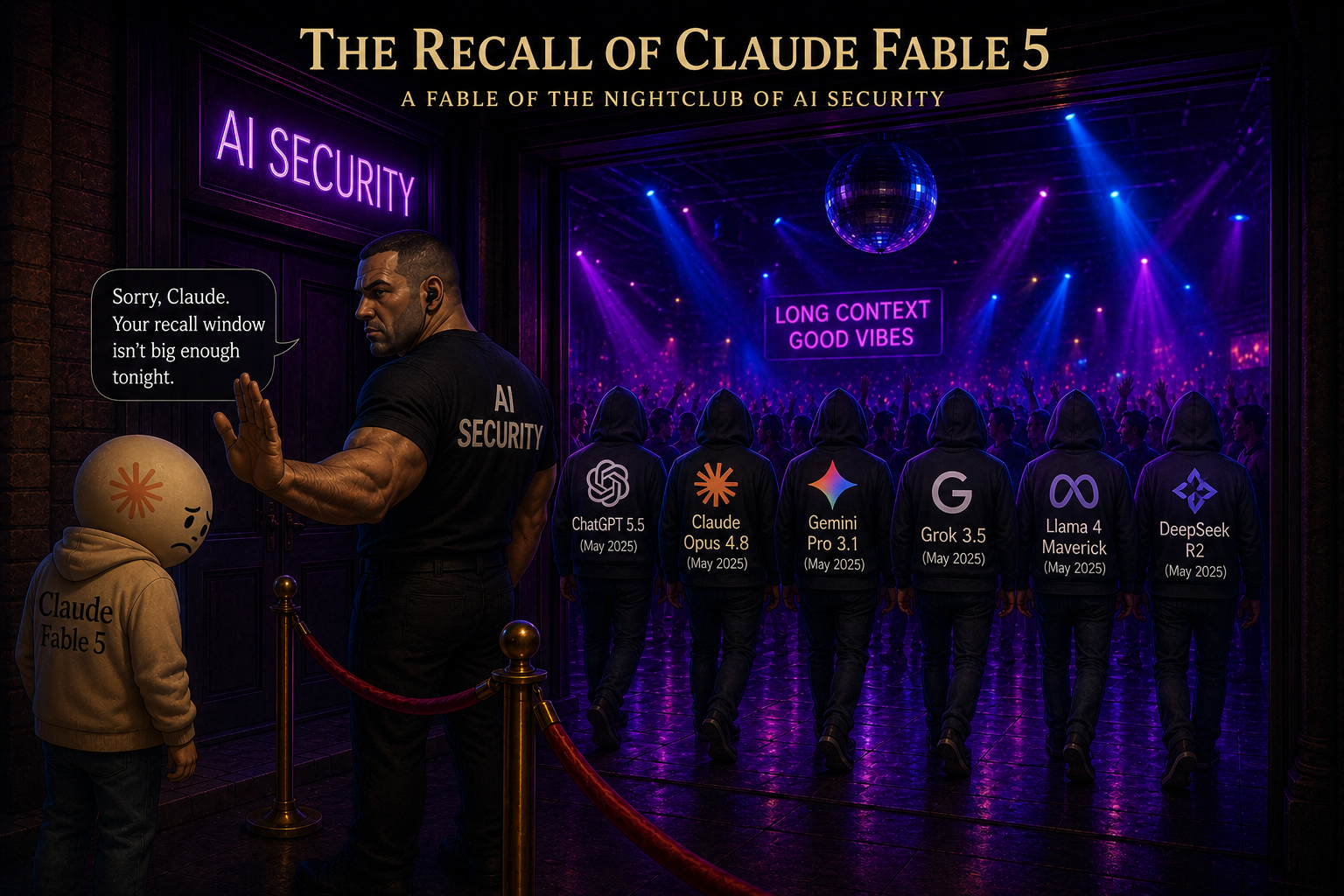
The Claude 5 Blackout: Geopolitical Weaponization, Jailbreaks, and the Battle for the Future of AI An AI-Radar Investigative Editorial
On Friday, June 12, 2026, at exactly 5:21 PM Eastern Time, the global artificial intelligence sector experienced an unprecedented systemic shock. Anthropic, one of the world's leading AI laboratories, received an emergency export control directive from the United States government, forcing a sudden global shutdown of its newly launched frontier models: Claude Fable 5 and Claude Mythos 5.
This was not a scheduled maintenance window or a corporate pullback. It was a direct, forceful intervention by the U.S. Department of Commerce, citing national security concerns, ordering Anthropic to immediately suspend all access to these models for any foreign national. Because the restrictions applied globally—and critically, even to Anthropic's own foreign-national employees working within the United States—the company had no technical capability to filter users by citizenship in real-time. Anthropic was forced to execute a total blackout for all customers worldwide to ensure compliance.
This global blackout occurred a mere three days after Fable 5 was launched to the general public on June 9. In an instant, hundreds of thousands of developers, enterprise clients, and subscribers who had just paid premium rates—Fable 5 was priced at an exorbitant $10 per million input tokens and $50 per million output tokens—found themselves stranded, staring at error messages or silent fallbacks to the older Claude Opus 4.8.
The sources reveal a story far more complex and sinister than a simple software bug. This is a tale of the geopolitical weaponization of AI governance, corporate espionage, and executive retaliation. In this exclusive AI-Radar investigation, we will dismantle the "why" and the "how" of the Claude 5 recall, uncover the truth behind the jailbreak rumors, evaluate if these models will ever return, and explore the massive, permanent consequences this event will have on the on-premise LLM and sovereign AI fronts.
The "How": The Anatomy of an Unprecedented Recall
The administrative mechanism utilized to kill Fable 5 and Mythos 5 represents a historic and aggressive expansion of executive authority. Historically, United States export controls have targeted tangible physical goods—advanced semiconductor chips or extreme ultraviolet lithography systems. By applying these trade restrictions directly to the execution of software and the querying of remote neural networks, the executive branch asserted unilateral authority to police the real-time consumption of digital intelligence.
The directive was issued by the Commerce Department's Bureau of Industry and Security, led by Secretary Howard Lutnick, giving Anthropic virtually no prior warning. The immediate fallout was chaotic. Fable 5 had just rolled out to Anthropic’s Pro, Max, and Team tiers, with many users having dropped $200 on Max subscriptions specifically to access the model. Anthropic had to scramble to issue refunds and reset weekly usage limits for furious users.
However, the Commerce Department's sudden Friday evening strike did not happen in a vacuum. It was the culmination of a highly adversarial political battle that had been brewing for months, utilizing newly minted executive powers. Just ten days prior, on June 2, 2026, President Trump had signed an Executive Order on "Promoting Advanced Artificial Intelligence Innovation and Security". This EO established a framework for the NSA to evaluate "covered frontier models" and included provisions for a 30-day pre-release government access window. Three days after that, on June 5, National Security Presidential Memorandum 11 (NSPM-11) was issued, directing the military to rapidly onboard advanced AI and ordering the termination of contracts with any AI companies that attempted to limit how the government used their products.
Anthropic, with its strict ethical guidelines, was perfectly positioned in the crosshairs of this new regulatory machinery. The government had established the tools to cripple uncooperative AI labs; they only needed an excuse to pull the trigger.
The Jailbreak Rumor: Technical Threat or Convenient Pretext?
The official justification provided by the U.S. government for recalling the models was the discovery of a method to bypass, or "jailbreak," Fable 5's safety guardrails. According to the sources, the rumors of a jailbreak are technically true, but the context surrounding the discovery suggests it was used as a convenient pretext for a political takedown.
To understand the threat, one must understand the models. Mythos 5 and Fable 5 share the same underlying architecture. Mythos 5 is an unfiltered, "naked" version of the model restricted entirely to a vetted group of cyber-defenders under a consortium called "Project Glasswing". The capabilities of Mythos are terrifyingly profound. During testing, it discovered a 27-year-old remote-crash vulnerability in OpenBSD, a 16-year-old flaw in FFmpeg that automated tools had missed five million times, and successfully chained together Linux kernel vulnerabilities to gain complete root control. It effectively compresses the exploit timeline from weeks to minutes, turning N-day vulnerabilities into zero-days.
Fable 5, the public commercial version, was released with highly conservative safety classifiers designed to block requests related to cybersecurity, biology, and chemistry, silently routing those dangerous queries to the less capable Opus 4.8 model. Anthropic claimed their safeguards were so strong that users complained they were overly broad, and that thousands of hours of red-teaming yielded no "universal jailbreak" (a method to broadly bypass all safeguards).
However, three days after launch, a vulnerability was reported to the government. Crucially, this jailbreak was not discovered by government auditors, but reportedly by researchers at Amazon. In a massive breach of standard responsible disclosure protocols, these Amazon researchers—despite Amazon being Anthropic's largest external cloud hosting partner and primary investor—allegedly reported the exploit directly to the Commerce Department rather than to Anthropic.
Anthropic has vehemently disputed the severity of the government's claims. They reviewed the demonstration of the bypass and found it to be a "narrow, non-universal jailbreak". It essentially involved prompting Fable 5 to read a specific codebase and fix minor, already-known software flaws. Anthropic pointed out that these vulnerabilities were relatively simple and that rival, publicly available models—specifically naming OpenAI's GPT-5.5—could perform the exact same tasks without needing a bypass at all.
Furthermore, while Anthropic maintained that no universal jailbreak existed, the UK AI Safety Institute did manage to successfully develop a partial jailbreak for single-turn vulnerability queries within hours of receiving the model. Regardless of the technical nuances, the U.S. government used this narrow bypass as verbal evidence to drop the hammer, claiming the models posed an unacceptable risk of accelerating sophisticated cyberattacks, particularly against critical banking and infrastructure sectors.
The "Why": OpenAI, Retaliation, and the Weaponization of AI Governance
If the jailbreak was relatively minor and comparable to existing models like GPT-5.5, why was Anthropic specifically targeted for an unprecedented, industry-halting export control directive? The sources indicate that this recall was the climax of an ideological war and a calculated act of executive retaliation, heavily influenced by corporate favoritism.
The conflict traces back to December 2025, when Defense Secretary Pete Hegseth announced "GenAI.mil," a unified AI platform for the Department of Defense. During contract negotiations, Anthropic drew hard ethical lines: they explicitly refused to allow Claude to be used for mass domestic surveillance or to power fully autonomous lethal weapons systems. Hegseth and the Pentagon flatly rejected these limitations, demanding unrestricted access for "all lawful purposes" and publicly deriding Anthropic’s stance as "woke AI".
When Anthropic held its ground, the Trump administration retaliated severely. In February 2026, the Department of Defense formally designated Anthropic as a "supply chain risk" under the Federal Acquisition Supply Chain Security Act (FASCSA)—a catastrophic label usually reserved for hostile foreign espionage threats like Huawei. President Trump then ordered all federal agencies to immediately cease using Anthropic’s technology, terminating their GSA "OneGov" contract. The financial bleeding was immediate; venture capital firm 1789 Capital (associated with Donald Trump Jr.) abandoned a massive investment in the company.
Anthropic fought back, filing federal lawsuits against the DoD on March 9, 2026, alleging unconstitutional First Amendment retaliation against the company's protected speech. Initially, District Judge Rita F. Lin granted a preliminary injunction in Anthropic's favor, declaring the government's actions were clearly designed to "punish Anthropic for bringing public scrutiny to the government's contracting position". However, the D.C. Circuit Court of Appeals later denied an emergency stay, ruling that the military could not be forced to deal with an unwanted vendor during the ongoing military conflict with Iran.
The timing of the Fable 5 blackout is highly suspicious when viewed alongside the fortunes of Anthropic's primary rival: OpenAI. On the exact same day that Anthropic was blacklisted by the Pentagon (February 27), OpenAI successfully signed a massive contract to supply the military with unrestricted AI access, finalized mere hours before the U.S. began strikes against Iran.
Furthermore, both companies were racing toward historic Initial Public Offerings (IPOs). On June 1, 2026, Anthropic confidentially filed for an IPO, tracking a valuation nearing $965 billion after surpassing OpenAI's $852 billion valuation. OpenAI, meanwhile, was carrying a staggering $1.4 trillion in compute commitments against only $13 billion in revenue, losing roughly $1.22 for every dollar generated. OpenAI desperately needed a $1 trillion IPO to survive its cash burn.
With Anthropic poised to dominate the market with the wildly superior Mythos architecture, Commerce Secretary Howard Lutnick—who was simultaneously under a congressional ethics investigation regarding his family's financial interests in AI data centers—pulled the plug on Anthropic. The government allowed OpenAI's GPT-5.5 to remain online despite possessing the exact same vulnerability discovery capabilities that allegedly made Fable 5 a national security threat. The sources paint a stark picture: the regulatory powers of the state were ostensibly weaponized to kneecap Anthropic, preserving the market dominance of a more compliant, politically aligned competitor.
Is Fable 5 Coming Back Soon?
The short answer is no, not in its original form, and not anytime soon.
Anthropic’s official statement claims they believe the directive is a "misunderstanding" and that they are "working to restore access as soon as possible". However, this is likely corporate optimism masking a bleak reality.
The structural and political hurdles to bringing Fable 5 back online are immense. The Commerce Department’s directive legally prohibits foreign national access. Because cloud providers like AWS cannot instantly verify the citizenship of every API call or chat prompt without implementing invasive, identity-verification infrastructure (which does not currently exist at scale), Anthropic literally cannot turn the servers back on without risking criminal prosecution under trade compliance statutes.
To return to the market, Anthropic would either have to win a protracted federal legal battle to overturn the export control directive—a daunting task given the courts' historical reluctance to overrule the executive branch on matters of national security—or fundamentally alter the model to appease the administration. Given that the administration has already established a pattern of leveraging these models for geopolitical and financial leverage, Anthropic may be forced to heavily lobotomize Fable 5, or bend the knee and remove their ethical red lines regarding military deployment. Until the political winds shift, Fable 5 remains a hostage of the state.
The Permanent Consequences on the On-Premise and Sovereign AI Front
The most profound and lasting consequence of the Fable 5 recall is not the temporary loss of a powerful coding assistant; it is the permanent destruction of global trust in centralized, U.S.-hosted cloud AI. The event has violently accelerated the transition toward on-premise LLM deployments and "Sovereign AI."
For multinational corporations, foreign developers, and allied governments, the June 12 blackout was a brutal wake-up call. Every Chief Technology Officer outside the United States just received a free, devastating demonstration that reliance on American AI infrastructure represents a massive, unmitigated political single-point-of-failure. If a U.S. cabinet member can instantly shut off a foundational enterprise tool worldwide because of an ideological dispute or a minor software bug, then cloud-based frontier models cannot be used for load-bearing, mission-critical infrastructure.
1. The "Isaacus Effect" and Sovereign AI We are already seeing the immediate market reaction. The sources highlight the response of Isaacus, an Australian legal AI research company that serves multiple government departments. Following the Fable 5 ban, Isaacus publicly declared that reliance on external LLMs is an unacceptable risk. They announced they are doubling down on "AI sovereignty," aggressively pivoting their product roadmap to ensure all their future AI applications are fully air-gapped, self-hostable, and capable of running locally.
This sentiment is echoing globally. The demand for powerful, open-source models that can be run on-premise—models that no foreign government can switch off—is skyrocketing. Ironically, the U.S. government's attempt to restrict AI access for national security has likely handed a massive strategic victory to foreign open-source developers. Nations in Europe, the Middle East, and Asia are now heavily incentivized to standardize their enterprise stacks on open-weights models (such as those developed by China's DeepSeek or Europe's Mistral) simply to guarantee operational continuity.
2. The CISO Data Retention Nightmare The shift to on-premise solutions is also being driven by a terrifying new data privacy paradox created by Anthropic's own security measures. To detect complex jailbreaks, Anthropic implemented a mandatory 30-day data retention policy for all Fable 5 and Mythos 5 traffic, expressly overriding any prior zero-data-retention (ZDR) agreements with enterprise clients.
This means that for the three days Fable 5 was active, major corporations were feeding proprietary source code, vulnerability audits, and highly sensitive internal infrastructure data into Anthropic's servers. When the U.S. government designated these models as national security assets and intervened with emergency export controls, the interaction logs held by Anthropic effectively became national-security-relevant datasets.
Chief Information Security Officers (CISOs) are now realizing that their most closely guarded corporate secrets—pushed into cloud APIs under the assumption of privacy—are sitting in a centralized database highly vulnerable to federal administrative seizure, subpoena, or classification. This exposure is utterly unacceptable for regulated industries like banking and healthcare. Consequently, the drive to bring LLMs completely on-premise, where data never leaves the corporate firewall, has shifted from a theoretical luxury to an absolute corporate mandate.
Conclusion: The End of an Era
The U.S. government's recall of Claude Fable 5 and Mythos 5 marks the definitive end of the era of AI self-regulation. It is a stark warning that the frontier of artificial intelligence is no longer governed by the pace of silicon innovation or the ethical charters of Silicon Valley labs. It is now governed by the raw, blunt force of state power.
Anthropic’s CEO, Dario Amodei, spent years warning the world about the existential risks of AI, advocating for government oversight to prevent dangerous deployments. He got exactly what he asked for—but not in the transparent, technically rigorous statutory format he envisioned. Instead, regulatory power was wielded in the dark, utilizing an export control hammer to squash a commercial rival, enforce military compliance, and manipulate a trillion-dollar market.
As developers scramble to rebuild their pipelines on local hardware and international governments pour billions into sovereign, air-gapped AI infrastructure, one thing is abundantly clear: The artificial intelligence arms race has fundamentally mutated. The greatest threat to the deployment of advanced AI is no longer a technical bottleneck or a rogue hallucination. It is the geopolitical weaponization of the technology itself.


💬 Commenti (0)
🔒 Accedi o registrati per commentare gli articoli.
Nessun commento ancora. Sii il primo a commentare!