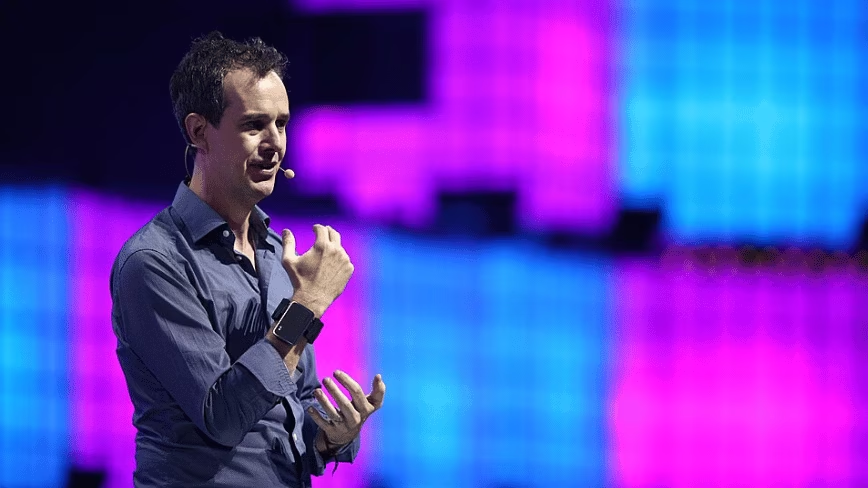
Thomas Reardon and the Challenge of Low-Power AI: Thinking on Just 20 Watts
Thomas Reardon, a prominent figure in the technology landscape, known for leading the creation of Internet Explorer and co-founding CTRL-labs, a pioneering neural interface company, is embarking on a new and ambitious endeavor. His current goal is to develop artificial intelligence capable of processing information and "thinking" while consuming a meager amount of energy: just 20 watts. This vision represents a significant challenge for an industry that traditionally sees Large Language Models (LLM) and other AI workloads requiring high-energy intensity infrastructure.
Reardon's career is marked by projects that have redefined entire sectors. From transforming Microsoft into a dominant web player with Internet Explorer, to developing innovative human-machine interface technologies with CTRL-labs, later acquired by Meta, his path highlights a propensity to explore technological frontiers with far-reaching impact. His new initiative follows this trajectory, aiming for an energy efficiency that could unlock previously unfeasible deployment scenarios.
The Quest for Efficiency: An Imperative for Future AI
Energy consumption is one of the primary concerns for companies implementing artificial intelligence solutions, particularly for demanding workloads such as training and Inference of complex LLMs. Current hardware architectures, often based on high-performance GPUs, require considerable power and cooling infrastructures, with a direct impact on the Total Cost of Ownership (TCO) and environmental footprint. Reardon's goal of a 20-watt AI sharply contrasts with this paradigm, proposing a radically more efficient computing model.
This pursuit of efficiency aligns with the growing need to bring AI closer to the data source, reducing latency and improving data sovereignty. Low-power AI could enable a wide range of edge and embedded applications, where energy resources are limited and cloud dependency is not always practical or desirable. This approach could foster the development of more autonomous and decentralized AI systems, with tangible benefits in terms of security and compliance.
Implications for On-Premise Deployments and Edge Computing
For organizations evaluating the deployment of AI workloads in self-hosted or air-gapped environments, energy efficiency is a critical factor. The ability to run complex AI models with only 20 watts of consumption could revolutionize the approach to infrastructure. Drastically reducing power requirements means lower operational costs for power and cooling, higher compute density per rack, and the ability to extend AI to remote or resource-constrained sites.
This scenario would open new opportunities for edge computing, allowing local Inference on devices with stringent power constraints, without compromising data privacy that should not leave the local environment. For those evaluating on-premise deployments, energy efficiency translates into a more favorable TCO in the long run, making the investment in dedicated hardware more sustainable. AI-RADAR offers analytical frameworks on /llm-onpremise to evaluate these trade-offs, highlighting how consumption optimization is a cornerstone for strategic infrastructure decisions.
Future Prospects and the Role of Silicio Innovation
Reardon's ambition for ultra-efficient AI reflects a broader trend in the industry: the search for new computing architectures and algorithmic approaches that overcome current limitations. This includes exploring brain-inspired (neuromorphic) computing models or pushing optimization at the silicio level for low-power Inference. While the path is complex, the potential impact of a 20-watt AI is enormous, promising to democratize access to advanced computing capabilities and enable a new generation of intelligent applications.
Innovation in this field would not only reduce AI's ecological footprint but also unlock new paradigms for data sovereignty and security, allowing companies to maintain full control over their models and sensitive data. Reardon's vision, if realized, could therefore not only change how AI is powered but also where and how it is used, further driving towards self-hosted and decentralized solutions.







💬 Comments (0)
🔒 Log in or register to comment on articles.
No comments yet. Be the first to comment!