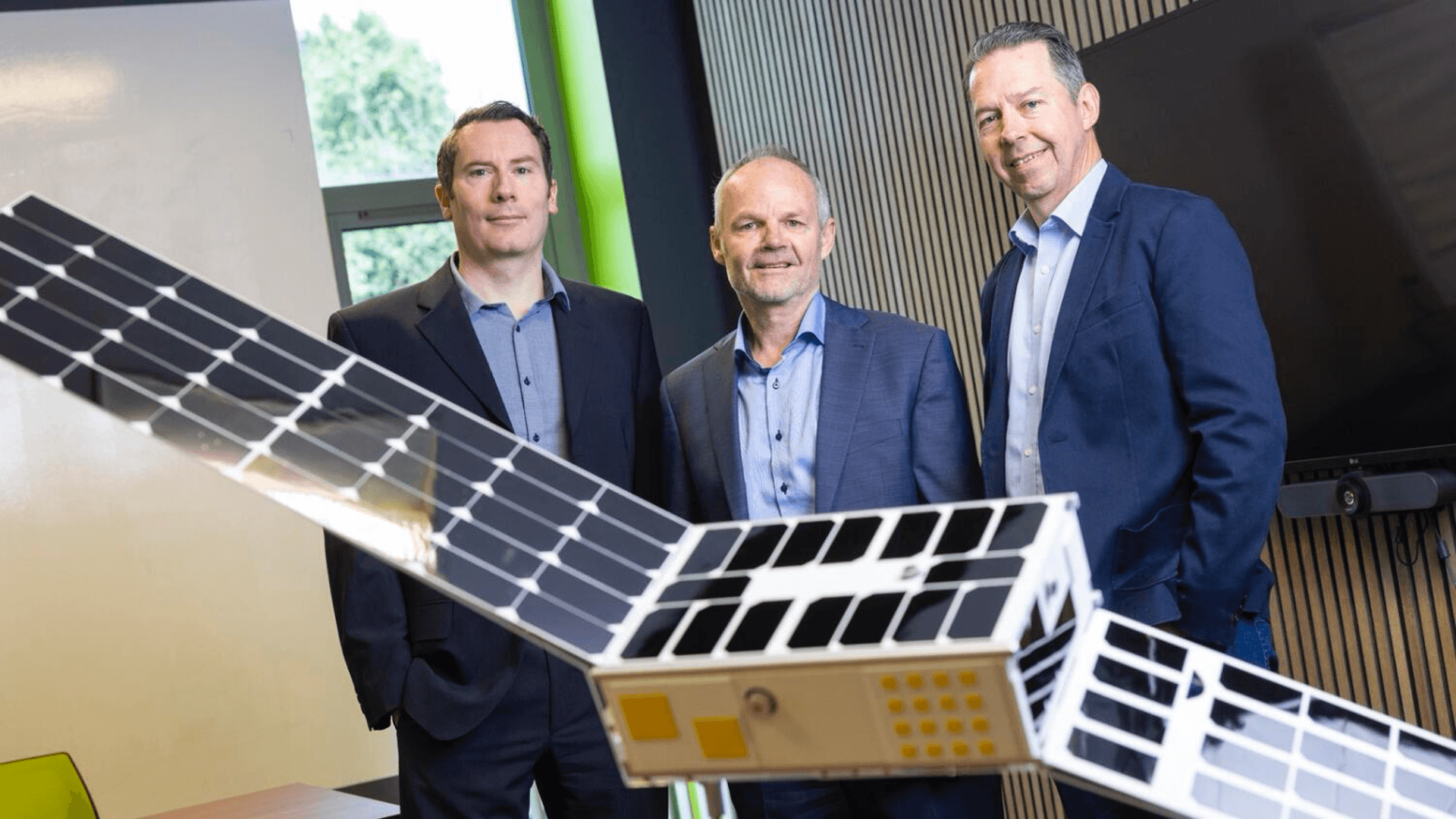
Ubotica Technologies has just secured $11 million in funding to bring artificial intelligence onboard satellites and reshape how ships, sea lanes, and critical infrastructure are monitored. The news marks a concrete shift from lab to operations for orbital AI, with a consortium led by Act Venture Capital and Greencode Ventures, alongside existing backer Atlantic Bridge.
The core of the project is the Live Maritime Intelligence (LMI) service, designed to give government agencies and security operators early warning capabilities against threats that have been difficult to detect: shadow fleets, vessels that switch off transponders, sanctions evasion, and potential sabotage of undersea cables or offshore assets.
In-orbit processing: why it changes the game
The difference from traditional Earth observation systems lies in the computing architecture. Instead of capturing images and transmitting them to the ground for processing, Ubotica’s technology runs inference directly on the satellite. This shift of intelligence from the central data center to the space edge cuts latency and allows reactions to suspicious events within minutes, rather than waiting for downlink windows and after-the-fact analysis.
For those following the evolution of on-premise and edge stacks, the Ubotica case is emblematic: the platform relies on a mix of embedded hardware and optimized software to operate in environments with limited compute resources, constrained energy budgets, and intermittent connectivity. While no public technical specifications have been released, the principle mirrors the same trade-offs IT teams weigh when evaluating local inference: compact models, aggressive quantization, and remote update pipelines.
Autonomous decision-making and data sovereignty
Live Maritime Intelligence goes beyond data processing: it dynamically tasks the most suitable satellite sensors without requiring commands from the ground. This autonomous tasking approach brings orbital AI closer to the orchestration concepts that enterprises implement with Kubernetes and distributed scheduling, but in a domain where connectivity is patchy and information sovereignty is a strict requirement.
The choice to keep intelligence onboard has direct implications for confidentiality and data control, central concerns for government bodies and critical infrastructure. Instead of streaming petabytes of raw imagery onto public clouds or shared networks, satellites extract only relevant information and forward it to operations centers. It’s a model reminiscent of air-gapped architectures or tightly locked-down on-premise deployments, where minimizing external exposure is paramount.
The competitive landscape and infrastructure implications
The investment comes at a time when protecting shipping routes and subsea cable backbones has climbed international policy agendas. The ability to fuse AI with distributed space assets acts as an efficiency multiplier for organizations that must monitor millions of square kilometers with constrained resources. Ubotica is not alone in this direction – other players are experimenting with edge computing on drones and nanosatellites – but the combination of real-time detection and automatic sensor reassignment places it in a highly specialized segment.
For technology decision-makers, the story offers concrete insight into how distributed AI paradigms are moving beyond the boundaries of corporate racks. Orbital constraints – limited power, passive cooling, fault tolerance – are an extreme testbed for the same techniques that allow language models to run on a bare metal server on premises, far from hyperscale data centers. While general attention remains focused on Large Language Models and high-end GPUs, projects like Ubotica serve as a reminder that AI infrastructure also extends to space, with tangible consequences for security and operational autonomy.








💬 Comments (0)
🔒 Log in or register to comment on articles.
No comments yet. Be the first to comment!