A Strategic Initiative for Defence Innovation
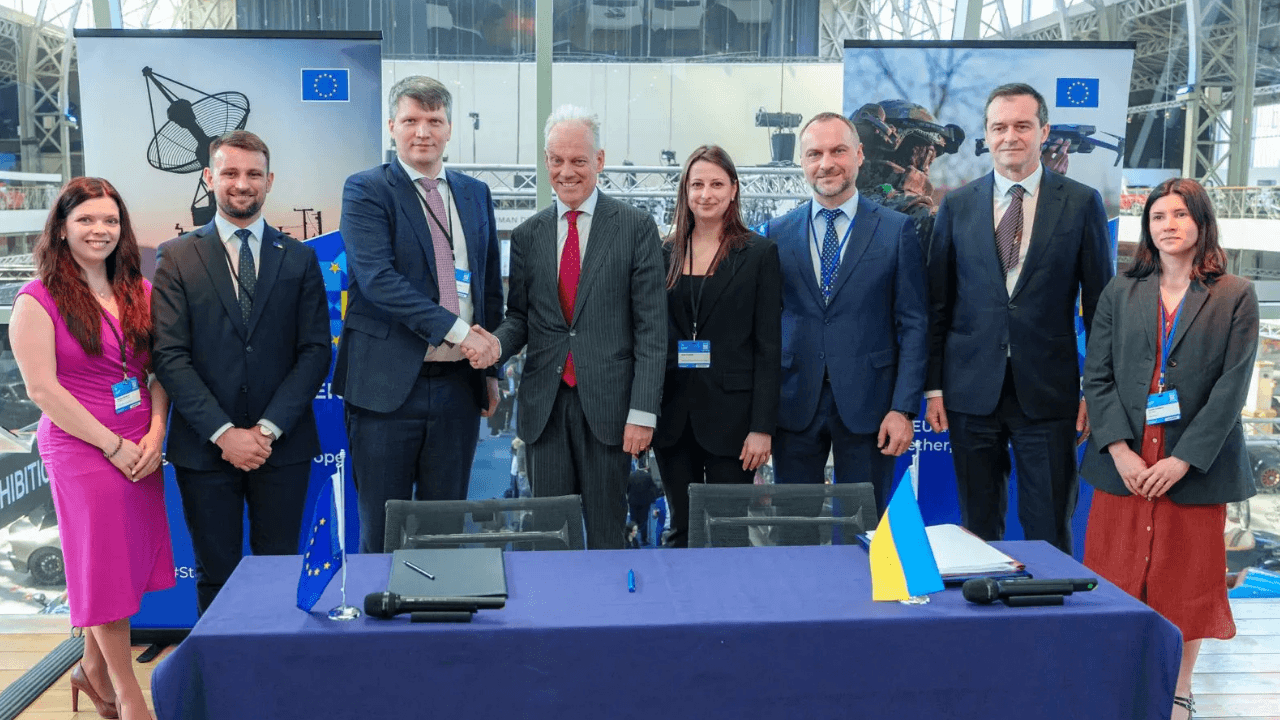
The European Commission and Ukraine’s Ministry of Defence recently launched a new cooperation initiative, unveiled during the EU–Ukraine business summit in Brussels. This program is designed to stimulate investment in innovative and breakthrough technologies, with a strategic focus on strengthening Ukraine's stability, developing its defence-industrial complex, and bolstering state defence capabilities.
The agreement establishes a comprehensive €160 million financial program. This sum includes a €140 million EU guarantee and a further €21 million in EU investment grants. These financial instruments are structured to unlock up to €400 million in bank financing, intended to support both capital investment and operating costs for the involved companies.
Dual-Use Technologies and the Role of AI
The program focuses on supporting strategic sectors of the Ukrainian economy, with a particular emphasis on industries developing innovative and advanced dual-use technologies. These include air, land, and sea drones; electronic protection devices; space technology; communications; navigation; and critical components. This vision underscores the importance of solutions that can serve both civilian and military purposes, maximizing the impact of investments.
A crucial aspect of the initiative is the creation of new opportunities for startups and scaleups operating at the intersection of defence and deep tech. By de-risking early-stage investment and facilitating access to larger pools of capital, the program aims to help emerging companies move more quickly from prototype to deployment. This is particularly relevant in areas such as autonomous systems, AI-enabled battlefield intelligence, and resilient communications, where innovation can provide a significant advantage.
Implications for Deployment and Data Sovereignty
The focus on advanced defence technologies, including AI-enabled systems, brings with it significant implications for deployment strategies. In such sensitive contexts, data sovereignty, security, and operational resilience become absolute priorities. This often translates into the need for self-hosted or air-gapped environments, where control over the hardware and software infrastructure is total.
For those evaluating on-premise deployment, the need for data sovereignty and control over infrastructure becomes a critical factor, especially in sensitive sectors like defence. AI-RADAR offers analytical frameworks on /llm-onpremise to evaluate the trade-offs between self-hosted and cloud solutions, considering aspects such as TCO and compliance. The ability to manage AI/LLM workloads on local infrastructure, with specific GPU and high VRAM requirements, is fundamental to ensuring performance and security without compromising information confidentiality.
Future Prospects and European Cooperation
Serhiy Boyev, Deputy Minister of Defence of Ukraine for European Integration, emphasized the importance of this initiative: “We are launching systematic cooperation with the European Commission in the field of investing in defence innovations. Our efforts are aimed at supporting technologies that have already proven effective on the battlefield and determining the advantage in modern warfare.”
Hanna Hvozdyar, Adviser to the Minister of Defence of Ukraine, added: “Today, dual-use technologies play an important role in both defence and industrial development. Therefore, such support contributes to specific Ukrainian capabilities: stronger production, greater technological capabilities, and the development of solutions needed by defence. In a broader sense, it is also a contribution to the security of the whole of Europe.” The Ministry of Defence of Ukraine will coordinate the program, while the National Development Institution (NUR) will serve as its executor, ensuring effective and targeted investment management.








💬 Comments (0)
🔒 Log in or register to comment on articles.
No comments yet. Be the first to comment!