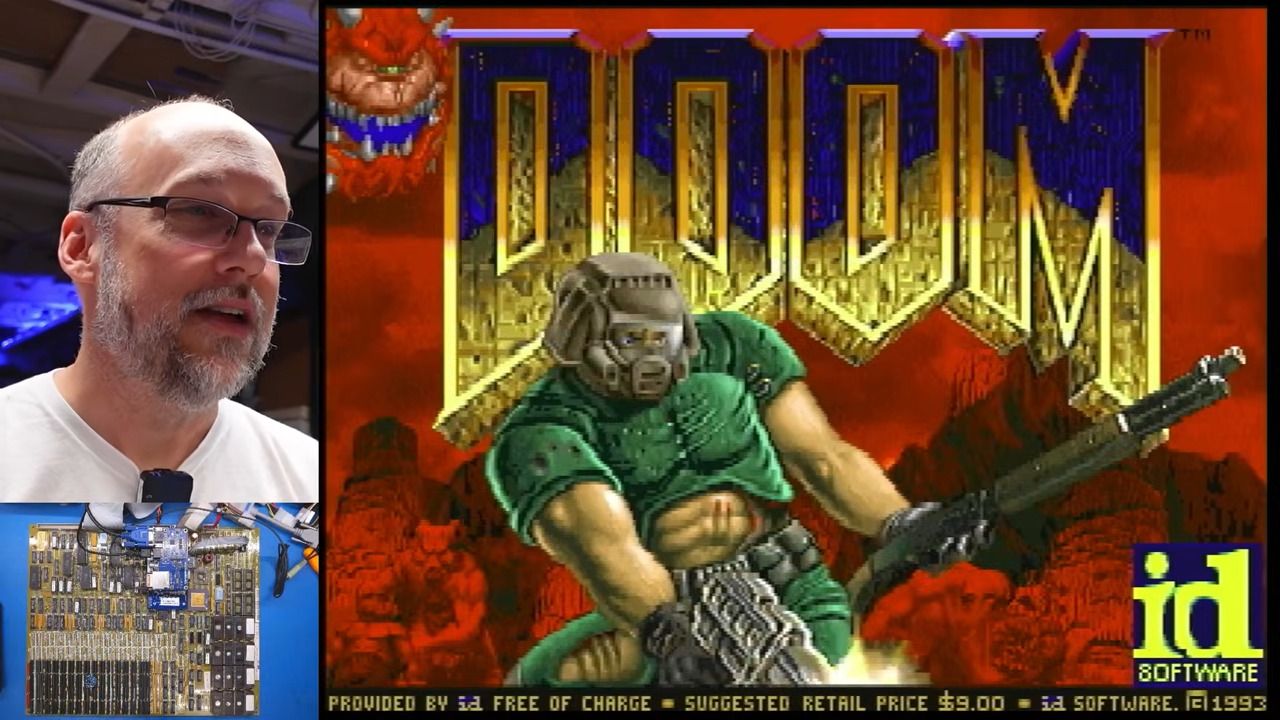
Doom on Vintage Hardware: A Testament to Ingenuity
The world of technology often witnesses feats that push the boundaries of hardware, and the latest demonstration comes from an enthusiast who managed to run the famous video game Doom on a decidedly unusual system: an Agfa Compugraphic 9000PS printer controller. This device, dating back approximately forty years, was certainly not designed for interactive entertainment, but its internal architecture provided fertile ground for a software optimization challenge.
This event, which has captured the attention of the tech community, is not just a curiosity but a reminder of software's adaptability and human ingenuity in overcoming hardware constraints. Running a title like Doom, known for pushing the limits of PCs of its era, on such an old system with a completely different purpose, underscores the importance of thoroughly understanding available resources and knowing how to leverage them to their fullest.
The Heart of the Operation: The Motorola 68020
At the core of this singular operation is the Motorola 68020 processor, a component that, at the time, represented the cutting edge for rapid processing. The Agfa Compugraphic 9000PS, a high-end printer for professional publishing and graphics, integrated this chip precisely to handle complex composition and printing tasks efficiently. Its presence on board provided the necessary computing power for the endeavor.
With its 32-bit architecture and advanced memory management capabilities for its time, the Motorola 68020 allowed the enthusiast to adapt Doom's code. This porting operation was not trivial, requiring deep knowledge of both the game and the underlying hardware architecture. It is a striking example of how, even with limited resources compared to today's standards, careful software engineering can unlock unexpected functionalities.
Implications for Hardware and Modern Optimization
While running Doom on a printer controller might seem like a mere stylistic exercise, it offers significant insights for the modern IT infrastructure world, particularly for the deployment of demanding workloads such as Large Language Models (LLMs). The challenge of running complex software on resource-constrained hardware is a recurring theme, whether it's an old Motorola processor or an on-premise server with VRAM or processing power limitations.
For companies evaluating self-hosted or air-gapped solutions for their LLMs, optimization becomes crucial. Techniques like model Quantization, efficient Inference Frameworks, and Throughput management are fundamental to maximizing performance on specific hardware. Understanding the trade-offs between memory requirements, latency, and processing capacity is essential for CTOs and system architects aiming for optimal TCO and data sovereignty, avoiding exclusive reliance on cloud resources.
Beyond the Game: The On-Premise Challenge
The feat of running Doom on such dated and specialized hardware is a fitting analogy for the challenges organizations face today in deploying on-premise AI solutions. The ability to extract the most from every hardware component, be it an old Motorola 68020 or a modern GPU with limited VRAM, is a valuable skill. For those evaluating on-premise deployments, analytical frameworks exist that can help assess the trade-offs between initial (CapEx) and operational (OpEx) costs, performance, and compliance requirements.
Choosing a Bare metal infrastructure or hybrid solutions requires meticulous planning and a deep understanding of hardware specifications. The goal is to ensure that AI workloads, such as LLM Inference, can operate efficiently, securely, and in compliance with data sovereignty regulations. The ingenuity demonstrated in running Doom on a forty-year-old printer controller serves as an inspiration: with the right combination of technical knowledge and creativity, surprising results can be achieved even with seemingly inadequate resources.








💬 Comments (0)
🔒 Log in or register to comment on articles.
No comments yet. Be the first to comment!