Predictive Analytics and the Challenge of Tech Attrition
The technology sector has long grappled with high employee turnover, a phenomenon known as "attrition" that incurs significant costs for companies, both economic and in terms of knowledge loss. Understanding the factors that drive employees to leave a company, especially within the first few months, is crucial for strategic planning and long-term sustainability. In this context, the application of Machine Learning (ML) models is emerging as a powerful tool for obtaining predictive insights.
A recent study conducted by a professional with over a decade of experience in People Analytics, including time at Meta, explored this very dynamic. The objective was to develop an ML model capable of predicting which tech sector employees would leave their positions within the first year. The author, drawing on extensive field experience, had established theories about the primary drivers of attrition, but the model's results delivered unexpected surprises.
The Machine Learning Model and Initial Hypotheses
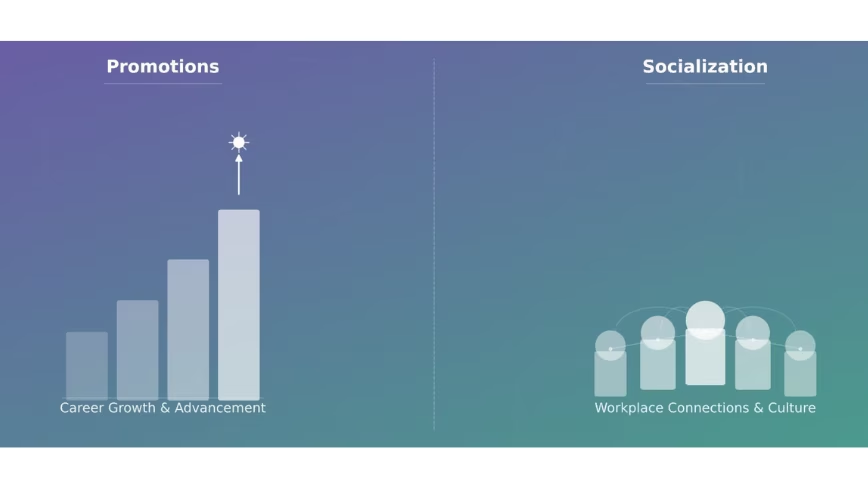
Building a Machine Learning model for attrition prediction requires analyzing vast datasets related to employee performance, engagement, demographics, and other behavioral indicators. These models are designed to identify complex patterns that might escape traditional human analysis, providing predictions based on statistical evidence. In this specific case, the expert had formulated a clear hypothesis: they believed that two specific factors were primarily responsible for early attrition.
However, the power of predictive analytics lies precisely in its ability to challenge pre-existing intuitions. The results generated by the model demonstrated that the underlying dynamics of attrition were more complex and different from what was initially hypothesized. This discrepancy between theory and data highlights the importance of a data-driven approach, where decisions and strategies are informed by rigorous analysis rather than mere conjecture.
Implications for Tech Leaders and Talent Management
For CTOs, DevOps leads, and infrastructure architects, understanding attrition has direct implications for team stability, project continuity, and ultimately, the Total Cost of Ownership (TCO) of human capital. A high turnover rate can slow down the development of new features, compromise code quality, and increase recruiting and onboarding costs. The adoption of predictive models, even if not directly related to AI infrastructure, can influence strategic decisions regarding resource allocation and workforce planning.
The ability to anticipate attrition allows companies to intervene proactively, implementing targeted retention strategies or reallocating resources more efficiently. This not only helps maintain operational stability but also supports innovation, ensuring that key teams remain intact to develop and manage complex technology stacks, including on-premise Large Language Models (LLM) deployments.
Future Prospects and the Importance of Data Sovereignty
This professional's experience underscores how data analysis can reveal unexpected truths, even for industry experts. In an era where data is the new oil, the ability to securely and compliantly collect, process, and analyze internal information is fundamental. For companies considering the implementation of Machine Learning solutions for HR or any other business domain, the issue of data sovereignty and compliance (such as GDPR) becomes central.
Running such models in self-hosted or air-gapped environments, as often discussed on AI-RADAR for LLM workloads, offers greater control over sensitive data. This approach ensures that critical information, such as employee data, remains within corporate boundaries, mitigating security risks and ensuring regulatory compliance. Predictive analytics, therefore, is not just a matter of algorithms, but also of infrastructure and data governance.







💬 Comments (0)
🔒 Log in or register to comment on articles.
No comments yet. Be the first to comment!