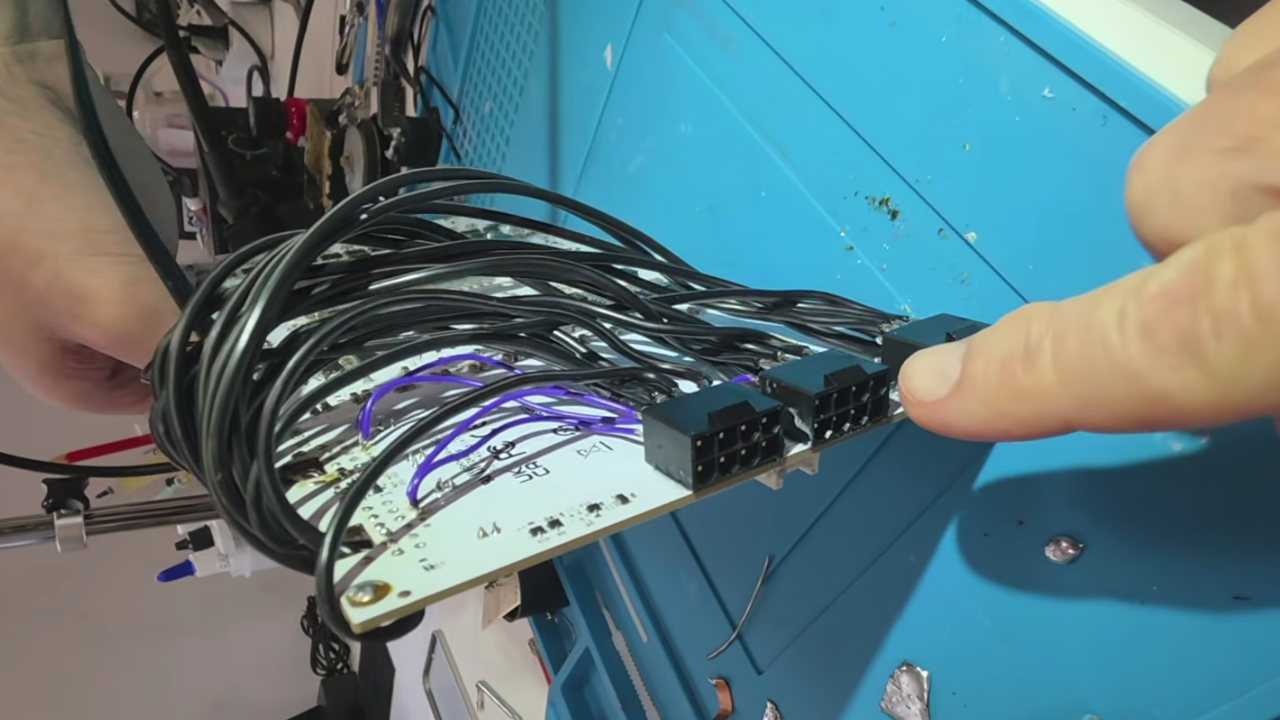
The news comes from the modding community: a RTX 5090 has been modified to abandon the 16-pin power connector in favor of three 8-pin connectors, reaching 900 watts of power draw and a 3,400 MHz clock.
The connector swap is not a cosmetic detail. The 16-pin connector, introduced to simplify cabling and reduce bulk, has been at the center of discussions about contact robustness and thermal management under heavy loads. Replacing it with three 8-pin connectors spreads the current across multiple cables and connectors, increases contact surface area, and lowers the risk of hot spots. It's a choice many system builders know well: stable power delivery is the prerequisite for maintaining high clocks during sustained compute sessions.
For anyone using an RTX 5090 in an on-prem workstation, the news has practical implications. Inference workloads are not short bursts like a benchmark: they can run for hours and put continuous stress on the power delivery system. An under-spec connector or unbalanced load distribution can lead to throttling, instability, or damage. Moving to three 8-pin connectors is not a plug-and-play solution: it requires a power supply with multiple rails, adequate cabling, and a more complex internal case layout. But it signals a direction: when power becomes the critical variable, redundancy and modularity matter more than compactness.
There is a second layer. The mod does not come from a manufacturer: it comes from a single modder who chose to bypass the standard connector. This shifts the debate from simple overclocking to the reliability of local infrastructure. In a context where consumer GPUs are adapted as compute nodes for LLMs, TCO is not measured only by the price of the card, but also by machine downtime, component wear, and maintenance. Replacing a connector may look like a hobbyist intervention; in reality it lines up the constraints a company faces when it decides to self-host: power delivery, cooling, reliability, and control.
The fact that a single mod reaches 900 watts and 3,400 MHz is a signal: the stated limits of cards are increasingly distant from the real limits of the silicon, but the cost of approaching those limits falls on those who design the power delivery. For the on-prem ecosystem it is confirmation that optimization is not only software: it runs through cables, rails, and connector tolerance.







💬 Comments (0)
🔒 Log in or register to comment on articles.
No comments yet. Be the first to comment!