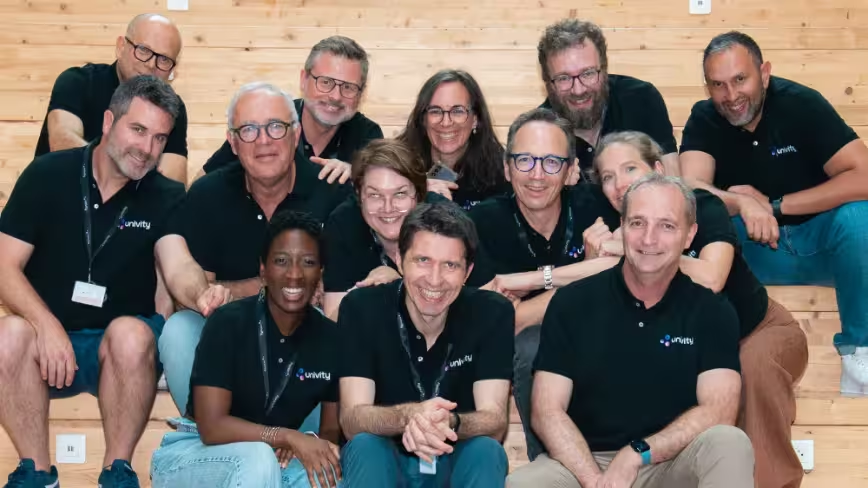
Univity Secures €27 Million for Satellite Constellation Ambitions
Univity, the Paris-based French startup, has announced the successful closure of a €27 million Series A funding round. This investment boosts the company's total capital raised to €68 million, a sum that encompasses equity, debt, subsidies, and contract revenues. Founded in 2022 and formerly known as Constellation Technologies & Operations, Univity is establishing itself as an ambitious player in the space communications landscape.
This fresh injection of capital is earmarked to support Univity's primary objective: the deployment of a vast satellite constellation. The company plans to position at least 1,600 units in very low Earth orbit (VLEO), a strategy that promises significant advantages in terms of latency and space debris management.
Univity's Technological Vision and 5G mmWave Spectrum
Univity's operational model stands out due to its innovative approach to spectrum utilization. Instead of competing with existing telecom operators, the startup intends to leverage their 5G mmWave spectrum. This strategic choice allows Univity to integrate into terrestrial network infrastructure, offering complementary rather than alternative services. Very low Earth orbit, or VLEO, presents unique challenges, such as increased atmospheric drag, but also offers opportunities to reduce latency and enhance communication efficiency.
The use of 5G millimeter-wave (mmWave) frequencies, traditionally employed for short-range, high-capacity links in terrestrial networks, represents a novel application in the satellite context. This synergy could open new frontiers for global connectivity, extending the reach of 5G networks even to remote areas or those difficult to access with traditional infrastructure. Univity's ability to operate in this manner could redefine satellite "backhaul" and the integration between space and terrestrial networks.
Market Context and Strategic Implications
The satellite constellation sector is rapidly expanding, with giants like SpaceX's Starlink, OneWeb, and Amazon's Project Kuiper dominating the landscape. In this competitive environment, Univity's strategy of not directly competing for spectrum but rather collaborating with telecom operators could prove to be a key differentiator. This approach reduces barriers to entry and potentially accelerates the adoption of its services, positioning it as an enabler for existing 5G networks.
The investment in Univity reflects growing market confidence in startups' ability to innovate in the space sector. The potential to offer high-speed, low-latency connectivity, even in complex environments, is crucial for the evolution of multiple sectors, from IoT and precision agriculture to logistics and emergency management. Data sovereignty and the resilience of communication infrastructures are increasingly relevant topics, and solutions like those proposed by Univity can help diversify available options.
Future Prospects and Impact on Global Connectivity
With total funding of €68 million, Univity possesses the necessary resources to advance the development and deployment of its ambitious constellation. The success of this project would not only strengthen France's position in the space sector but could also offer an alternative model for expanding global connectivity. The ability to integrate satellite capabilities with existing terrestrial 5G networks represents a significant step forward towards a more cohesive and resilient communication ecosystem.
For companies and organizations evaluating connectivity solutions for critical workloads, the emergence of new players like Univity broadens the range of options. While AI-RADAR's focus is primarily on on-premise LLM deployments, the evolution of global network infrastructures is fundamental for any distributed deployment strategy, including hybrid or edge scenarios. The ability to access reliable, low-latency connectivity, even in remote areas, is a prerequisite for many advanced AI applications.






💬 Comments (0)
🔒 Log in or register to comment on articles.
No comments yet. Be the first to comment!