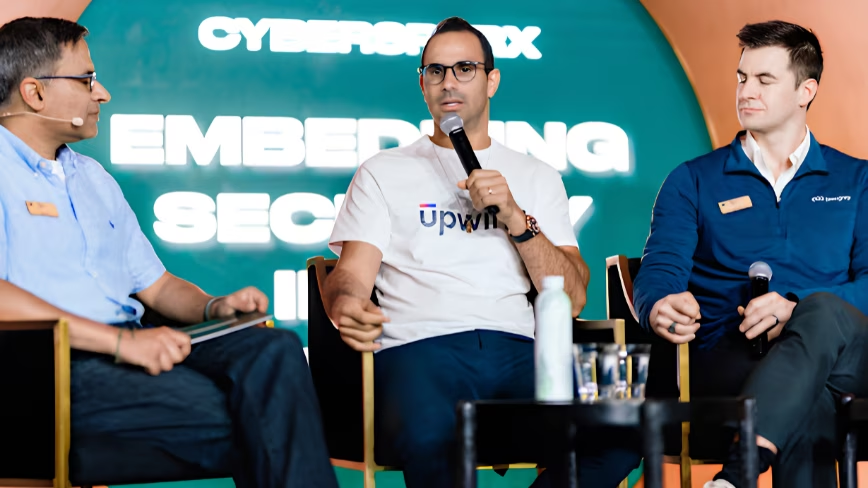
It’s no secret that artificial intelligence is redrawing the boundaries of enterprise security. But while IT departments focus on protecting servers and the cloud, the most exposed frontier might be the developer’s laptop. That’s where prompts are written, models downloaded from public repositories are tested, and APIs are connected to sensitive data. And that’s where Upwind has decided to plant its flag with the launch of the AI Sensor for Endpoints.
The announcement, though sparse on technical details, signals a shift: it’s no longer enough to monitor cloud workloads or data center containers. Generative AI has moved the action to endpoints, where developers interact daily with LLMs, often without security teams having real visibility into what’s happening. Upwind’s sensor promises to fill this gap by tracking calls, data movements, and anomalies related to the use of AI tools directly on user machines.
When AI turns the laptop into a risk vector
The spread of self-hosted LLMs and tools like Ollama or LM Studio has made local inference commonplace. For companies adopting on-premise models, the individual device becomes a critical node: a careless prompt can expose intellectual property, a manipulated model can generate malicious output, a compromised plugin can exfiltrate data. Traditional EDR (Endpoint Detection and Response) systems are not designed to inspect human–model interactions. Upwind’s AI Sensor addresses this gap, offering a contextual control layer that recognizes when an AI application is reading sensitive files or when a token stream hides an attack.
What changes for those running LLMs locally
For organizations choosing on-premise deployment for data sovereignty or TCO reasons, endpoint security is often the weak link. Hardening the servers hosting the models isn’t enough; every access point must be guarded. Tools like the one proposed by Upwind suggest the market is maturing toward more granular protection, where the ability to distinguish a legitimate LLM interaction from suspicious behavior becomes central. This evolution aligns with AI-RADAR’s ongoing analysis of trade-offs between local control and operational risks. The question is no longer just which GPU or how much VRAM is needed, but also how to secure the workflow when inference moves closer to the user.
Beyond the product: what this move signals
Upwind’s initiative is a symptom of an industry recognizing AI as a new vulnerability domain, uncovered by existing tools. The focus on endpoints indicates that the perimeter has definitively shifted: it’s no longer physical, nor merely network-based, but follows the cognitive interactions between people and machines. While we await further details on the sensor’s actual capabilities – such as real-time prompt analysis or model exfiltration blocking – the news confirms that 2025 will be the year AI security becomes an operational requirement, not an add-on. And for those managing local stacks, keeping an eye on these developments is already part of the game.







💬 Comments (0)
🔒 Log in or register to comment on articles.
No comments yet. Be the first to comment!