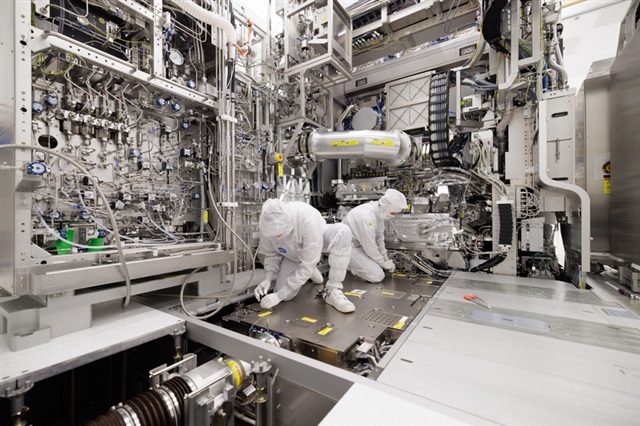
Chip Equipment Market Reaches New Heights
The global chip manufacturing equipment sector has experienced unprecedented expansion, reaching a total value of $135 billion. This historic milestone reflects a phase of intense growth and innovation, largely driven by the rapid evolution and adoption of artificial intelligence technologies. The massive investment in new production capacities and cutting-edge machinery is a direct response to the increasing demand for increasingly powerful and specialized semiconductors.
The surge in investments in the chip equipment sector underscores a fundamental trend: AI is no longer a niche, but a core driver of the digital economy. Companies worldwide are accelerating the integration of AI into their operations, from Large Language Models (LLMs) for automation and data analysis, to computer vision systems and robotics. This widespread adoption requires robust and scalable hardware infrastructure, which in turn fuels the demand for chip manufacturing equipment.
AI as a Demand Driver and Infrastructure Implications
The AI impetus on the chip equipment market is intrinsically linked to the need for computational power. Training and inference of LLMs and other complex models require GPUs with high amounts of VRAM and exceptional throughput capabilities. This translates into a race for innovation and the production of increasingly performant chips, capable of handling intensive workloads with reduced latencies. Companies developing and implementing AI solutions are therefore faced with crucial strategic decisions regarding their infrastructure.
For organizations evaluating the deployment of AI workloads, the increase in investments in the chip equipment sector has several implications. On one hand, it indicates a growing availability of cutting-edge technologies; on the other, it highlights the pressure to acquire and manage dedicated hardware. The choice between a self-hosted infrastructure and the use of cloud services becomes increasingly complex, requiring an in-depth analysis of the Total Cost of Ownership (TCO), which includes not only acquisition costs (CapEx) but also operational costs (OpEx) related to energy, cooling, and maintenance.
Evaluating On-Premise Deployment: Control, Sovereignty, and TCO
In a context of such significant investments in the semiconductor sector, the on-premise deployment of AI infrastructures gains strategic relevance for many companies. The ability to maintain full control over data and models, ensuring data sovereignty and compliance with stringent regulations like GDPR, is a decisive factor. Air-gapped environments, for example, offer a level of security and isolation that is difficult to replicate in the public cloud, a crucial aspect for sectors such as finance, defense, or healthcare.
The TCO evaluation for a self-hosted AI infrastructure requires detailed analysis. Although the initial investment in hardware like high-VRAM GPUs (e.g., A100 80GB or H100 SXM5) can be considerable, long-term operational costs may prove more advantageous compared to cloud consumption models, especially for predictable, high-utilization workloads. For those evaluating on-premise deployment, AI-RADAR offers analytical frameworks on /llm-onpremise to assess these trade-offs, considering factors such as scalability, resilience, and resource management.
Future Outlook and Strategic Considerations
The record sales in the chip equipment market are a clear indicator of the direction in which the technology industry is moving. AI will continue to be a catalyst for innovation and investment, pushing the boundaries of hardware and software capabilities. For CTOs, DevOps leads, and infrastructure architects, this scenario demands careful and forward-thinking strategic planning. The ability to choose the most suitable infrastructure – whether bare metal, hybrid, or edge – based on specific performance, cost, and security needs, will be a critical success factor.
Vendor neutrality and an understanding of the constraints and trade-offs between different hardware and software solutions remain fundamental principles. The goal is not to identify the 'best' solution overall, but the one most appropriate for specific business requirements, balancing performance (tokens/sec, batch size, latency), costs, and compliance requirements. The chip equipment market, with its records, is a reliable barometer of this evolution, signaling a future where AI will increasingly be at the center of infrastructure decisions.









💬 Comments (0)
🔒 Log in or register to comment on articles.
No comments yet. Be the first to comment!