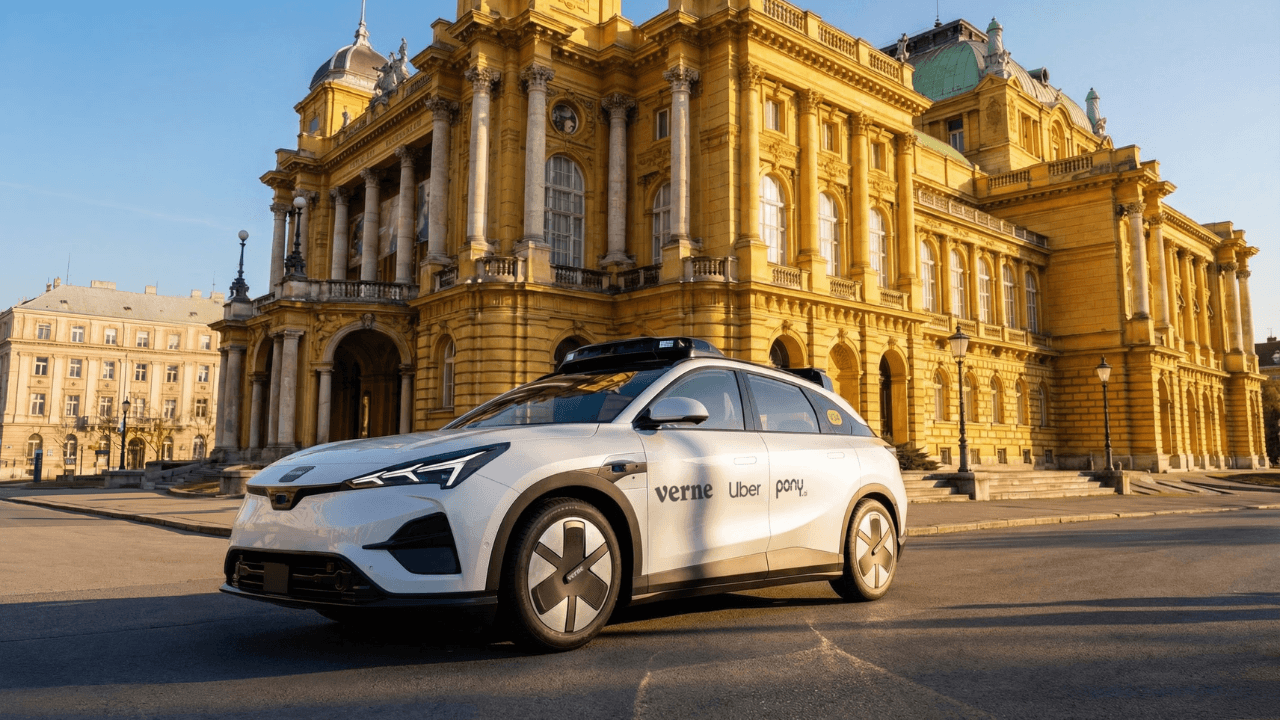
The Launch of Service in Zagreb
Verne today announced the launch of Europe’s first commercial robotaxi service, commencing operations in Zagreb, Croatia. Starting today, the public can book and pay for an autonomous ride through the Verne app, a service that will soon also be available via the Uber app, following a recently announced strategic partnership between the three companies.
This milestone represents the culmination of several years of development and close collaboration with regulators, positioning Verne among the emerging leaders of autonomous mobility on the continent. Marko Pejković, co-founder and CEO of Verne, emphasized the significance of this moment: "For the first time in Europe, there is a real commercial robotaxi service. People can use it and take real autonomous rides. We said we would launch in Zagreb in 2026. Today, we did. This is just the start."
Operational Details and Expansion Prospects
The initial commercial deployment will utilize electric vehicles equipped with Pony.ai’s seventh-generation autonomous driving system. These vehicles will operate autonomously, although trained autonomous vehicle operators will be onboard during the early phase of the rollout for supervision. The initial service zone covers key districts of the Croatian capital, with ambitious plans to expand coverage across the entire city.
The companies aim to transition to fully driverless operations as soon as possible, subject to regulatory approvals and the service meeting required safety and reliability standards. Verne has already initiated discussions to obtain permits in 11 cities across the EU, UK, and the Middle East, with over 30 additional cities currently under consideration. In the long term, Verne also plans the deployment of its own purpose-built two-seat robotaxi, designed specifically for driverless ride-hailing. This approach underscores the need for robust, localized AI infrastructure to handle real-time inference and ensure data sovereignty in each operational area.
The European Autonomous Mobility Landscape: A Comparison
Verne's launch marks an evolution from earlier paths to vehicle autonomy in Europe. Until recently, one of the region's most prominent players was the French company EasyMile, a pioneer in fully driverless L4 autonomous shuttles, such as the 12-seater EZ10, deployed in contexts like business parks, campuses, and commercial roads. EasyMile operates throughout Europe, with autonomous shuttles active on public roads in several German and French cities. However, earlier this year, the company announced a strategic pivot to heavy-duty applications for airports and industrial sites, focusing on software licenses for these markets, where autonomy is considered commercially more viable today.
In parallel, the German company Fernride develops human-supervised autonomous trucking systems, used in container terminals, industrial yards, and defense logistics. Its technology, which involves retrofitting existing vehicles with AI, sensors, and software, has already been deployed in real-world operations and received TÜV approval for autonomous trucks in Europe in 2025. Fernride was acquired by Quantum Systems in late 2025 as part of a broader push to build a multi-domain autonomy stack spanning air and ground systems. Meanwhile, the Swedish-founded Einride deploys electric fleets and its driverless "Pod" vehicles, which can operate autonomously or be remotely controlled. The company positions itself as a software-driven freight operator, optimizing deliveries and fleet management.
Alternative Approaches and AI Infrastructure Implications
Against these developments, global players like the US company Waymo have also announced their intention to launch a fully driverless ride-hailing service in London by the fourth quarter of 2026, with intensive trials already underway. A different approach to autonomous mobility has been explored by teledriving, with companies like Estonia's Elmo and Germany's Vay. This model involves the remote delivery of an electric vehicle to the user; the user takes control for the trip, and at the end, another remote operator handles parking, eliminating the search for parking spaces.
These diverse approaches highlight a fragmented yet interconnected landscape for vehicle automation in Europe, ranging from controlled environments and industrial use cases to complex urban settings. For companies evaluating the deployment of AI solutions in these sectors, it is crucial to consider the trade-offs between centralized cloud processing and distributed edge inference. The need for low latency for safety, the management of large volumes of sensor data, and stringent data sovereignty regulations (such as GDPR) make self-hosted or hybrid architectures particularly attractive. For those evaluating on-premise deployments, analytical frameworks like those offered by AI-RADAR on /llm-onpremise exist to understand the trade-offs between self-hosted and cloud-based solutions, especially in contexts requiring low latency and direct control over infrastructure and data.








💬 Comments (0)
🔒 Log in or register to comment on articles.
No comments yet. Be the first to comment!